How Birmingham's Humidity Destroys Your HVAC System
Birmingham doesn't just have hot summers. It has hot, humid summers — and that distinction matters enormously for your HVAC system. Humidity is the silent accelerant behind component failures, mold growth, and the uncomfortable feeling of a house that's cool enough on the thermostat but miserable to live in. Here's what's actually happening and what to do about it.
Quick Answer
Birmingham's 80-90% summer humidity corrodes electrical components, clogs drain lines with algae, promotes mold growth on evaporator coils, and makes oversized AC systems short-cycle without dehumidifying. Annual coil cleaning, monthly drain line treatment, and proper system sizing are the defenses.
1. Birmingham's Humidity Problem
Birmingham sits in a natural bowl formed by Red Mountain to the south, the Jones Valley, and the ridges of the Appalachian foothills. That geography limits air circulation and traps humid air. From May through September, relative humidity regularly exceeds 80% — sometimes staying above 90% from midnight to noon on overcast days.
Compare that to Phoenix, Arizona — another hot city — where summer humidity averages 20-30%. Same heat, radically different comfort level and radically different demands on HVAC systems. Everything about how you design, size, and maintain an HVAC system in Birmingham has to account for the moisture load in ways that don't apply elsewhere.
The areas around Shades Creek and the Cahaba River bottomlands in Homewood, Vestavia Hills, and Pelham are particularly humid. Lower elevation, proximity to water, and dense vegetation create micro-climates that can run 5-10% higher relative humidity than hilltop neighborhoods a half mile away. Homes in these areas see faster drain line clogging, more frequent coil contamination, and higher mold risk.
2. How Humidity Damages HVAC Components
Moisture accelerates the degradation of nearly every component in your HVAC system:
Electrical Components
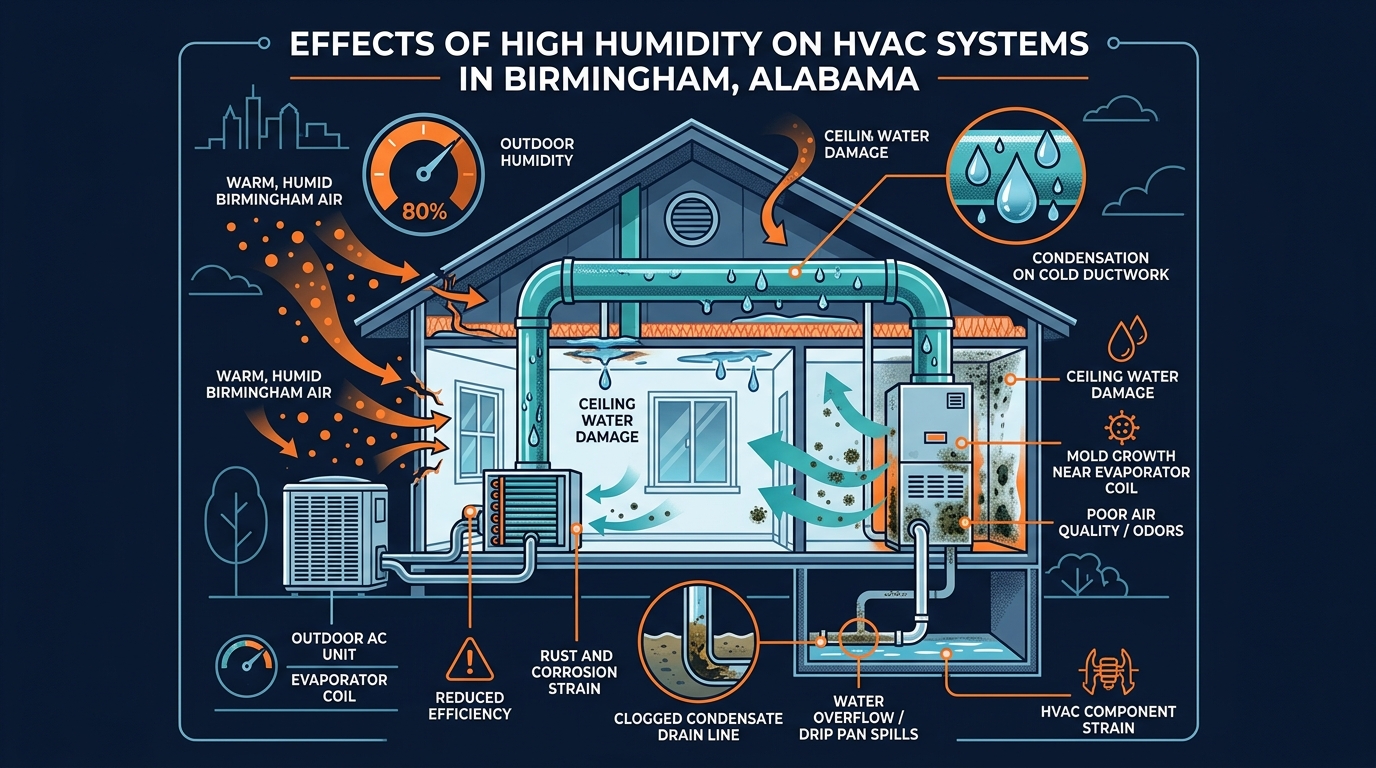
Capacitors, contactors, control boards, and wiring connections all corrode faster in high-humidity environments. Outdoor units in Birmingham accumulate moisture condensation on electrical components during humidity swings. Corrosion on capacitor terminals and contactor contacts increases electrical resistance, which means components work harder and fail sooner. This is why Birmingham homeowners replace capacitors more often than homeowners in drier climates with similar heat loads.
Coils and Fins
The aluminum fins on evaporator and condenser coils are naturally corrosion-resistant, but combined with Birmingham's high pollen load, red clay dust, and humidity, they accumulate a layer of contamination that reduces heat transfer efficiency. A dirty, partially blocked coil makes the whole system work harder. Indoor evaporator coils in Birmingham homes need cleaning more often than the once-every-few-years schedule that might be adequate in a drier climate.
Drain Lines
The condensate drain line carries the moisture your AC pulls from the air to the outside. In Birmingham, this drain carries a significant volume of water through summer — a properly functioning AC system can remove several gallons of water per hour from indoor air. The combination of moisture, darkness, and warm temperature creates ideal conditions for algae and slime growth in drain lines. These lines clog faster in Birmingham than anywhere we've worked. Without quarterly drain line maintenance, backup into the air handler is common.
Refrigerant Lines
The insulation on refrigerant lines absorbs moisture over time, especially at joints and penetrations. Degraded insulation causes condensation on the lines themselves, which drips into attic spaces, wall cavities, and ceilings. This is a slow-developing problem that often goes unnoticed until water damage becomes visible.
Key Takeaway
Birmingham's humidity attacks every major HVAC component — electrical connections corrode faster, coils accumulate contamination quicker, and drain lines clog with algae in weeks. Components that last 15+ years in dry climates may need replacement in 8-10 years here without proper maintenance.
3. Mold in Your HVAC System
This is the issue that concerns most Birmingham homeowners, and reasonably so. The evaporator coil operates cold and wet every time the AC runs. The drain pan beneath it collects condensate. The air handler cabinet is dark and humid. Without regular maintenance, all of these surfaces grow mold — and when they do, your AC distributes mold spores throughout every room in the house.
The signs: a musty or sour smell when the system runs, allergy symptoms worse indoors than outside, visible discoloration on supply grilles. If your house smells like a wet basement when the AC turns on, mold is the most likely explanation.
Prevention is straightforward: annual coil cleaning, regular drain pan treatment with biocide tablets or diluted bleach, and keeping the filter clean to prevent contaminated air from being pulled through the system. Remediation is more involved — it requires a thorough cleaning of the air handler interior, drain pan, and coil, sometimes with EPA-registered antimicrobial treatment.
Don't try to address HVAC mold with spray Lysol and hope. The mold is inside the air handler and ductwork, not on a surface you can reach with a can. Call us if you're smelling it.
Musty smell when the AC kicks on? That's mold talking.
Call (205) 994-64024. Why Oversized Systems Make Humidity Worse
This is counterintuitive to most homeowners: a bigger AC system can actually make your house more uncomfortable by creating worse humidity problems.
Here's why: dehumidification happens as a byproduct of cooling. The evaporator coil extracts moisture from the air as it passes over the cold coil surface. This is a time-dependent process — the longer a cycle of air runs across that coil, the more moisture gets extracted. An oversized system cools the house to thermostat setpoint very quickly, then shuts off. Short cycles mean less moisture removal per degree of temperature reduction.
In a dry climate, this is no problem — there's not much moisture to remove anyway. In Birmingham, an oversized system that short-cycles leaves the house at the right temperature but at 65-70% humidity. That's why the house feels clammy even though the thermostat reads 74.
Properly sized systems sized using Manual J calculations account for the moisture load specifically. A correctly sized system runs longer cycles, removes more moisture, and creates a more comfortable home even at higher temperature settings. See our discussion of AC installation and sizing for more on this.
Key Takeaway
A bigger AC does not mean better comfort in Birmingham. Oversized systems short-cycle, cooling the air quickly but leaving humidity at 65-70%. A properly sized system runs longer, pulls more moisture, and makes 76 degrees feel better than an oversized unit at 72.
5. What You Can Do About It
Birmingham homeowners can't control the outdoor humidity, but they can manage its effects:
Annual Coil Cleaning
In Birmingham's climate, we recommend having both the evaporator and condenser coils cleaned every spring. This removes the contamination layer that reduces efficiency and provides a surface for mold growth. A dirty coil is doing three things wrong: reducing efficiency, enabling mold, and making the system work harder. A clean coil eliminates all three.
Drain Line Maintenance
Pour a cup of diluted bleach (1 cup bleach to 1 gallon water) down the condensate drain access port monthly during summer. This kills algae before it can form a clog. Some homeowners also drop biocide tablets in the drain pan. It takes two minutes and prevents significant water damage.
Filter Changes
Change filters monthly during Birmingham's cooling season. A clogged filter restricts airflow, which reduces the evaporator coil's ability to extract moisture. The connection between filter neglect and humidity problems is direct.
Exhaust Fan Use
Run bathroom exhaust fans during and for 15-20 minutes after showers. Cook with the range hood running. These minor behavioral changes meaningfully reduce the moisture your AC has to remove.
Whole-Home Dehumidifier
For homes with chronic humidity problems that a well-maintained AC isn't resolving — typically lower-elevation homes, older construction, or homes with significant air infiltration — a whole-home dehumidifier installed in the HVAC system is worth discussing. These work in parallel with the AC and can reduce indoor humidity to the 45-50% range even when the AC isn't running. Call us if you've tried everything else and your house still feels like a terrarium.
Humidity Issues in Your Home?
A service call addresses both comfort and system health. Call us to diagnose what's going on.
call (205) 994-6402FAQ: Birmingham Humidity and HVAC
How humid does Birmingham actually get?
Relative humidity above 80% is common May through September, sometimes staying above 90% for extended periods. The bowl geography limits air movement and concentrates moisture.
What indoor humidity should I aim for?
40-55% is the comfortable and healthy range. Below 30% causes dry air problems. Above 60% promotes mold and dust mites. In Birmingham, hitting 50% consistently in summer is a realistic goal with a properly functioning, properly sized system.
My house is 74 degrees but feels hot — what's wrong?
High indoor humidity makes 74 degrees feel much hotter than it should. Your AC may be working but not dehumidifying properly — dirty coil, low refrigerant, or an oversized system that short-cycles are the common causes. We can diagnose which one applies to your home.
Does humidity cause mold in HVAC?
Yes. The evaporator coil and drain pan are perpetually wet. Without regular cleaning, mold establishes quickly. Musty smells from vents are the tell. Annual maintenance prevents it; remediation clears it once established.
Will a dehumidifier help in Birmingham?
For homes with persistent humidity problems that proper AC maintenance doesn't resolve, yes. A whole-home dehumidifier tied into the HVAC system is more effective than portable units and addresses the full house. Call to discuss whether your situation warrants one.