Furnace Out at 11 PM?
We're Dispatching Now
Alabama winters get cold enough to matter. After Hours HVACR repairs gas furnaces, electric heat, and heat pumps across the Birmingham metro 24/7 — including ignition failures, blower issues, and thermostat problems. Call (205) 994-6402.
Alabama winters don't seem that bad — until your heat goes out at 2am and it's 28 degrees outside. We handle gas furnace, heat pump, and electric heating repair. Available every night of the year.
call CALL (205) 994-6402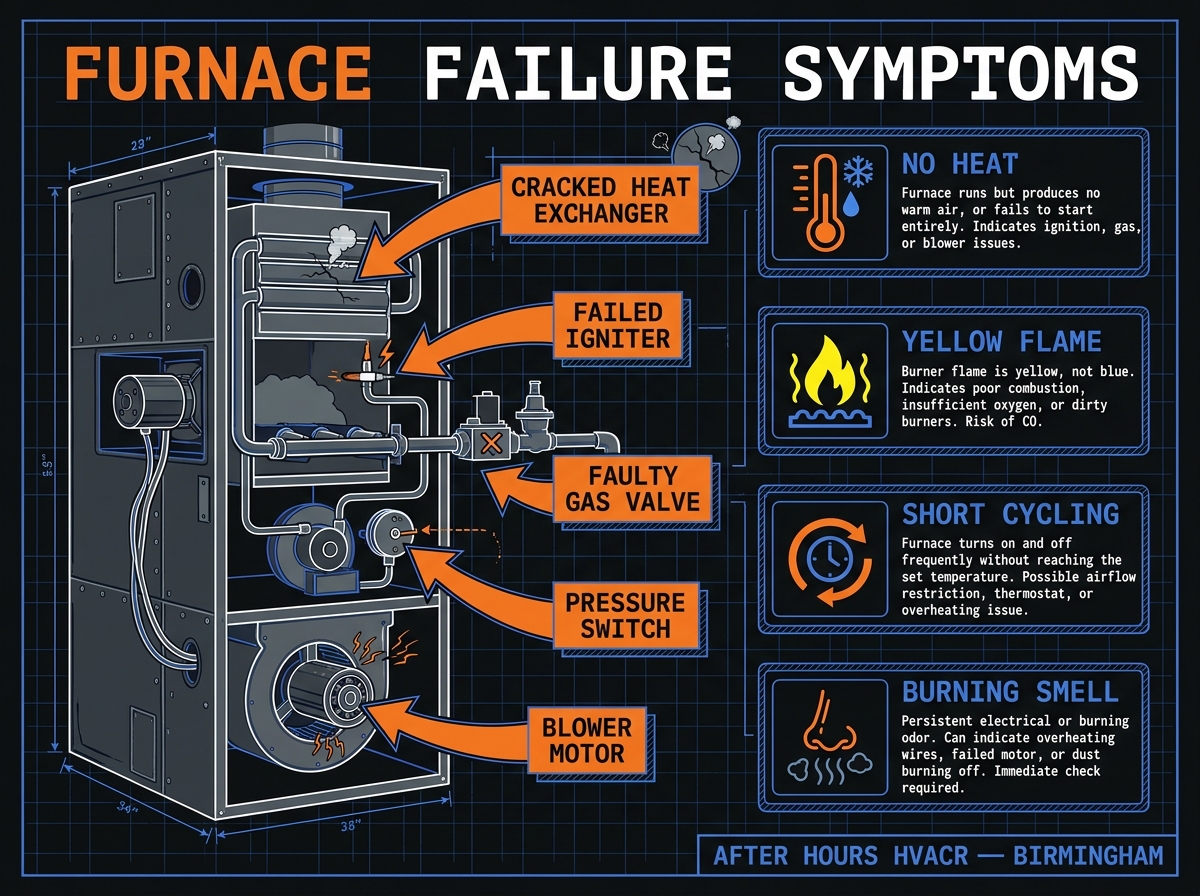
Signs Your Heating System Needs Repair
System won't fire or heat pump runs but doesn't warm the house. Multiple possible causes — igniter, gas valve, heat pump refrigerant, electric heat strip failure.
System runs but only moves cool or room-temperature air. On a gas furnace this means ignition failure. On a heat pump in cold weather, it may mean the system is stuck in cooling mode or has a reversing valve issue.
Furnace runs for a few minutes then shuts off before reaching temperature. Common causes: dirty filter restricting airflow, tripped high-limit switch, cracked heat exchanger. The last one is a carbon monoxide risk.
A healthy gas furnace burns with a mostly blue flame. Yellow or orange flame indicates incomplete combustion, which produces carbon monoxide. This requires immediate service.
Dust smell at first startup of the season is normal. Persistent burning smell, sulfur/rotten egg smell (gas leak), or musty smell all require investigation. Gas smells mean evacuate and call the gas company first.
A bang when the furnace fires is often delayed ignition — a potentially dangerous condition where gas accumulates before lighting. Rattling usually indicates loose panels or duct connections. Either way, don't ignore it.
What We Repair
Common heating system failures diagnosed and repaired across Birmingham. Sources: U.S. Dept. of Energy, Angi. Call (205) 994-6402 for a written estimate.
| Component | System Type | Failure Signs | Urgency |
|---|---|---|---|
| Hot Surface Igniter | Gas furnace | No heat, furnace tries to start repeatedly, no flame | High |
| Flame Sensor | Gas furnace | Lights then shuts off after a few seconds | High |
| Reversing Valve | Heat pump | Stuck in cooling mode, no heat, hissing sound | High |
| Heat Exchanger | Gas furnace | CO detector alarm, soot, yellow flame | Critical |
| Heat Strips | Electric / heat pump | Insufficient heat, tripping breaker, burning smell | Medium |
| Blower Motor | All types | No airflow, loud noise, system overheating | High |
Gas Furnaces
Most Birmingham homes with gas service have a forced-air gas furnace in the attic or a utility closet. We repair all brands and models. Common gas furnace repairs include igniter replacement, flame sensor cleaning, gas valve service, inducer motor repair, and heat exchanger inspection. We carry ignitors and flame sensors on the truck for most common makes.
Heat Pumps in Heating Mode
Heat pumps work differently from gas furnaces — they extract heat from outdoor air even in winter. In Alabama's climate, heat pumps work well down to about 35-40 degrees before they need supplemental heat strips to keep up. Common heating-mode failures include reversing valve problems, defrost board failures, and low refrigerant. We see a lot of heat pumps in Alabama that were sized correctly for cooling but run the electric heat strips too often in winter because the refrigerant charge is slightly off.
Electric Furnaces
All-electric homes without gas service typically use electric furnaces with resistance heat strips. These are simpler mechanically than gas furnaces but have their own failure modes — sequencer failures, heat strip burnout, and control board issues. We diagnose and repair all of these.
Heat Exchangers
A cracked heat exchanger is the most serious furnace problem — combustion gases including carbon monoxide can enter the living space. We inspect heat exchangers during every heating service call. If we find a crack, we'll show you what we found and give you options. This is not a repair we'll rush past or minimize.
Furnace & Heating Repair Across the Birmingham Metro
Furnace repair Birmingham AL and heating repair Birmingham AL are the bread-and-butter of our winter queue. Same techs run furnace service Birmingham AL maintenance calls when systems are still working but starting to short-cycle. Outside city limits, we handle furnace repair Hoover AL across Riverchase and Ross Bridge, furnace repair Homewood AL across Edgewood and Hollywood, and furnace service Homewood AL preventive checks before December cold snaps roll in.
Why Alabama Heating Emergencies Are Serious
Birmingham averages 12-15 nights per year below freezing. Most homeowners don't think of this as a significant cold-weather risk compared to northern states — but it's enough to freeze pipes in exterior walls, endanger elderly people who can't regulate body temperature as well, and put infants at risk. When the temperature drops to 20 degrees and your heat dies at midnight, waiting until morning is not a reasonable option.
We take heating calls as seriously as AC calls in the summer. If your heat goes out in cold weather, call us immediately. Don't try to heat with ovens or space heaters as a primary heat source — both create fire and carbon monoxide risks.
Furnace Repair FAQ
Why did my furnace stop working overnight?
Furnaces work hardest when outdoor temperatures are lowest — which is usually nighttime. The most common overnight failures are hot surface igniter burnout and pressure switch issues. Both are usually same-visit repairs.
I smell gas — what do I do?
Leave the house immediately. Call your gas company from outside or a neighbor's home. Do not flip switches, use your phone inside, or try to find the leak yourself. Once the gas company clears it, call us for the furnace diagnosis.
My heat pump runs constantly but the house won't warm up. Why?
In cold weather below about 35 degrees, heat pumps struggle to extract enough heat from outdoor air. If your system is running continuously and not reaching temperature on a cold day, it may be in defrost mode frequently, may have low refrigerant, or may need the auxiliary heat strips to kick in. Call us for a diagnosis.
How do I know if I have a cracked heat exchanger?
You often can't tell from the outside without proper inspection tools. Symptoms can include headaches or nausea when the furnace runs, a flickering flame visible through the burner viewport, or soot marks near the heat exchanger. If you suspect it, call us — carbon monoxide poisoning is a real risk with cracked heat exchangers.
Is it worth repairing a 20-year-old furnace?
Depends on the repair. Simple igniter replacements on a 20-year-old furnace can easily be worth it if everything else checks out. Heat exchanger replacement on a 20-year-old furnace usually isn't — that cost is close to a new system. We'll give you the honest analysis.