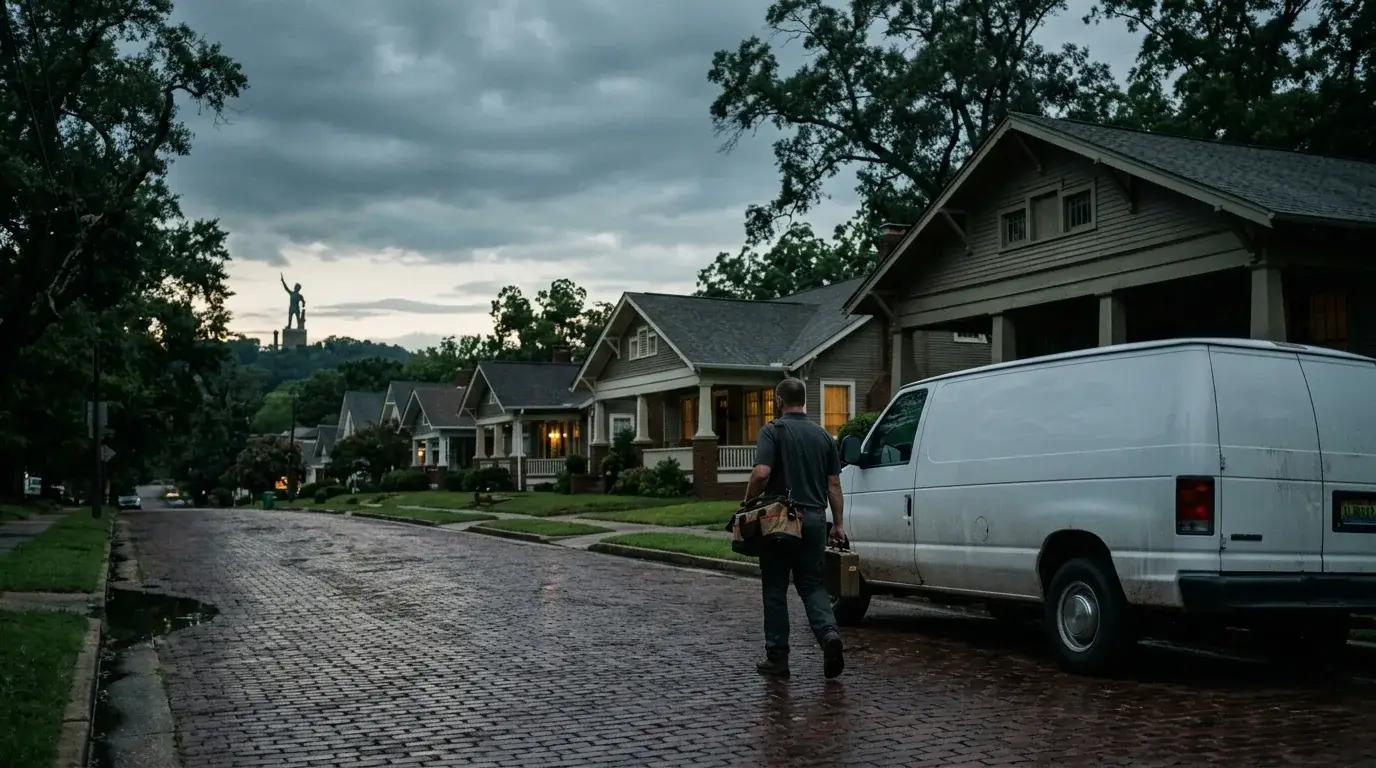
Birmingham's five HVAC-distinct residential districts.
Birmingham proper is not one housing-stock story — it's five. Each of the city's five NRHP-listed or NRHP-eligible historic residential districts has a distinct build era, a distinct typical HVAC infrastructure, and a distinct common failure profile. After Hours HVACR dispatches with district-specific knowledge, not generic city-wide coverage. The following registry maps each district to the housing era and the HVAC-service pattern that dominates our after-hours call queue.
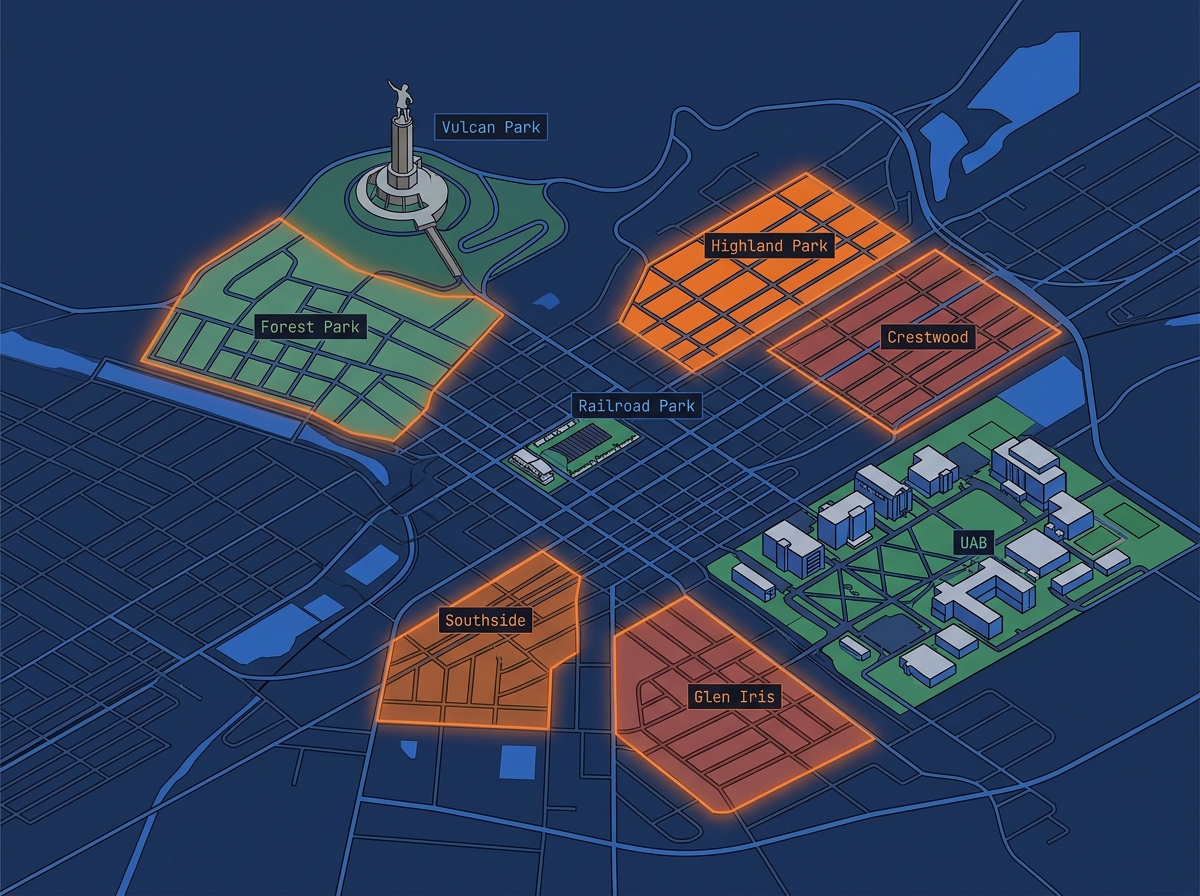
Craftsman bungalows · 1908-1925
Pier-and-beam foundations. Crawl-space ductwork. Retrofit central air is universal; original ducting is often still in place.
Victorian + Craftsman · 1890s-1920s
Oldest surviving residential housing in Birmingham. Queen Anne Victorians next to later bungalow infill.
Brick cottages · 1920s-1940s
Low-elevation. Absorbs downtown urban heat island overnight. Compressors log heavy hours here.
Mixed 1890s-1960s · UAB corridor
Dense mix. Owner-occupied next to rental. Light-commercial duplex / quad-unit service is common.
1910s-1930s · Glen Iris Park ridge
Elevated ridgeline. Homes on steep slopes — access-restricted outdoor condenser placements.
Source: Birmingham Historical Society districts reference · BhamWiki neighborhood taxonomy · National Register of Historic Places listings for Forest Park + Highland Park · Census Bureau housing-age data for ZIP codes 35205, 35209, 35213, 35222.
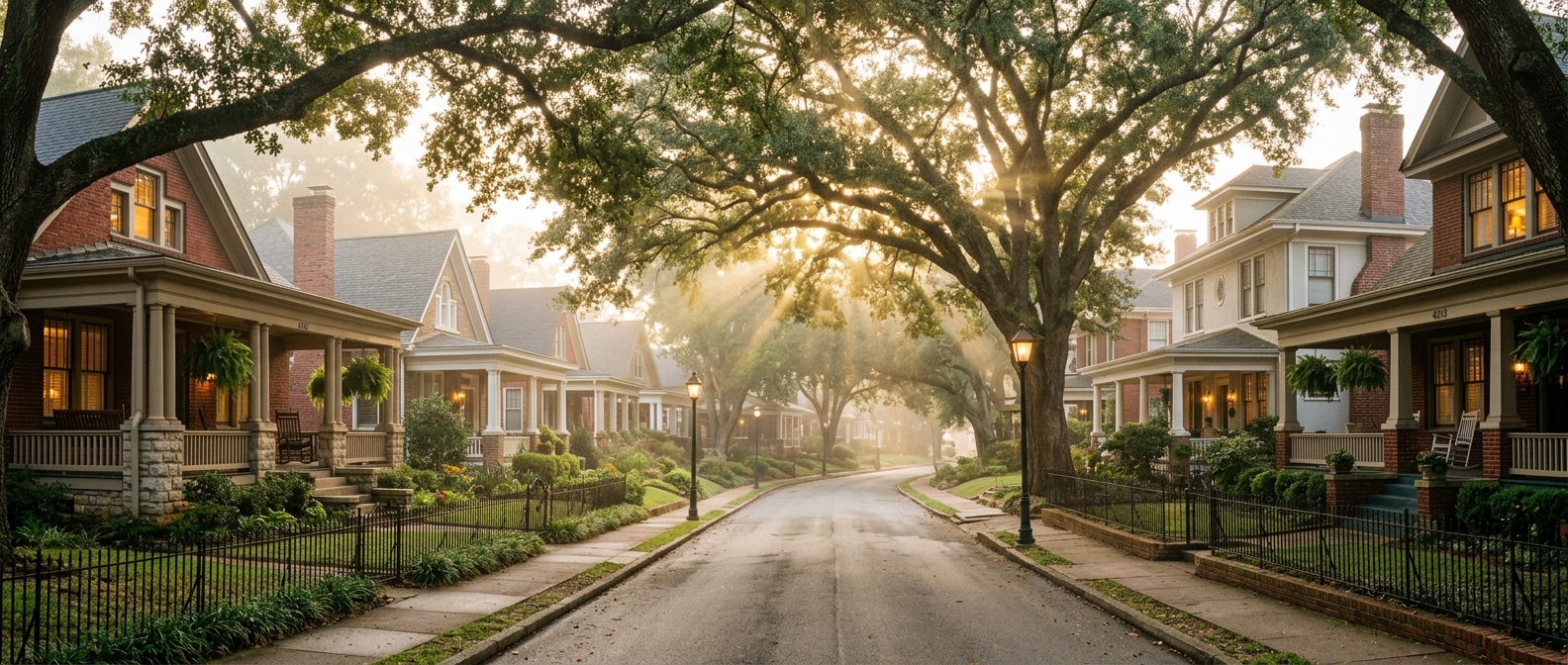
Birmingham's oldest residential streets — every home is a retrofit HVAC puzzle built on top of original pier-and-beam bones.
What's hiding in the Birmingham basement.
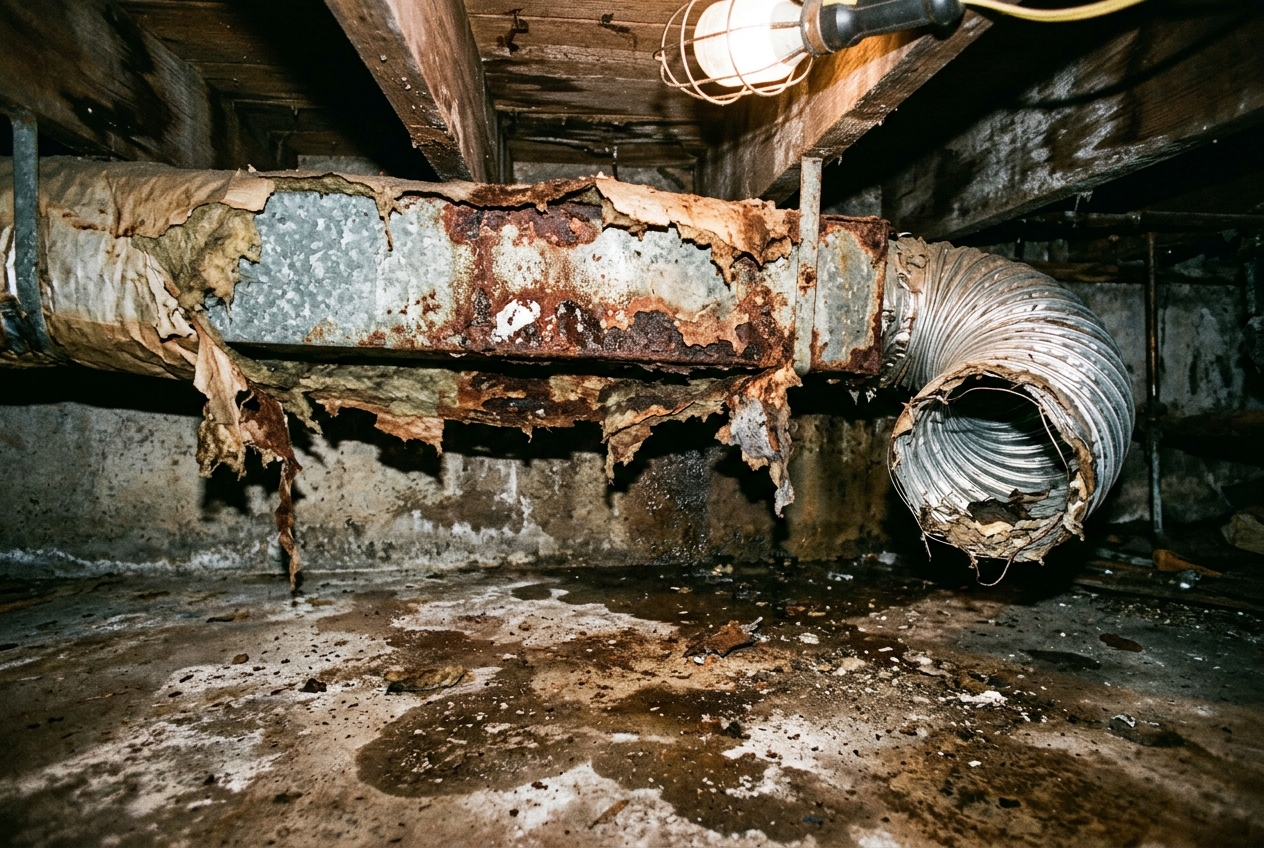
The first 30 seconds of a Birmingham HVAC call often happen under the house. Original galvanized trunk lines from 1920s-1950s installations, flex-duct boots disconnected by decades of foundation settling, insulation peeling into the damp crawl space below. A U.S. Department of Energy study of Southeastern housing found that up to 30% of conditioned air is typically lost to duct leakage in homes of this era — a figure we see borne out almost daily in Forest Park and Highland Park service calls.
In Birmingham's oldest districts, it is routine to find ductwork where a meaningful portion of the conditioned air never reaches a register. The system runs, the thermostat reads correctly, and the homeowner's Alabama Power bill climbs while specific rooms stay uncomfortable. Diagnosis requires pressure-testing the duct system, not just inspecting the condenser.
Our Birmingham-proper service vehicles carry flat-body pressure testers, foil tape, mastic compound, and replacement flex-duct in 6-inch, 8-inch, and 10-inch diameters — the field inventory required to service old Birmingham housing stock without a return trip.
Source: U.S. Department of Energy residential duct-leakage studies · energy.gov/energysaver/duct-systems · EPA ENERGY STAR duct-sealing guidance.
When Birmingham calls after midnight, what's usually broken.
Birmingham's 2am emergency HVAC queue follows a consistent seasonal pattern. After Hours HVACR's dispatch log, aggregated across a typical summer week, shows that the most common after-hours failure by clock-hour correlates strongly with a specific Birmingham district's housing-stock era and HVAC infrastructure. The table below maps dispatch hour to the most common failure and the district where it typically originates — the data behind why we stage specific parts on specific trucks.
| Hour | Most common failure | Typical district |
|---|---|---|
| 18:00–21:00 | Run-capacitor failure after peak-heat day | Crestwood · Glen Iris |
| 21:00–00:00 | Condensate drain overflow · safety-switch trip | Forest Park · Highland Park |
| 00:00–04:00 | Compressor seize · refrigerant loss | All districts · 20+ year systems |
| 04:00–07:00 | Thermostat · control-board failure | Southside (storm-related) |
| Winter overnight | Furnace ignitor · flame-sensor fouling | Forest Park · Highland Park (gas) |
Source: After Hours HVACR internal dispatch log · cross-referenced against NOAA Birmingham summer dew-point and temperature data · Alabama Power residential-load reports.
Every Birmingham ZIP inside city limits.
Birmingham-specific questions.
What is After Hours HVACR's coverage in Birmingham, Alabama?
After Hours HVACR is a 24/7 emergency HVAC dispatch service that covers Birmingham, Alabama from its Hoover headquarters at 2090 Columbiana Rd. Coverage includes every Birmingham city ZIP code and every historic residential district — Forest Park, Highland Park, Crestwood, Southside, Glen Iris, Avondale, Woodlawn, Five Points South, Downtown, and East Lake. Licensed Alabama HVAC technicians are on-call every night, weekend, and holiday. Call (205) 994-6402.
Which Birmingham neighborhoods have the oldest HVAC-affected housing stock?
Birmingham's oldest surviving residential housing is concentrated in five historic districts: Forest Park (Craftsman bungalows from 1908-1925), Highland Park (Victorian and Craftsman homes from the 1890s-1920s), Glen Iris (1910s-1930s on the Glen Iris Park ridgeline), Crestwood (1920s-1940s brick cottages), and Southside (mixed 1890s-1960s). Most systems have been replaced multiple times, but original pier-and-beam foundations and crawl-space ductwork commonly remain and drive most emergency service calls.
What is the most common summer emergency HVAC call in Birmingham?
Run-capacitor failure in the outdoor condensing unit is the number-one summer emergency in Birmingham. According to NOAA climate data, Birmingham's July dew points regularly exceed 73°F and average afternoon temperatures exceed 90°F. The combined heat and latent load pushes run capacitors past their rated duty, especially on 15-year-plus systems with direct afternoon sun exposure. Secondary calls are condensate-drain overflows in crawl-space-drained homes where debris clogs the outlet.
How is Birmingham's urban heat island reflected in HVAC demand?
Birmingham's urban core and Southside corridor run 3 to 6°F hotter than ridge communities such as Mountain Brook and Vestavia Hills on typical summer evenings, according to urban-heat-island research published by the University of Alabama at Birmingham. Cooling loads persist deep into the night — AC systems in Crestwood, Glen Iris, and the Five Points South / UAB corridor rarely reset from cool outdoor air. Compressor hour accumulation runs measurably higher than in suburban Hoover.
How quickly can After Hours HVACR dispatch to Birmingham from Hoover?
Our Hoover headquarters at 2090 Columbiana Rd is roughly 12 minutes from Five Points South and 15 minutes from Forest Park in typical traffic conditions, using Highway 31, I-65, or I-459. Birmingham proper sits inside our core coverage radius. Actual arrival depends on current dispatch queue, time of day, and weather. Call (205) 994-6402 and a live dispatcher confirms a technician to you — no voicemail, no callbacks.
Does After Hours HVACR service Birmingham's historic bungalows?
Yes. Birmingham's Forest Park and Highland Park bungalows typically sit on pier-and-beam foundations with 18 to 30 inches of crawl-space clearance. Supply ducts run through the crawl space and require flat-body tooling for repair, drain cleaning, or coil servicing. Many HVAC companies refuse these calls. Our Birmingham-dispatch vehicles carry the access tooling specific to historic bungalow infrastructure — flat-body pressure testers, mastic, and 6- to 10-inch replacement flex-duct.
What HVAC brands are most common in older Birmingham homes?
Retrofit central-air systems installed in Birmingham's historic districts during the 1970s-1990s lean toward Trane, Carrier, Rheem, and American Standard. More recent replacements in Forest Park, Highland Park, and Avondale have moved to Lennox, Bryant, and Goodman under homeowner-led installations. After Hours HVACR services every residential HVAC brand installed in the Birmingham metro. Licensed Alabama HVAC technicians carry universal replacement parts across brand families.
Are After Hours HVACR's Birmingham technicians licensed in Alabama?
Yes. All After Hours HVACR field technicians are licensed by the Alabama Board of Heating, Air Conditioning, and Refrigeration Contractors. Each technician also holds EPA Section 608 certification required for refrigerant handling, per United States Environmental Protection Agency rules. License and insurance documentation is provided on request before any work begins in a Birmingham home.
AC down in Birmingham tonight?
Live dispatcher answers the phone. Licensed Alabama technician heads your way. 24/7, every historic district.
call (205) 994-6402