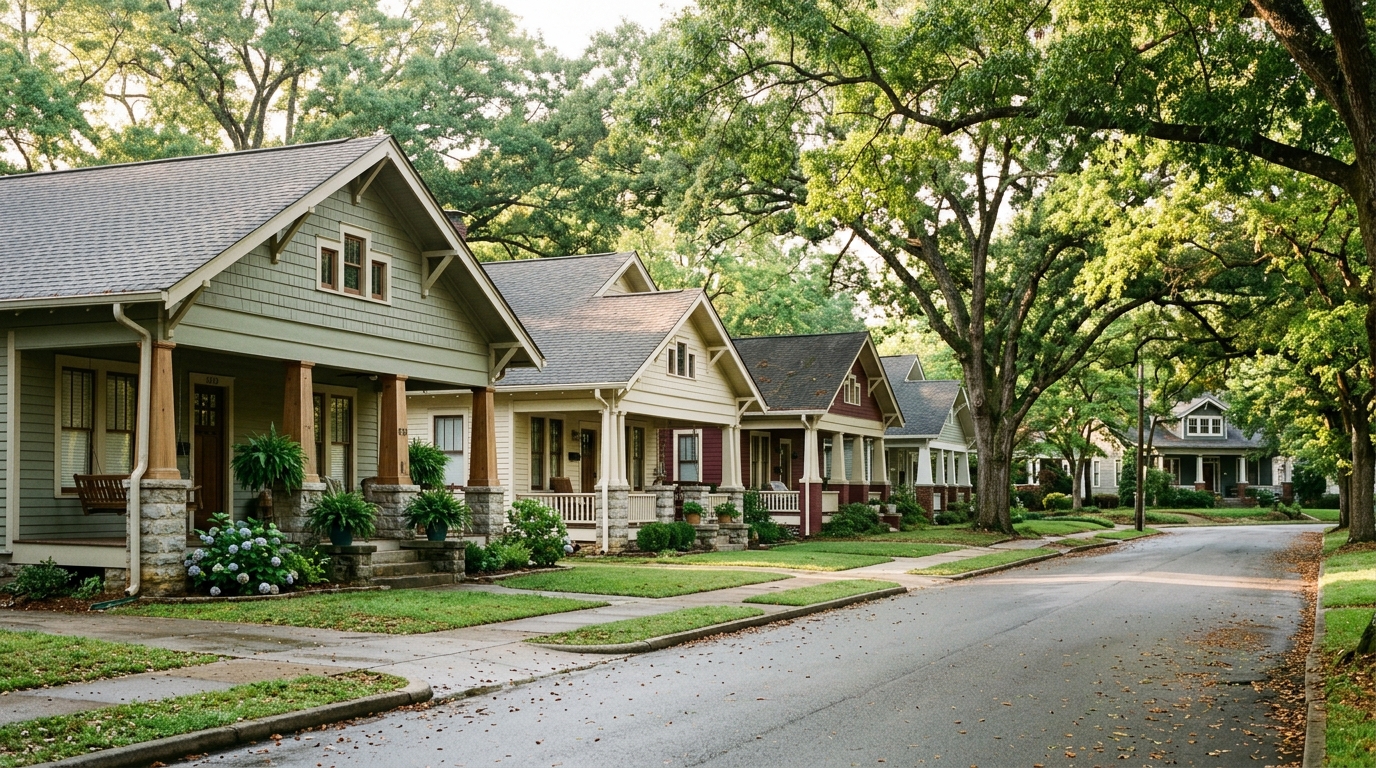
These homes were
built before AC existed.
Emergency HVAC Service in Homewood, Alabama.
Homewood's 1920s Craftsman bungalows were designed around cross-ventilation, not ductwork. Every central AC system in these homes is a retrofit. When one fails at midnight, you need a technician who knows what's actually down in that crawl space.
After Hours HVACR is a 24/7 emergency HVAC dispatch service that covers all four Homewood ZIP codes — 35209, 35211, 35223, 35229 — nights, weekends, and holidays. Licensed Alabama technicians. Call (205) 994-6402.
Air conditioning service Homewood AL is the bulk of what we run — but the call list does not stop there. We handle furnace repair, furnace installation Homewood AL, and full furnace replacement Homewood AL when an old gas system finally lets go in January. For the bungalows that never had ductwork to begin with, ductless mini splits Homewood AL are the cleanest retrofit. And for older homes with persistent allergy issues, indoor air quality Homewood AL work — duct cleaning, sealing, filtration upgrades — usually solves the symptom the homeowner thought was an AC problem.
Central AC didn't come with the house. Neither did the ductwork.
Most Homewood bungalows were built between 1910 and 1945. Not one of them was designed with central air conditioning. Every duct run, every air handler, every refrigerant line in these homes was added after the fact — often decades after the home was built. Understanding that retrofit history is the starting point for every emergency call we take in Homewood.
The most common retrofit path
In Edgewood and Hollywood bungalows, the standard retrofit approach cut vertical chases through interior walls to carry supply ductwork from a closet air handler up into the attic. From there, round or rectangular trunk lines distribute air to each room through ceiling registers. The problem: those chases were framed inside existing load-bearing walls, making future access extremely difficult. Duct runs in unconditioned attics across a Birmingham summer also face temperatures above 130°F — well above what standard flex-duct is rated to handle repeatedly. NOAA Birmingham climate data documents an average of 46 days per year above 90°F at the surface; attic temperatures run 30 to 50 degrees higher than ambient. Every degree above the rated threshold shortens the liner's service life.
Added in the 1970s and 1980s — now reaching end of life
When flexible duct became widely available in the 1970s, HVAC contractors retrofitting Homewood bungalows used it heavily. It was cheap, easy to route through existing framing, and required no sheet-metal fabrication. The downside is longevity: flex duct from that era is now 40 to 50 years old. The inner liner cracks. The insulation layer compresses to near-zero R-value. The wire coil that keeps the tube round collapses at bend points. When we pull a flex-duct section from an Edgewood crawl space or attic, we routinely find material that should have been replaced 20 years ago. A system with failing duct can lose 25 to 40 percent of its conditioned air before it reaches the rooms it is supposed to cool — consistent with U.S. Department of Energy research on duct system loss rates in unconditioned building cavities.
The converted bedroom closet as mechanical room
Lacking a utility room or basement, Homewood bungalow retrofits frequently converted a hall or bedroom closet into the air handler location. The closet gives the contractor a vertical space to mount the unit and a path to the attic above, but it creates several ongoing problems. First, return air has to get back to the handler through a filter grille cut into the closet door — typically undersized for the tonnage installed. A restricted return drops static pressure, starves the evaporator coil of airflow, and causes the coil to ice over. Second, closet air handlers make condensate drain routing awkward, and secondary drain pan overflows inside a finished closet can go undetected until drywall damage appears. We carry a condensate pump on every service vehicle specifically because Homewood closet air handlers rarely have gravity drain access to the exterior.
The purpose-built retrofit solution for ductwork-free homes
High-velocity systems — brands such as Unico and SpacePak — were developed specifically for homes without existing ductwork. They use a small-diameter two-inch flexible supply tube that can snake through existing wall cavities, joist bays, and tight attic spaces without demolition. The tradeoff is noise: high-velocity systems are louder than conventional low-velocity ductwork, and the outlet diffusers require specific placement for the induction-mixing effect they depend on for comfort. Several Edgewood and Hollywood historic homes have been retrofitted with these systems, and we service them. They have their own failure modes — the high-pressure air handler requires more frequent filter changes, and the small-diameter supply tubes are intolerant of partial blockages that a conventional system would push past without incident.
The least glamorous — and most failure-prone — part of the system
Pier-and-beam Homewood homes need return air pulled back to the air handler from the living space. The path of least resistance in a 1970s retrofit was to run a large flexible return duct through the crawl space. Crawl-space return ducts in Homewood face two compounding problems. Ground moisture condenses on the outside of the cool return duct, promoting mold growth on the duct liner and on the vapor barrier below. And when a return duct connection separates in the crawl space, the system pulls unfiltered crawl-space air — dirt, mold spores, insect debris — directly into the air stream. The U.S. Department of Energy's duct efficiency documentation specifically flags crawl-space returns in high-humidity climates as among the highest-priority items for remediation. We inspect return duct integrity on every Homewood service call as a standard diagnostic step.
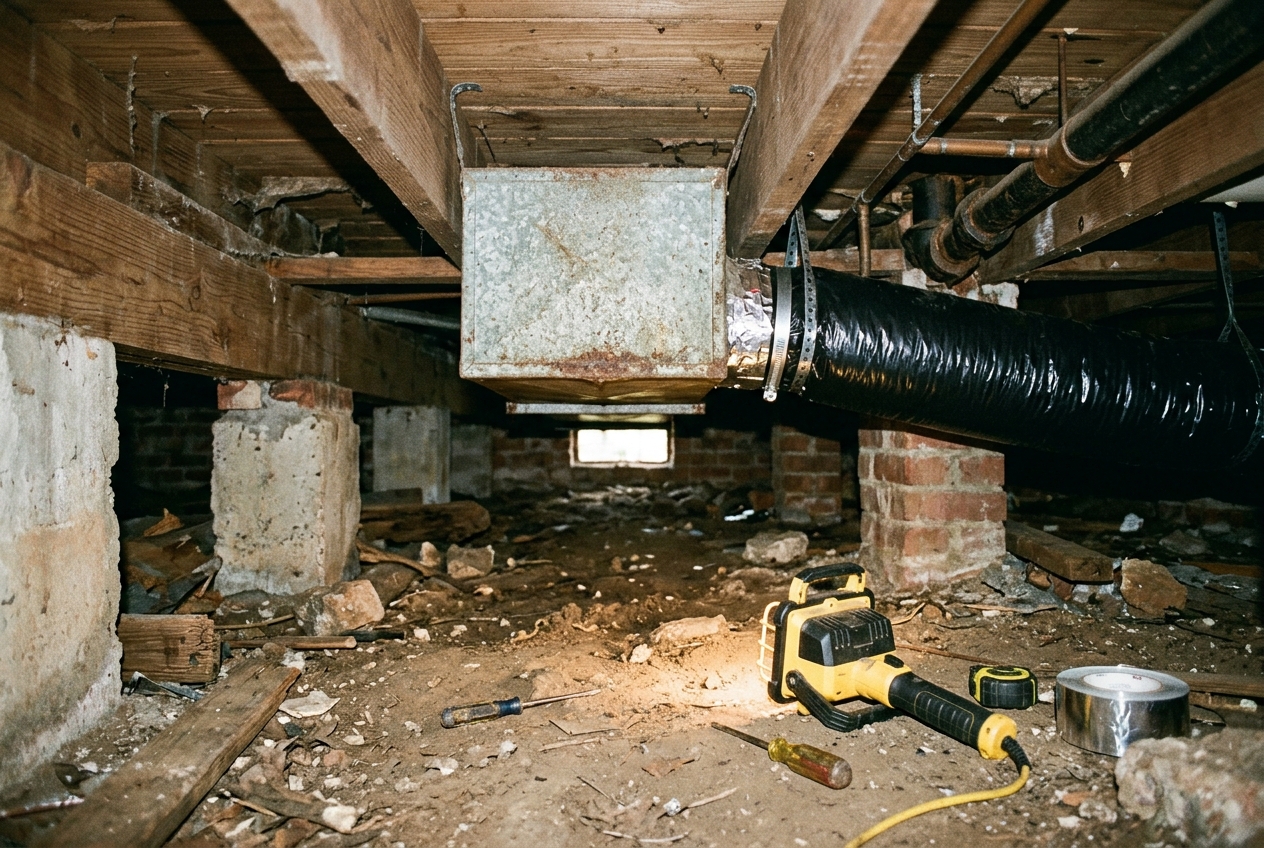
This is what a 1970s retrofit crawl-space duct run looks like after 50 years under a pier-and-beam Edgewood bungalow. The inner liner has collapsed at the elbow. The insulation wrap is saturated. This section delivers roughly 20 percent of its rated airflow.
All four Homewood ZIPs, covered.
Homewood occupies just 8.4 square miles — a small footprint for a city of 26,414 residents (U.S. Census Bureau, 2020). Every ZIP sees 24-hour dispatch. There is no premium zone and no minimum call threshold for nights or weekends.
West Homewood, US-31 corridor, SoHo Square
Southwest Homewood, Oak Grove edge
Edgewood Historic District, Hollywood, Rosedale, 18th Street
Eastern Homewood, Mayfair, Mountain Brook border
The 1920s pier-and-beam reality: why crawl-space ductwork is the #1 Homewood emergency call.
Pier-and-beam construction — the standard for Homewood homes built through the 1940s — elevates the floor structure on concrete or masonry piers. The resulting crawl space is typically 18 to 36 inches deep, uninsulated, and directly exposed to ground moisture. In Homewood, the drainage topography between Red Mountain and Shades Creek creates seasonal high water table conditions under many Edgewood and Rosedale lots.
When HVAC retrofit contractors in the 1970s and 1980s ran ductwork through these crawl spaces, they used flexible duct that was never rated for the moisture exposure it would face. The U.S. Department of Energy has documented that ductwork in unconditioned crawl spaces — particularly in humid climates — loses 25 to 40 percent of conditioned air through leakage and thermal loss before it reaches the living space. In practice, Homewood crawl-space duct runs we inspect frequently perform worse than that benchmark.
The failure pattern is consistent: a flex-duct section separates at a connection point, or the inner liner collapses at an unsupported bend. The system runs continuously. The upstairs stays hot. The homeowner calls at 11 PM convinced the compressor is dead. It is not — the problem is six inches underground, in a space nobody has looked at in 20 years.
"Duct systems can lose 25 to 40 percent of the heating or cooling energy before it reaches the conditioned space." — U.S. Department of Energy, Building Technologies Office, Duct Sealing guidance.
Collapsed inner liners at unbraced flex-duct bends. Mold on the insulation wrap from crawl-space condensation. Disconnected elbow joints at the plenum takeoff. Crushed duct from crawl-space pest exclusion work. Vapor-barrier punctures that pool water directly beneath the duct run.
Birmingham averages 54 inches of annual rainfall and 68 days with dew points above 70°F. Ground moisture in Homewood crawl spaces is not a seasonal problem — it is a year-round condition that never stops working on duct connections and vapor barriers.
Six Homewood neighborhoods, six HVAC stories.
Homewood's neighborhoods each represent a different era of construction and a different set of retrofit decisions. We know what we are walking into before the truck leaves the lot.
Edgewood
The oldest and most architecturally intact neighborhood in Homewood, listed on the National Register of Historic Places. Craftsman and Tudor bungalows with original plaster walls, 2×4 framing, and no original duct chases. Every AC system is a retrofit and most were installed 30 to 50 years ago. Trane and Carrier appear most often in the 1980s-era installations. Exterior equipment placement often dates to an era when historic restrictions were less enforced — some condensers sit in awkward rear-yard locations with undersized disconnect service and limited refrigerant line access.
Rosedale
One of Birmingham's oldest African-American residential communities, Rosedale developed in the 1920s along the eastern slope of Homewood below Red Mountain. Pier-and-beam construction dominates. The crawl-space conditions here are among the most challenging in the city — the terrain channels drainage beneath many of the older lots along the Red Mountain slope. Flex-duct failures, return-air contamination, and drain-pan overflows are the most frequent calls. Goodman and Rheem appear most often in the recent replacement cycle installations in this neighborhood.
Hollywood Historic District
Hollywood's English cottage and Tudor Revival streetscape is the visual identity of central Homewood. The housing stock is almost identical in age to Edgewood, and the retrofit HVAC history is similar. What distinguishes Hollywood is a higher share of homes that went through full renovation in the 2000s and 2010s — newer Lennox, American Standard, and Bryant air handlers installed during renovation, sitting atop original 1970s duct runs that nobody replaced. Mixed-age system diagnostics are the norm, and the duct age often surprises homeowners who believe the new system is the whole picture.
West Homewood
West Homewood runs along US-31 toward the Hoover border and includes the SoHo Square commercial corridor and the 18th Street district. The residential streets mix 1930s bungalows with 1950s and 1960s ranch-style homes — the first Homewood construction to include purpose-built duct chases. Ranch-era homes here often have slab-on-grade or shallow crawl-space construction, a different set of challenges than the deep crawl spaces in Edgewood. Attic ductwork is more common, and high attic temperatures driven by Birmingham's 46-plus days above 90°F are the primary efficiency concern. Carrier and Rheem are the most common brands in this corridor.
Oak Grove
Oak Grove occupies the western edge of Homewood near the I-65 corridor, with a mix of 1940s cottages and mid-century ranch construction. This area sees a wider brand mix than the historic core — Goodman, American Standard, and Bryant installations from the 1990s and 2000s replacement wave are common. Equipment access is generally easier than in the historic districts, and crawl-space conditions are less extreme than on the Red Mountain slope. Capacitor and contactor failures from unobstructed western sun exposure are the dominant summer emergency call type, driven by the same afternoon heat loading that affects southern-facing equipment throughout Jefferson County.
Mayfair
Mayfair sits on the eastern edge of Homewood adjacent to Mountain Brook, with housing stock spanning the 1940s through the 1970s. The neighborhood includes some of the larger lot sizes in Homewood, and the 1960s and 1970s construction here was the first to include properly sized duct systems from the factory rather than field retrofits. However, those original duct systems are now 50 to 60 years old. Lennox equipment appears frequently in Mayfair — a legacy of the brand's strong Alabama dealer network in the 1970s. Heat pump systems are more common here than in the older bungalow neighborhoods closer to Edgewood and Rosedale.
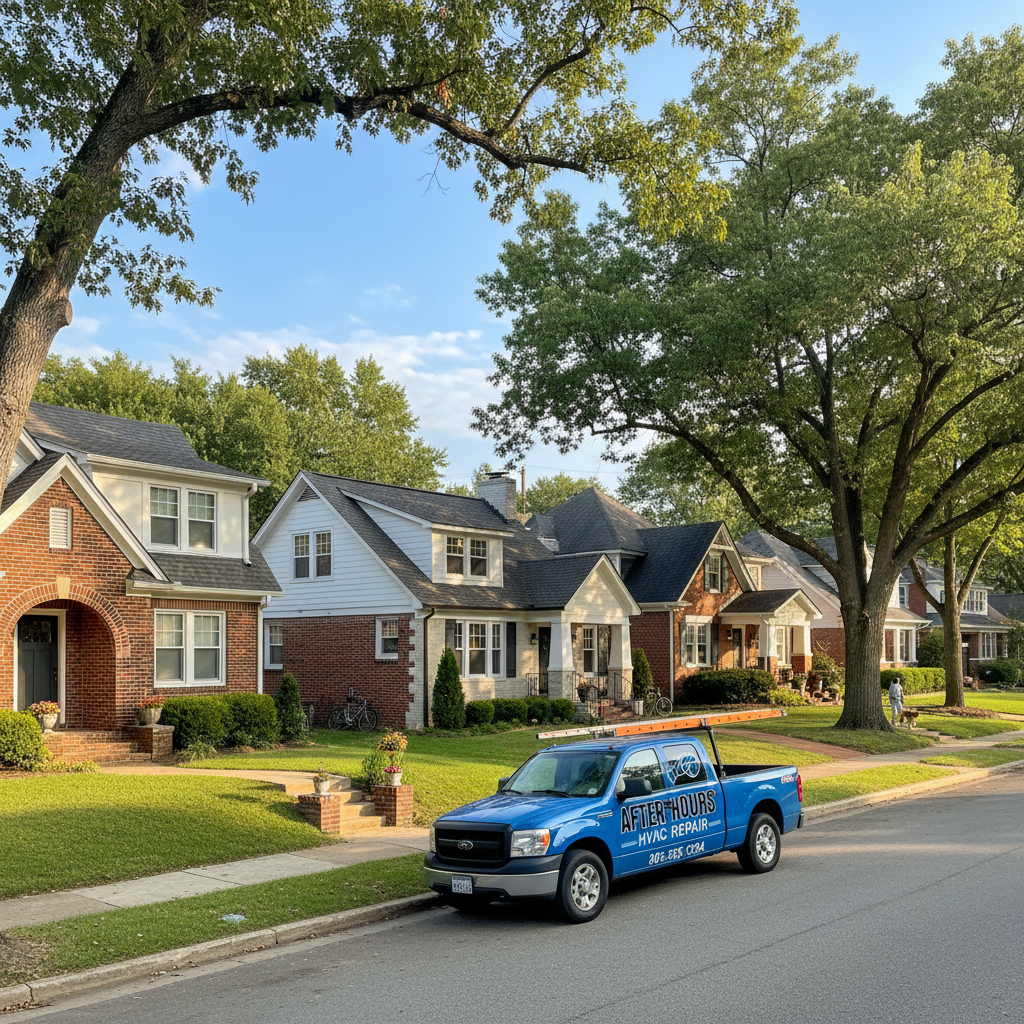
What a Homewood night call looks like.
The streets in Edgewood and Hollywood are narrow — original 1920s residential widths not designed for modern service vehicles. The oak canopy overhead is beautiful during the day and pitch black at midnight. The condensate line is behind the original 1952 lathe-and-plaster wall inside a converted closet. The flex-duct connection is in a crawl space with 20-inch clearance and Shades Creek dampness in the soil.
This is not a standard residential service call. It requires a technician who has worked in these conditions before — who carries a low-profile crawl-space light, a condensate pump, a flex-duct repair kit, and enough Trane, Carrier, Rheem, Lennox, Goodman, American Standard, and Bryant parts to handle whatever system they find once they are inside the door.
Homewood is a city where Vulcan's torch is visible from half the front porches, where 18th Street fills on Friday nights, and where the houses have been standing since before World War I. The AC that keeps them livable deserves a tech who respects the building it is cooling.
Homewood-specific questions.
Where is After Hours HVACR headquartered relative to Homewood?
After Hours HVACR is headquartered at 2090 Columbiana Rd, Suite 100 in Hoover, Alabama 35216 — approximately four miles southwest of Homewood's central 18th Street corridor via I-65. Homewood sits directly south of Birmingham along Red Mountain, bordered by Shades Creek to the south and the crest of Red Mountain to the north. Our Hoover base puts on-call technicians within a short drive of every Homewood ZIP code at any hour of the night or weekend.
Which Homewood ZIP codes does After Hours HVACR cover?
After Hours HVACR covers all four ZIP codes that serve Homewood residences: 35209 (northwest Homewood, West Homewood corridor along US-31), 35211 (southwest fringe and Oak Grove edge), 35223 (central and eastern Homewood including Edgewood and Hollywood Historic District), and 35229 (eastern Homewood, Mountain Brook border, Mayfair). Every ZIP receives the same 24-hour dispatch regardless of neighborhood or historic district status.
Why do 1920s Edgewood bungalows have more AC problems than newer homes?
Edgewood bungalows — the Craftsman, Tudor, and English cottage styles built between roughly 1910 and 1940 — were designed around natural ventilation, not mechanical cooling. There was no ductwork, no equipment pad, and no electrical service sized for a modern air handler. Every central AC system in these homes is a retrofit: attic chase runs were cut through original plaster ceilings, closets were converted to mechanical rooms, and crawl-space returns were added after the fact. Each of those improvised connections is a future failure point. The National Register of Historic Places listing for the Edgewood Historic District also constrains exterior modifications, which limits where outdoor equipment can be placed and how refrigerant lines are routed.
What is the biggest HVAC emergency risk in pier-and-beam Homewood homes?
Crawl-space ductwork failure is the leading emergency call in pier-and-beam Homewood homes. The U.S. Department of Energy documents that uninsulated or poorly sealed ductwork in crawl spaces loses 25 to 40 percent of conditioned air before it reaches the living space. In Homewood's 1920s and 1930s construction, flex-duct runs laid directly on crawl-space soil absorb ground moisture, develop mold at connection points, and eventually collapse at the elbow joints. When a duct section fails, the system runs continuously, the upstairs bedrooms never cool, and the homeowner often assumes the compressor has failed — when the actual problem is 10 feet below the floor in the crawl space.
How does Homewood's tree canopy affect HVAC equipment life?
Edgewood and Hollywood are among the most heavily canopied residential streets in the Birmingham metro. Mature white oaks, red maples, and tulip poplars drop catkins in spring and leaf litter in fall. Both accumulate on condenser coils and pack into the bottom of outdoor units, reducing airflow and forcing the compressor to work harder. NOAA Birmingham climate data shows the metro averages 54 inches of rainfall annually, which keeps that organic debris wet and promotes coil corrosion. Equipment under a dense oak canopy typically shows 20 to 30 percent more fin damage and coil fouling than equipment in open sun — and it needs cleaning twice as often to maintain rated efficiency.
Do Homewood's historic district rules affect emergency HVAC repairs?
Emergency repairs inside the home — blower motor replacements, refrigerant recharges, duct repairs in the crawl space or attic, air handler swaps in a closet mechanical room — are not affected by historic district overlay. The Edgewood Historic District rules apply to exterior alterations visible from the street: new equipment pads, condensate line routing, lineset covers on front facades. Alabama contractor licensing board rules require a licensed HVAC contractor for any refrigerant work regardless of historic status. For routine emergency calls in Edgewood, expect no regulatory friction. For new equipment installations that require exterior modifications near the front facade, a city-level design review may apply.
What are the most common after-hours failures in Homewood?
Three failure types dominate Homewood after-hours calls. First, crawl-space flex-duct collapses — most common in homes where original retrofit ducts have never been replaced and a hot summer pushes the system past its design limits. Second, capacitor failures on outdoor condensers, particularly units installed on south-facing concrete pads in Rosedale and West Homewood where afternoon sun is unobstructed. Third, air handler drain-pan overflows: the high humidity along Shades Creek and Red Mountain drainage corridors causes evaporator coils to produce more condensate than the original drain pans were sized to handle, leading to attic or closet water damage when the safety float fails. Trane, Carrier, Rheem, Lennox, Goodman, American Standard, and Bryant equipment all appear in Homewood's mixed housing stock.
Why does crawl-space ductwork fail faster in historic Homewood homes?
Three factors combine to accelerate crawl-space duct failure in Homewood's 1920s pier-and-beam stock. First, crawl-space ground moisture: Shades Creek feeds a high water table along the southern edge of Homewood, and Red Mountain drainage creates seasonal saturation under many Edgewood and Rosedale lots. Second, the retrofit nature of the ductwork itself — flex duct laid in a crawl space without proper support hangers sags, kinks, and loses 15 to 20 percent of its flow capacity from geometry alone, before any seal failure. Third, original installation quality varied widely: when bungalows were retrofitted in the 1970s and 1980s, there were no performance standards for crawl-space duct insulation. The DOE duct loss research confirms that uninsulated crawl-space runs in high-humidity climates are the single worst location for ductwork in terms of system efficiency and longevity.
Need a technician in Homewood tonight?
We know pier-and-beam construction. We know crawl-space ductwork. We know Edgewood. Call and a live dispatcher routes the closest on-call technician to your address. 24/7. Written estimates before any work begins.
call (205) 994-6402