AC Blowing Warm Air? What Birmingham Homeowners Should Check First
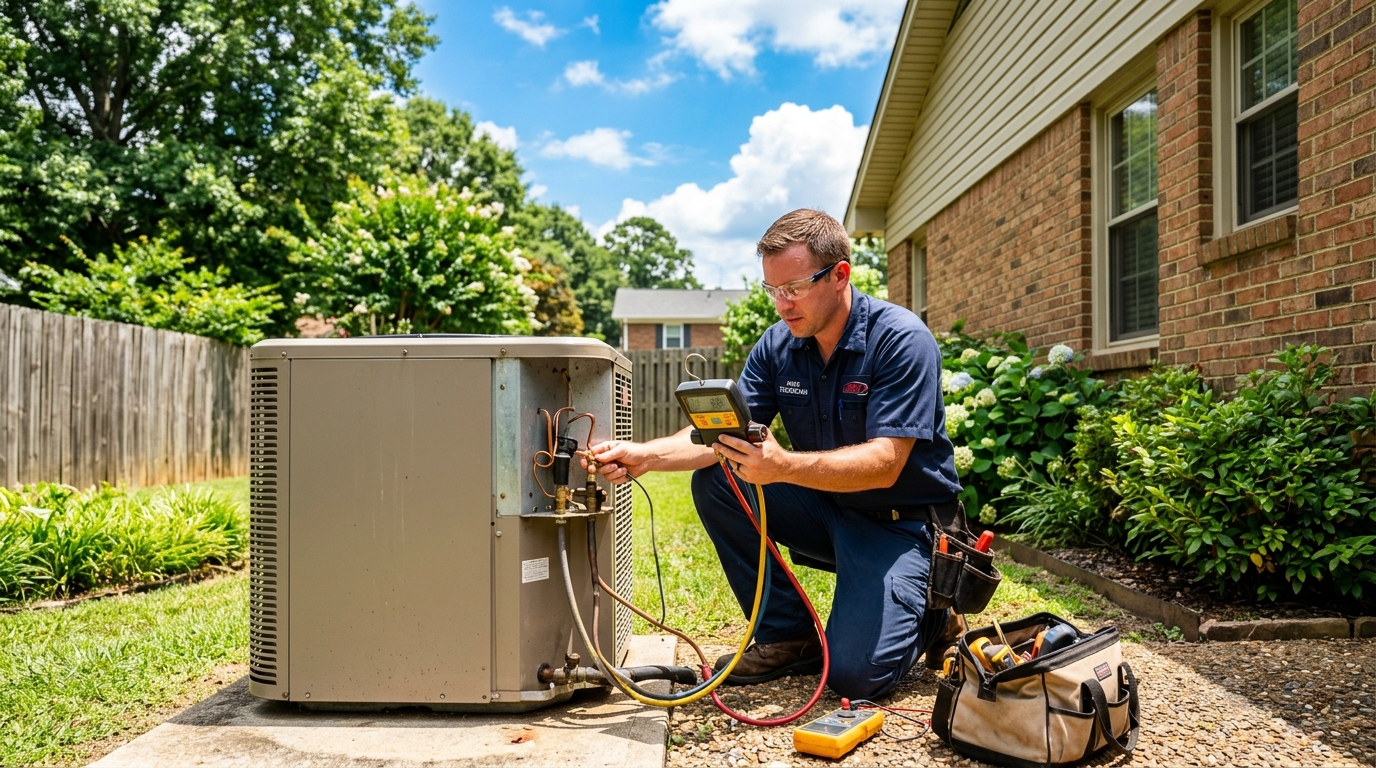
You walk into your Birmingham home after a long day, and the house feels like a sauna. You check the thermostat: it is set to 72, but the temperature reads 84 and climbing. The vents are blowing air, but it is warm. Before you panic and call for emergency service, there are five things you can check yourself that might fix the problem or at least prevent further damage while you wait for a technician.
Quick Answer
Check these 5 things before calling: (1) Replace a dirty air filter, (2) Verify thermostat is set to COOL/AUTO, (3) Reset tripped circuit breakers, (4) Inspect the outdoor unit for debris or a non-spinning fan, (5) Check for a clogged condensate drain line. If none of these fix it, call a professional.
Step 1: Check and Replace Your Air Filter
A dirty or clogged air filter is the single most common cause of an AC blowing warm air in Birmingham, and it is the easiest problem to fix yourself. When the filter becomes clogged with dust, pet hair, pollen, and the fine red clay particles that are everywhere in central Alabama, it restricts airflow over the evaporator coil. Without adequate airflow, the coil temperature drops too low and ice begins to form on its surface. Once the coil freezes over, it can no longer absorb heat from the air passing through your system, and your vents start blowing warm or room-temperature air instead of cold. The fix is straightforward: turn off your AC system completely, locate the return air filter (usually in a hallway ceiling, wall return, or at the air handler), and pull it out. If you can not see light through the filter when you hold it up, it needs replacing. In Birmingham's environment, with heavy pollen in spring, high humidity promoting mold growth, and dust from Alabama's red clay soil, filters clog faster than the national average. During peak cooling season from May through September, Birmingham homeowners should check their filter every two weeks and replace it at least monthly. Replacement filters are inexpensive and available at any Birmingham hardware store or big box retailer.
Key Takeaway
A clogged filter is the #1 cause of AC blowing warm air in Birmingham. The fix takes 60 seconds and filters are cheap at any hardware store. Check it first — before calling anyone.
Step 2: Check Your Thermostat Settings
Before assuming the worst, verify that your thermostat is set correctly. This sounds obvious, but it resolves more service calls than you might expect. First, make sure the system is set to COOL mode, not HEAT or FAN ONLY. Someone in the household may have accidentally bumped it, or a power flicker could have reset a digital thermostat to its default settings. Second, confirm the fan switch is set to AUTO, not ON. When set to ON, the blower fan runs continuously even when the AC compressor is not actively cooling. During these fan-only cycles, the air coming from the vents feels warm because it is simply circulating unconditioned air. Third, check that the set temperature is at least 3 to 5 degrees below the current room temperature. In Birmingham during peak summer, setting your thermostat below 72 degrees when it is 98 outside pushes your system to its absolute limits. The general recommendation for Birmingham homes is to keep the thermostat at 75 to 78 degrees during the hottest months to prevent the system from running continuously without reaching the set temperature. If you have a programmable or smart thermostat, check whether a schedule or energy-saving mode has changed the setpoint without your knowledge.
Step 3: Check Your Circuit Breakers
Your central AC system runs on two separate electrical circuits: one for the indoor air handler or furnace, and one for the outdoor condensing unit. If the outdoor unit's breaker trips, the indoor blower fan continues running and pushing air through the vents, but that air is not being cooled because the compressor and condenser are not operating. This creates the exact symptom of warm air from the vents. Go to your electrical panel, usually located in the garage, basement, or utility room, and look for the breakers labeled AC, HVAC, or CONDENSER. If one is in the middle or OFF position, flip it fully to OFF, wait 30 seconds, then flip it back to ON. In Birmingham, breakers trip more frequently during summer because AC systems draw near their maximum electrical capacity during extreme heat. Older homes in neighborhoods like Southside, Avondale, Woodlawn, and East Lake often have electrical panels that were not designed for the high-draw modern AC systems now installed in them. If the breaker trips again immediately after you reset it, do not keep resetting it. A breaker that trips repeatedly indicates an electrical fault that could be a short circuit, a ground fault, or a failing compressor drawing excessive current. At that point, you need a licensed technician.
Checked everything and still blowing warm? We can diagnose it.
Call (205) 994-6402Step 4: Inspect Your Outdoor Unit
Walk outside and take a look at your condensing unit, the large box with a fan on top that sits on a concrete pad beside or behind your house. First, check if the fan is spinning. If the outdoor unit is completely silent and the fan is not moving, the problem could be a tripped breaker (which you already checked), a failed capacitor, a burned-out contactor, or a more serious electrical issue. If you hear a humming sound but the fan is not spinning, the capacitor has likely failed, which is one of the most common emergency repairs in Birmingham during summer. Second, look at the condition of the unit itself. Birmingham's lush vegetation means outdoor units frequently become choked with leaves, grass clippings, cottonwood seeds, and other debris. If the unit is surrounded by overgrown bushes or covered in a thick layer of debris on the fins, it cannot release heat effectively. Carefully clear any debris from the unit and trim vegetation back to at least two feet on all sides. You can gently hose down the condenser fins from the inside out with a garden hose to remove built-up dirt, but never use a pressure washer as the high pressure can damage the delicate aluminum fins. Third, check the copper refrigerant lines running from the outdoor unit to your home. If the larger insulated line is covered in ice or frost, you likely have a refrigerant issue or a frozen evaporator coil. Do not try to scrape off the ice. Instead, turn the system off and allow everything to thaw naturally for two to three hours before attempting to run it again.
Step 5: Check Your Condensate Drain Line
Birmingham's oppressive humidity means your AC system removes gallons of water from the air every day during summer. All that water drains through a condensate drain line, usually a small PVC pipe that exits your home near the outdoor unit or into a floor drain. When this drain line clogs, which happens frequently in Alabama's humid climate due to algae and mold growth inside the pipe, the drain pan overflows and triggers a safety float switch that shuts down the system. You may see the AC turn off entirely, or in some cases it continues running the fan but stops cooling. Locate the drain line where it exits your home. If water is not dripping from it while the system is running, the line may be clogged. You can try clearing a simple clog by pouring a cup of white vinegar or a mixture of warm water and bleach into the drain line access point, which is usually a T-shaped PVC fitting near the indoor unit. For Birmingham homeowners, we recommend pouring a quarter cup of bleach into the drain line monthly during cooling season as a preventive measure. The warm, humid conditions inside the drain pan create an ideal environment for algae growth, and regular treatment keeps the line clear. If the vinegar flush does not restore drainage, the clog may be deeper in the line and will require a technician with a wet-dry vacuum or compressed air to clear.
Key Takeaway
Birmingham's humidity means your AC removes gallons of water daily. That water flows through the condensate drain line — and when it clogs with algae (which happens fast here), the safety switch shuts your whole system down. Monthly bleach treatments prevent it.
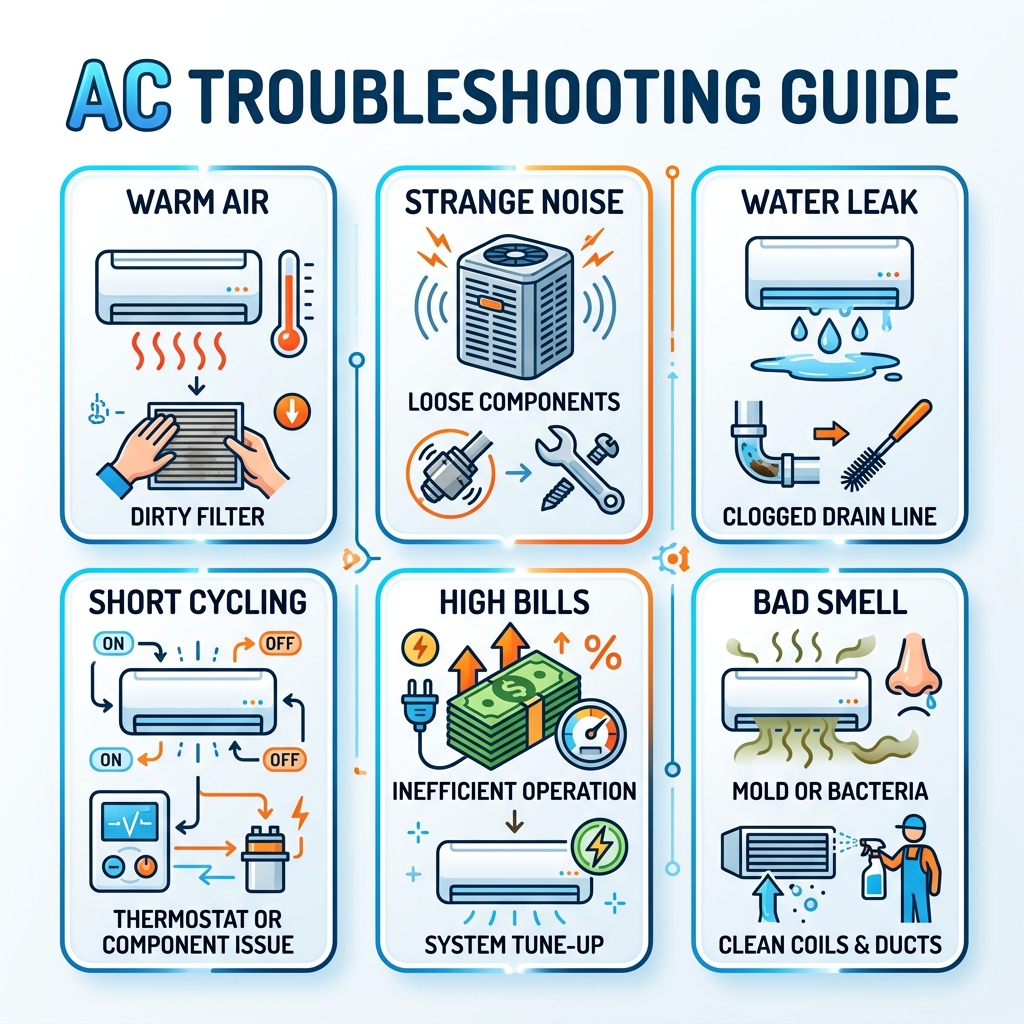
When Should You Stop the DIY and Call a Professional in Birmingham?
The five steps above can resolve many common AC issues without a service call. But there are clear warning signs that indicate you need a licensed HVAC technician and should not attempt further troubleshooting on your own. Call a professional immediately if you hear grinding, screeching, or metal-on-metal sounds coming from either the indoor or outdoor unit. These noises indicate mechanical failure that will get worse and more expensive if the system continues running. Call if you smell burning, electrical, or chemical odors near any component of the system. A burning smell can indicate overheating wiring, a failing motor, or a refrigerant leak, all of which pose safety hazards. Call if you see ice forming on the refrigerant lines and it does not resolve after thawing the system for several hours and replacing the filter. Persistent icing typically means you have a refrigerant leak that requires professional detection and repair. Call if the outdoor unit makes a loud buzzing or humming sound but will not start. This usually indicates a failed capacitor or contactor, both of which involve high-voltage electrical components that are dangerous for untrained homeowners to handle. And call if the breaker trips repeatedly after resetting. A breaker that will not stay engaged is telling you there is an electrical fault that needs professional diagnosis. In all of these situations, turn the system off completely at the thermostat to prevent further damage and call for professional service.
Why Does Birmingham's Climate Cause More AC Problems?
Birmingham's climate is uniquely demanding on air conditioning systems, and understanding why can help you prevent problems before they start. Birmingham sits in USDA Hardiness Zone 8a, with summer temperatures routinely hitting the mid to upper 90s and a heat index that frequently exceeds 105 degrees. But it is the humidity that truly sets Birmingham apart from drier southern cities like Dallas or Phoenix. Birmingham's average summer relative humidity ranges from 70 to 85 percent, which means your AC system is working double duty: cooling the air and wringing out moisture. On a typical July day in Birmingham, a residential AC system may remove 10 to 15 gallons of water from your home's air. That is an enormous amount of condensation flowing through your drain system, and it explains why clogged drain lines are among the most common service calls in the Birmingham metro. The humidity also promotes mold and mildew growth on evaporator coils and inside ductwork, which reduces efficiency and can cause musty odors. Many Birmingham homes, particularly those built in the 1960s through 1980s in neighborhoods like Homewood, Mountain Brook, and Vestavia Hills, have ductwork routed through unconditioned attics where summer temperatures can exceed 140 degrees. This superheated environment causes even well-insulated ducts to lose cooling efficiency, making the system work harder and increasing the likelihood of component failure.
How Can Birmingham Homeowners Prevent Their AC From Blowing Warm Air?
Prevention is always cheaper than emergency repair. For Birmingham homeowners, a few specific habits can dramatically reduce the chances of coming home to a house full of warm air. First, schedule annual preventive maintenance every spring, ideally in March or April before the summer rush. A qualified technician will inspect all electrical components, check refrigerant levels, clean the evaporator and condenser coils, verify proper airflow, and test the drain system. This annual checkup catches the small problems that turn into emergency failures during the first 95-degree week of summer. Second, change your filter monthly without exception from April through October. Set a monthly reminder on your phone. This single habit prevents more AC failures than any other maintenance task. Third, keep your outdoor unit clean and clear. In Birmingham, cottonwood season in late spring and fall leaf drop are the worst times for debris accumulation. Inspect the unit monthly and clear any buildup. Fourth, run your AC regularly even during mild spring weather. Birmingham can swing from 50 degrees to 85 degrees within a week during March and April. Running the AC occasionally during these transitional periods identifies problems early when prompt service is readily available rather than discovering them during the first heat wave when every HVAC company in Birmingham is booked solid.
What Happens If You Ignore an AC Blowing Warm Air in Birmingham's Heat?
Ignoring an AC that is blowing warm air in Birmingham is not just uncomfortable; it can be dangerous and expensive. When indoor temperatures climb above 85 degrees with Birmingham's typical humidity levels, the conditions create serious health risks, particularly for elderly residents, young children, and pets. Heat exhaustion and heat stroke are genuine medical emergencies, and they can develop faster indoors than many people realize when humidity prevents the body from cooling through perspiration. Beyond the health risks, continuing to run an AC system that is not cooling properly can cascade a minor problem into a catastrophic one. A frozen evaporator coil that goes unaddressed can burn out the compressor, turning a filter change into a full compressor replacement. A clogged drain line that overflows can cause water damage to ceilings, walls, and flooring, adding remediation costs on top of your HVAC repair bill. If your AC is blowing warm air and the basic troubleshooting steps in this guide do not resolve the issue quickly, do not wait. Call a professional. At After Hours HVACR, we answer the phone when other shops have gone home. A prompt repair costs far less than the damage caused by waiting.
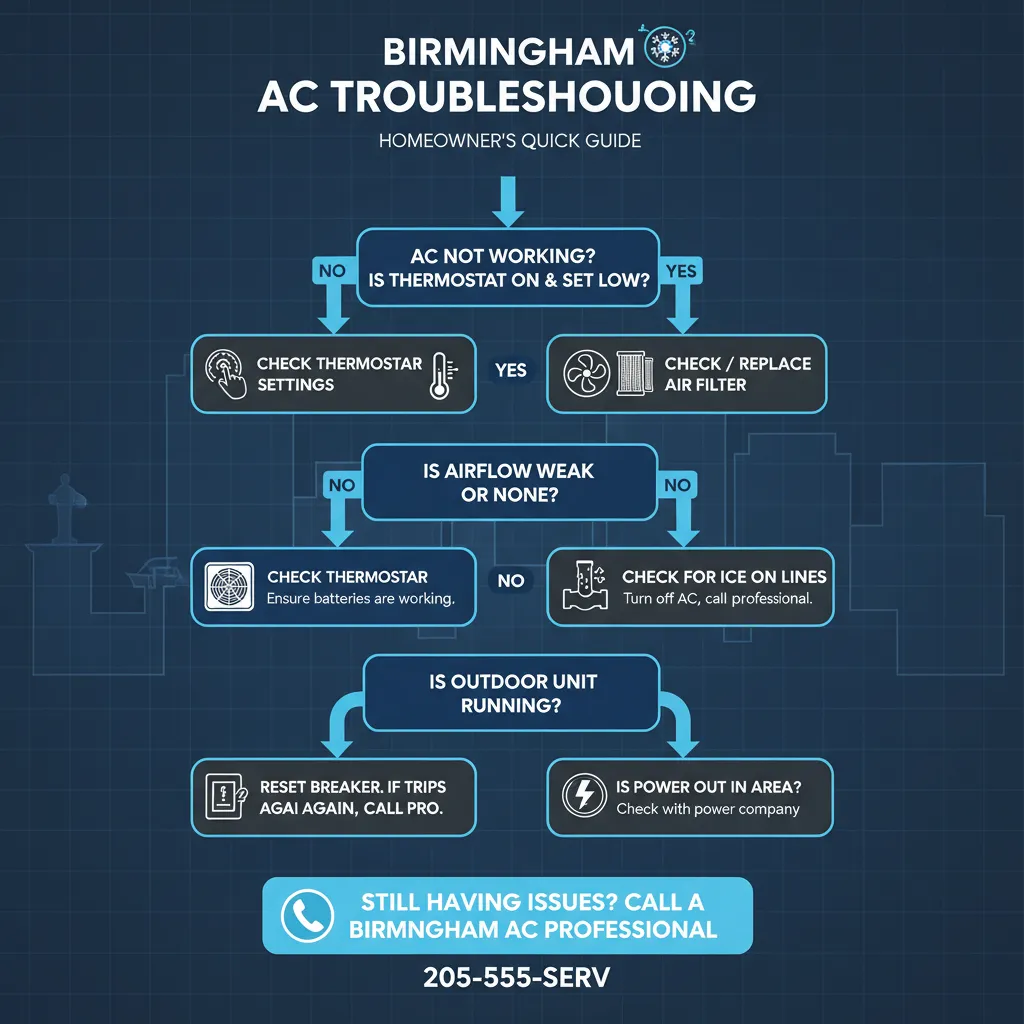
Share this infographic — afterhourshvacr.com
Tried Everything and AC is Still Blowing Warm?
Our licensed Birmingham technicians diagnose and fix the problem right. After-hours calls answered when other shops have closed.
call CALL NOW (205) 994-6402Ask for a written estimate before any work begins
Download Our Birmingham HVAC Homeowner Guide
Seasonal checklists, troubleshooting steps, and maintenance schedules built for Alabama's climate. Written by licensed HVAC technicians.
call Call (205) 994-6402Sources & Citations
EPA — Indoor Air Quality — Federal standards for indoor environmental quality and HVAC systems
U.S. Department of Energy — Air Conditioning — Energy efficiency standards and maintenance guidance
ASHRAE — American Society of Heating, Refrigerating and Air-Conditioning Engineers technical standards
ENERGY STAR — Heating & Cooling — Certified equipment ratings and efficiency benchmarks
NATE — North American Technician Excellence — HVAC technician certification standards
Alabama Board of Heating, Air Conditioning & Refrigeration Contractors — State licensing authority
About the After Hours HVACR Editorial Team
Our content is written and reviewed by Alabama-licensed HVAC technicians with NATE certification and EPA 608 Universal credentials. The After Hours HVACR team has decades of combined field experience diagnosing and repairing residential and commercial systems across Hoover, Vestavia Hills, Pelham, Homewood, and Mountain Brook. Every article reflects real-world troubleshooting knowledge from Birmingham's unique climate — not recycled advice from a national template.
Read Next
Keep going. These pair well with what you just read.
AC Freezing Up in Birmingham AL? Causes & Fixes
Ice on the indoor coil means a cause — not a fluke. Diagnose it right.
AC REPAIRAC Running But Not Cooling? Birmingham Fix Guide AfterHours HVACR
Air is moving but the house is not cooling. Run this checklist first.
AC REPAIRFrozen AC Line Set in Alabama: Emergency Diagnosis Guide
A frozen line set is a refrigerant warning. Read it correctly.
Related Resources for Birmingham Homeowners
How Much Does Emergency AC Repair Cost in Birmingham?
Complete 2026 pricing guide so you know what to expect.
Birmingham Summer HVAC Survival Guide
Monthly maintenance checklist to prevent AC problems before they start.
After Hours HVACR Emergency Services
After-hours AC repair across Birmingham. Licensed and insured.
Birmingham AC Repair Service Area
Serving all of Birmingham and 8 surrounding metro cities.