Heat Pump Trouble After Hours?
We're Up. We're Close.
After Hours HVACR services heat pump systems across the Birmingham metro — short-cycling, iced coils, reversing valve failures, and auxiliary strip diagnostics. Licensed Alabama technicians available 24/7. Call (205) 994-6402.
Heat pumps are an excellent choice for Alabama's climate — but they have unique failure modes that require technicians who understand how they work. We diagnose heat pump problems correctly the first time. Available 24/7 for emergency service.
call CALL (205) 994-6402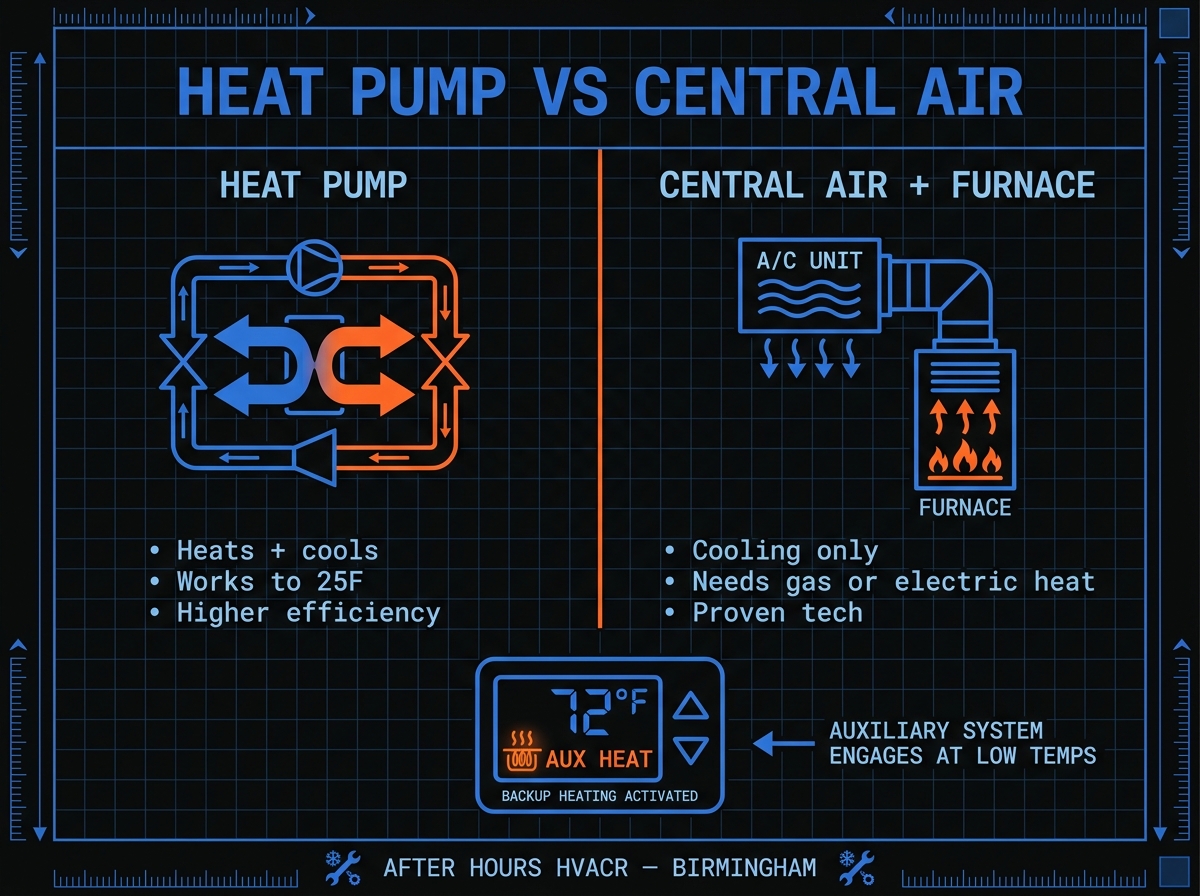
Heat Pump Service Across the Birmingham Metro
We run heat pump repair Birmingham AL all year, plus heat pump installation Birmingham AL and full heat pump replacement Birmingham AL when a 20-year-old condenser finally gives up. The same crew handles heat pump repair Hoover AL, heat pump service Hoover AL, heat pump installation Hoover AL, and heat pump replacement Hoover AL across Riverchase, Ross Bridge, and Bluff Park.
Homewood gets the same coverage: heat pump repair Homewood AL, heat pump service Homewood AL, heat pump installation Homewood AL, and heat pump replacement Homewood AL — including the historic-district homes where outdoor unit placement is tight.
Common Heat Pump Problems
Heat pump diagnostic reference. Sources: U.S. Dept. of Energy.
| Symptom | Likely Cause | Season | Urgency |
|---|---|---|---|
| Blows cold in heat mode | Stuck reversing valve, low refrigerant | Winter | High |
| Not cooling in summer | Capacitor, refrigerant leak, compressor | Summer | High |
| Runs constantly | Low refrigerant, dirty coil, undersized | Both | Medium |
| Ice on outdoor unit | Defrost board failure, low refrigerant | Winter | High |
| High electric bills | Heat strips running excessively, low charge | Winter | Medium |
The most common call in winter. Could be reversing valve failure, low refrigerant, defrost board issues, or auxiliary heat strips not engaging. Requires proper diagnosis to distinguish between these causes.
Heat pump not cooling is similar to a standard AC not cooling — refrigerant issues, capacitor failure, or compressor problems. We diagnose using refrigerant pressures and electrical testing.
A reversing valve failure can leave the heat pump stuck in either heating or cooling mode. In summer, a unit stuck in heating mode is an emergency. In winter, a unit stuck in cooling mode is dangerous.
Some frost on the outdoor unit in cold weather is normal. The unit frozen into a block of ice is not — this indicates a defrost system failure and the unit needs to be thawed and the defrost system repaired.
If your heat pump is running on electric heat strips more than it should, bills spike significantly. This can mean the system has insufficient refrigerant to heat effectively, or a control issue causing constant aux heat engagement.
Heat pump starts and stops frequently without completing a full cycle. Can be caused by a dirty filter, refrigerant issues, or control board problems. Short cycling increases wear on the compressor significantly.
How Heat Pumps Work in Alabama's Climate
A heat pump is a refrigeration system that runs in both directions. In cooling mode, it works exactly like a conventional AC — moving heat from inside your home to the outdoor air. In heating mode, the refrigerant cycle reverses, extracting heat energy from outdoor air and moving it inside.
This works because even cold air contains heat energy. At 40 degrees Fahrenheit, there's still substantial heat that a heat pump can extract. At 25 degrees, extraction efficiency decreases and the system needs help from electric resistance heat strips — the "auxiliary heat" or "emergency heat" on your thermostat.
Alabama's mild winters are well-suited to heat pump operation. Birmingham averages temperatures below 32 degrees for only about 60 nights per year, and temperatures below 20 degrees are rare. This means a properly functioning heat pump can handle the vast majority of heating days without needing to run the expensive electric heat strips.
The key phrase is "properly functioning." A heat pump with a slightly low refrigerant charge loses heating efficiency disproportionately. What works adequately in summer may become noticeably inadequate in winter. This is why we pay close attention to refrigerant charge on heat pump systems.
Heat Pump vs. Gas: What Makes Sense in Birmingham
This question comes up constantly. Here's a straightforward take:
If your home has natural gas service and you're replacing a gas furnace plus AC system, staying with gas heating plus an AC is often the simpler and more familiar choice. Gas heat is less affected by extreme cold, which matters during Birmingham's occasional 15-20 degree nights.
If your home is all-electric, a heat pump is dramatically better than electric resistance heat for winter heating efficiency. Heat pumps deliver 2-3 units of heat energy for every unit of electricity consumed — electric resistance heat delivers exactly 1 unit per unit consumed.
Modern cold-climate heat pumps can operate efficiently down to 0 degrees Fahrenheit, making the "heat pumps don't work in the cold" objection largely outdated for current equipment. For a detailed comparison specific to your home, call us.
See also: Heat Pump vs. Central Air: Which Is Right for Your Hoover Home?
Heat Pump FAQ
Are heat pumps good for Birmingham homes?
Yes. Alabama's climate is close to ideal for heat pump efficiency. Mild winters mean you get the full efficiency benefit with minimal reliance on backup heat strips. Warm summers where heat pumps run exactly like a conventional AC.
My heat pump is blowing cold air in winter — is it broken?
Not necessarily. If it just started, it may be in a defrost cycle — completely normal, lasts 5-10 minutes. If it consistently blows cool or room-temperature air when set to heat, that's a problem. Call us for diagnosis.
What does "auxiliary heat" mean on my thermostat?
Auxiliary heat is the electric heat strips that supplement the heat pump when outdoor temperatures drop low enough that the heat pump can't keep up alone. Some auxiliary heat activation in cold snaps is normal. Constant auxiliary heat in mild weather suggests a heat pump problem.
How long do heat pumps last in Alabama?
15-20 years with proper maintenance. Heat pumps run year-round as both heating and cooling systems, so they accumulate operating hours faster than separate heating and cooling systems. Annual maintenance matters more for heat pumps than for gas systems.
Do you install new heat pump systems?
Yes. We install heat pump systems sized for Alabama's climate. We'll assess your home, recommend appropriate equipment and efficiency levels, and install it correctly. See our installation page for the full process.