Storm Just Hit, AC Dead: Outdoor Unit Damage Assessment
The storm finally moved through. Your AC was running before, now it's not. You want to know what happened and what comes next. Here's how to assess it safely — and what to do before you call.
TL;DR
After a storm: (1) check for downed power lines before going outside — never approach a unit if a wire is near it; (2) photograph everything before you touch anything, including the data plate and surrounding debris; (3) don't run the system if there was a nearby lightning strike or impact damage — lightning damage often shows up hours later as catastrophic failure; (4) document for insurance with photos, dates, NOAA storm reports; (5) call a licensed tech for an inspection before resuming use if there's any visible damage or nearby lightning activity.
Storm damage assessment isn't a DIY job for anything beyond a visual look. Call for a licensed inspection before resuming use.
call (205) 994-64021. Safety First: Check Before You Approach
Before you walk outside to look at the AC, pause and check three things:
- Is the storm completely past? Not just paused. Active lightning is still a strike risk even after the rain stops. NOAA recommends 30 minutes after the last thunder before going outside.
- Are there downed power lines? Look out the window. Scan the yard, the driveway, and any trees. A wire on the ground — even one that looks dead — can be live and lethal. If you see a wire touching anything (your house, the AC, a fence, a tree), stay inside and call Alabama Power at 1-800-888-2726.
- Any active flooding around the unit? If the AC pad is submerged in standing water, don't approach until it drains. Don't touch any HVAC equipment that's been underwater — even after the water recedes, internal components may still be wet and energized.
Power Off Before Inspection
Before touching the unit, kill power at the outdoor disconnect (the gray box on the wall near the condenser) AND turn off the AC breaker inside. Two layers of safety. Storm-damaged equipment can have internal shorts that energize the cabinet itself.
2. Four Types of Storm Damage to HVAC
Alabama storms cause four different kinds of damage to outdoor units. Knowing which one you're dealing with helps you describe it accurately.
Lightning and electrical surge
The most dangerous because it's often invisible. A nearby strike (not necessarily a direct hit) can send a voltage surge through the power lines or even the earth that damages capacitors, contactors, control boards, compressor windings, and refrigerant lines. The unit might appear fine and even run for a while, then catastrophically fail.
Hail
Visible damage. Hail bends the aluminum fins around the outside of the condenser cabinet. Small hail makes a uniform pattern of dimples. Large hail leaves dents in the cabinet metal and broken fan blades or grille pieces. Fin damage restricts airflow and reduces efficiency. Severe fin damage warrants replacement.
Wind and debris impact
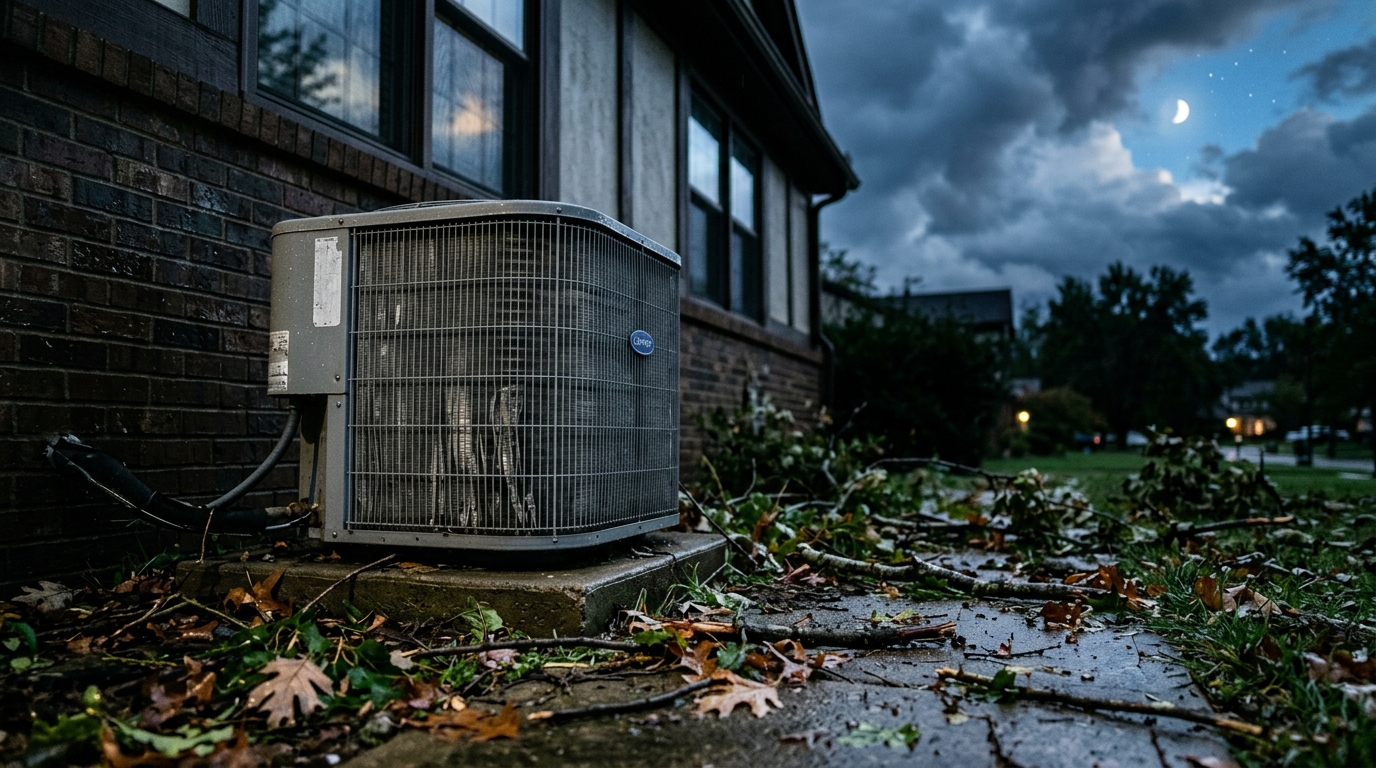
Tree branches, lawn furniture, kids' toys, roofing material thrown by wind. Impact damage can crack the fan, dent the cabinet, sever refrigerant lines, or knock the unit off its pad. A condenser tipped off its pad with refrigerant lines bent at sharp angles is a serious problem and means the system can't run until it's repositioned and inspected.
Water and flooding
Outdoor condensers are designed for rain — that's normal operation. The problem is flooding. If floodwater rises above the bottom of the cabinet and reaches the internal components, electrical and mechanical damage results. Submerged units typically need internal cleaning and component testing before reuse.
3. Visual Assessment Checklist
With power killed and the area clear, walk around the unit slowly with a flashlight. Look for:
Is the unit still level on its concrete pad? Or has it shifted, tipped, or moved? Refrigerant lines bent at sharp angles are a serious problem.
Any visible dents, punctures, or holes in the sheet-metal cabinet? Wind-thrown debris or hail can compromise the cabinet integrity.
Aluminum fins on the outside surfaces — uniform dimpling pattern (small hail), localized mashed areas (large hail or impact), or vertical lines (debris dragging).
Look down through the top grille. Is the fan blade intact and unbroken? Is the grille itself damaged or pushed in?
From outside, you can see the conduit and disconnect box. Look for severed, chewed, or burnt wires. Burnt smell coming from the disconnect is a clear sign of electrical damage.
The two copper lines coming out of the unit and going into the house. Any kinks, dents, breaks, or visible oil leaks (refrigerant carries oil; leaks are oily)?
What's around the unit that wasn't there yesterday? Branches, shingles, lawn furniture, insulation. Photograph everything in place before clearing.
4. When You Should NOT Run the System
Even if the system appears to start up after a storm, don't run it if:
- You heard a nearby lightning strike during the storm (loud crack with simultaneous flash, less than 1 second apart)
- The breaker tripped during the storm and now resets but the unit acts strange
- You see any visible damage to the cabinet, lines, wiring, or fan
- The unit is making new noises — humming, buzzing, grinding, or rattling that wasn't there before
- Floodwater reached the bottom of the cabinet at any point
- Any burning smell from the unit or the disconnect
- The thermostat shows error codes you've never seen
Running a damaged unit risks turning a $400 repair into a $4,000 compressor replacement or a $9,000 total system replacement. The scheduled delay for a tech inspection is cheap insurance.
If the indoor temperature is dangerous — vulnerable people, extreme heat — treat it like any other emergency. See our the evening emergency playbook for managing the wait.
5. Document for Insurance
Most Alabama homeowners policies cover sudden and accidental damage from storms, lightning, hail, and wind. Whether to file depends on damage vs. deductible math. Either way, document thoroughly — you might need it later.
Photos to take
- Wide shots from multiple angles showing the unit and surrounding area
- Close-ups of every piece of visible damage
- The data plate on the side of the unit (make, model, serial number, manufacture date)
- Debris in the position it landed in — tree branches, hail piles, fallen items
- Damage elsewhere on the property that supports the storm story (roof, fence, other items)
- Time-stamped photos — phone date/time matters
Records to keep
- NOAA storm report for your area (search the National Weather Service's storm events database for your date and ZIP)
- Service report from the licensed HVAC tech identifying the damage
- Original purchase receipt or installation paperwork if you have it
- Any prior maintenance records (proves the system was in working condition before)
When to file vs absorb
Honest math: if the damage repair will cost less than your deductible plus maybe $500, don't file — minor claims can affect future premiums. For a $400 capacitor on a $1,000 deductible, absorb it. For a $4,000 compressor replacement, file. For full system replacement after lightning damage, definitely file and consider getting a public adjuster involved.
6. What the Tech Will Check
When the tech arrives for a storm damage inspection, here's what a thorough assessment looks like:
- Full visual inspection of cabinet, fins, fan, lines, wiring
- Megohm test of compressor windings (catches lightning damage that's invisible)
- Capacitor capacitance measurement (surge damage often shows here)
- Contactor test under load
- Control board diagnostic and error code retrieval
- Refrigerant pressure check — high and low side
- Amp draw measurement on the compressor and fan motor
- Voltage check at the disconnect with the system running
- Inspection of the indoor air handler for related damage
A storm damage inspection takes 45-90 minutes if it's done right. If a tech shows up, glances at the unit for 10 minutes, and says "looks fine, run it," get a second opinion. Lightning damage missed today can mean total system failure in 60 days.
Storm just passed and your AC is acting weird? Get an inspection before running it.
Call (205) 994-64027. Preventing Future Storm Damage
Surge protection at the disconnect
A dedicated HVAC surge protector installed at the outdoor disconnect catches most surge events before they reach the unit. Modest cost installed. Pays for itself the first time a nearby strike hits the grid. Ask your HVAC tech about it at the next maintenance visit.
Whole-home surge protection
A whole-home surge protector at the main breaker panel protects all electronics, not just the AC. Modest cost installed by a licensed electrician. Good investment in lightning-prone Alabama.
Trim trees back
Branches that overhang the outdoor unit are the most common impact damage source. Keep at least 6 feet of clearance around the unit, with no overhanging branches that could fall in a wind event.
Hail protection
Properly designed hail guards exist for outdoor units — they protect the fins without restricting airflow during operation. Avoid solid covers, tarps, or plywood — those cause overheating and damage.
Annual maintenance
Annual spring maintenance catches degraded components that storm surges could push over the edge. A weak capacitor that survives normal use might fail catastrophically under storm-induced electrical stress. Catching it in April is preventive. See our maintenance options.
FAQ: Storm Damage to HVAC
Is it safe to go outside and look at my AC after a storm?
Only after the storm has fully passed and you've checked for downed power lines. Stay 30 feet from any wire on the ground. Don't approach if a wire is touching the AC or yard.
What should I photograph for insurance?
Wide shots of the area, close-ups of damage, the data plate, debris in place, time-stamped phone photos. Don't move debris before photographing — position tells the story.
Should I run my AC after a storm if it seems to be working?
Not if lightning was near or debris hit the unit. Lightning damage often shows up hours later as catastrophic failure. 5-minute tech inspection beats $4,000 compressor replacement.
What does hail damage on an AC unit look like?
Bent aluminum fins in a uniform dimpled pattern. Large hail dents the cabinet and can crack the fan blade. Severe fin damage restricts airflow and warrants insurance documentation.
Will homeowners insurance cover lightning damage?
Most Alabama policies cover lightning and electrical surge as sudden accidental damage. You need a licensed tech service report identifying the cause, photos, and storm documentation. Deductible applies.
How do I prevent storm damage to my AC?
Surge protector at the disconnect, trees trimmed back, properly designed hail protection. Whole-home surge protection at the breaker panel is also a good investment in Alabama.
After Hours HVACR — Birmingham Metro
Post-storm HVAC inspections across the Birmingham metro. Licensed Alabama technicians.
call Call (205) 994-6402Sources & Citations
National Weather Service — Lightning Safety — Federal lightning hazard guidance
NOAA Storm Events Database — Verifying storm activity for insurance claims
Alabama Power — Storm Safety — Downed line reporting (1-800-888-2726)
Insurance Information Institute — Homeowners Claims — Filing storm damage claims
ASHRAE — HVAC equipment service standards
About John — After Hours HVACR
John is an Alabama-licensed HVAC contractor with 35 years in the Birmingham metro market. EPA 608 Universal. He's run post-storm HVAC inspections after dozens of Alabama severe weather events since the late 1990s.