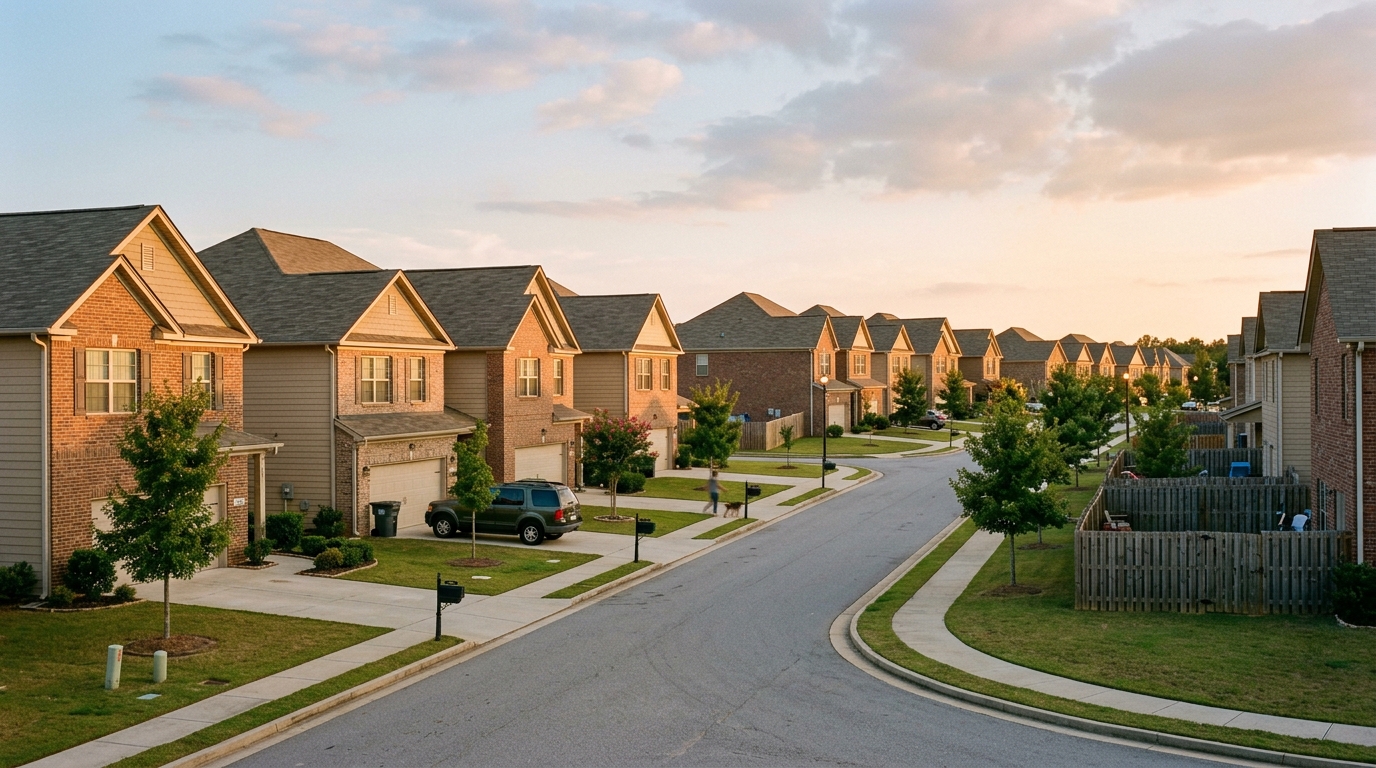
Four decades of growth.
Four generations of failing HVAC.
Emergency HVAC Service in Alabaster, Alabama.
Alabaster grew faster than almost any city in Shelby County. Every wave of construction dropped in a different generation of HVAC equipment. When one fails at midnight, After Hours HVACR heads south on I-65.
After Hours HVACR dispatches licensed Alabama HVAC technicians to all of Alabaster ZIP 35007, including Siluria, Weatherly, Forest Lakes, Kentwood, and the Thompson district subdivisions. Call (205) 994-6402 for 24-hour emergency service.
How Alabaster became Shelby County's fastest-growing city — and what that did to the HVAC stock.
Alabaster incorporated in 1953 around a limestone and gypsum mining economy — the name itself comes from the alabaster mineral found in local deposits. What followed over the next 70 years was one of the more dramatic suburban growth stories in Alabama, driven by I-65 access, Shelby County schools, and Birmingham commuters looking south. Each decade left a different fingerprint on the housing stock — and on every HVAC system inside those homes. (US Census, Shelby County growth data, 2020.)
Mining community anchors the Cahaba corridor
The Siluria Historic District represents the oldest settled portion of what would become Alabaster — a limestone and gypsum mining community along the Cahaba River corridor, predating incorporation by 70 years. Homes from this era that survive have been retrofitted with central HVAC systems at least twice. Any original equipment is long gone. What remains is often aging retrofit ductwork that does not match modern equipment specifications.
Small town, big Shelby County ambitions
Alabaster incorporated in 1953 with a modest population centered on Saginaw and the Siluria area. The I-65 corridor did not yet exist as a growth engine — that would come later. Through the 1960s and 1970s, the city grew slowly as a bedroom community for Birmingham workers who preferred Shelby County. HVAC from this era is universally replaced; what matters now is the ductwork those original installs left behind.
I-65 opens the floodgates south
The 1990s were Alabaster's first major growth wave. Builders platted ranch-style subdivisions across the I-65 and US-31 corridors — affordable, three-bedroom homes marketed to Birmingham commuters choosing Shelby County schools over Jefferson County options. The HVAC equipment installed in these homes was builder-grade 10 SEER — the DOE minimum at the time. Those units are now 25 to 35 years old. Compressor failure rates climb steeply past year 20, and capacitors in Alabama's climate typically fail between years 8 and 15. These homes are the dominant source of after-hours emergency calls in Alabaster today.
Weatherly, Forest Lakes, Kentwood take shape
The 2000s brought a more deliberate wave of development. Master-planned communities with amenity centers, lake features, and neighborhood covenants attracted a higher-income buyer who expected better equipment. The DOE raised the Southeast SEER minimum to 13 in 2006. Builders in communities like Weatherly and Forest Lakes installed Carrier, Trane, and Rheem 13 SEER systems — equipment that is now 15 to 20 years old and entering the primary failure window for outdoor fan motors, contactors, and compressors. These homes generate a growing share of Alabaster's service call mix.
Thompson High School district becomes the draw
By the 2010s, Thompson High School's reputation drove purchasing decisions as much as price. The EPA tightened Southeast SEER minimums to 14 in 2015, and builders installing post-2015 equipment in Alabaster's infill lots and new corridor communities used larger Goodman, American Standard, and Bryant systems. These units have another 5 to 10 years of life on core components, but they are not immune to capacitor failure, refrigerant loss, or the high-humidity latent load challenges that the Cahaba River corridor brings to Alabaster homes.
Thompson district: Alabama's fastest-growing school population
The 2020 US Census counted 33,284 residents — more than double Alabaster's 1990 population. New construction along the I-65 corridor and toward the Calera boundary now defaults to variable-speed heat pumps and inverter-driven compressors, reflecting the post-2023 EPA SEER2 minimum standards for the Southeast region. The Thompson High School district serves one of the fastest-growing school populations in Alabama, according to Alabama Department of Education data. Growth shows no sign of slowing, and the equipment mix is now wider than at any point in Alabaster's history.
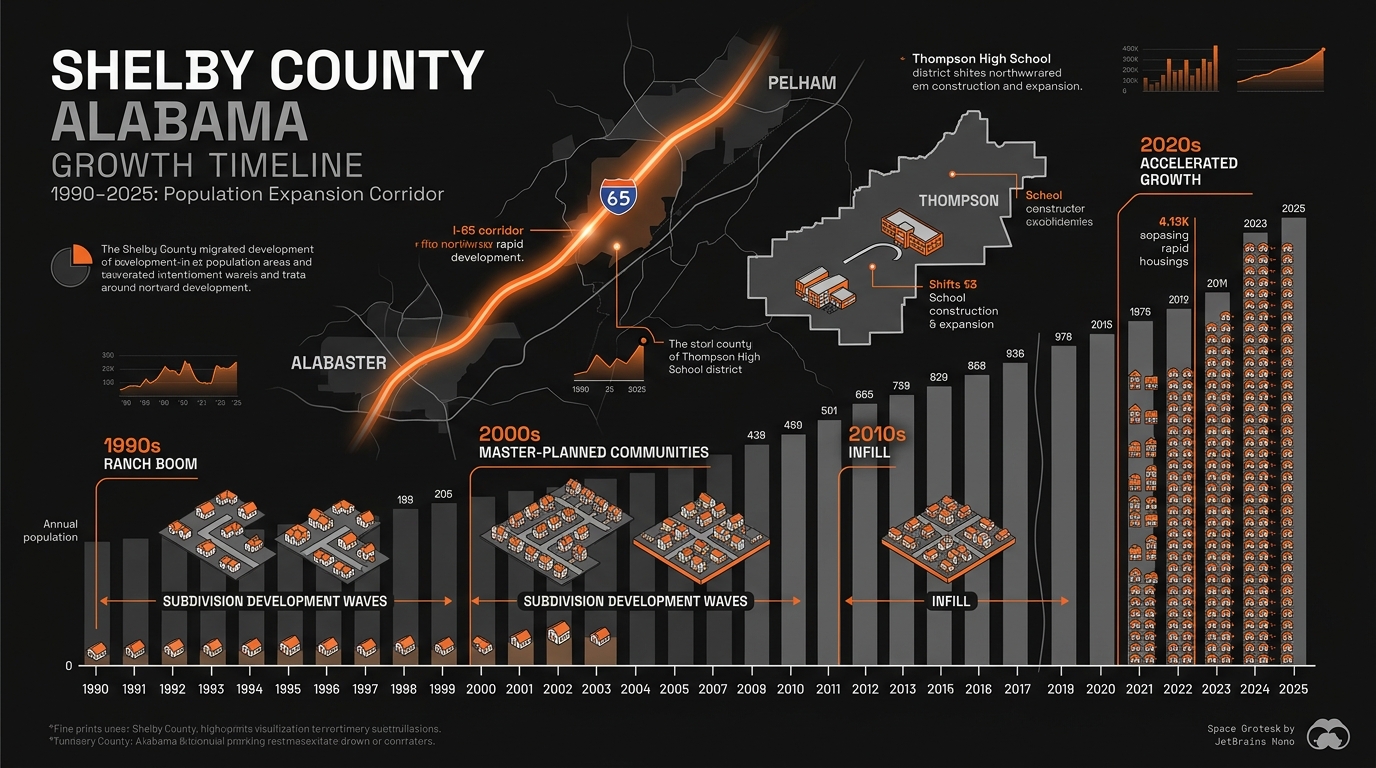
Four growth waves. Four HVAC generations. Each decade left different equipment in the walls — and a different failure timeline on the horizon.
Alabaster ZIP 35007, covered.
Alabaster operates under a single ZIP code — 35007 — that spans the city from the Siluria Historic District in the north through the I-65 growth corridor toward Calera in the south. Dispatch treats every street in that footprint the same: 24-hour emergency response, licensed Alabama HVAC technicians, written estimates before work begins.
All of Alabaster
Siluria Historic District · Saginaw · Weatherly · Forest Lakes · Kentwood · Navajo Hills · Mission Hills · Oakland Park · I-65 corridor subdivisions · Thompson district neighborhoods
Adjacent Shelby County coverage
Pelham (35124) · Helena (35080) · Calera (35040) — covered as part of the south Shelby County dispatch zone extending from our Hoover headquarters
2090 Columbiana Rd → Alabaster
South on I-65 or US-31. Straight shot, no mountain crossings. On-call technicians dispatch directly — not through a regional routing center.
Four growth waves, four HVAC generations. Which fails first, and why.
Federal SEER minimums changed in 1993, 2006, 2015, and 2023. Every builder in Alabaster installed whatever the current minimum allowed. The equipment in your walls reflects which wave your home was built in — and that determines what is most likely to fail, and when. (DOE Energy Efficiency Standards for Residential HVAC Equipment; EPA SEER2 transition 2023.)
The ranch-era systems. Now 25–35 years old.
Builder-grade 10 SEER condensing units from Goodman, Rheem, and Carrier were the default in Alabaster's first subdivision wave. The DOE did not mandate higher efficiency in the Southeast until 2006. These systems are now operating 10 to 15 years past their design life. Compressors in this era used older scroll and reciprocating designs with shorter life expectancies than modern units. Capacitors, contactors, and outdoor fan motors have usually been replaced at least once — sometimes twice. The compressor is now the primary failure point, and compressor replacement on a 30-year-old system is rarely cost-effective.
Weatherly and Forest Lakes era. Now 15–20 years old.
The 2000s master-planned communities installed higher-tier equipment: Carrier 13 SEER two-stage units, Trane XR series, Rheem classic series. These systems were better specified than the ranch-era units, but 15 to 20 years in Alabama's climate takes a measurable toll. Outdoor fan motors in two-stage units carry more electronic load than single-stage units and fail at higher rates in high-humidity environments. Contactor pitting from Alabama's afternoon thunderstorm voltage fluctuations is common in this era. The run capacitor is still the most likely first call, but the outdoor fan motor and metering device follow closely.
Thompson district infill. Now 8–12 years old.
The EPA's 2015 Southeast minimum of 14 SEER pushed builders toward Goodman, American Standard, and Bryant as primary brands in this era — all solid mid-tier equipment. At 8 to 12 years old, these systems are past the early-warranty period and entering their first significant service phase. Capacitors and contactors are the primary failure mode at this age. Refrigerant leaks at factory-brazed joints begin appearing around year 8, particularly in systems with copper-to-aluminum connections common in post-2010 coil manufacturing. Blower motor wear and filter-access panel seal failures contribute to indoor air quality complaints more often than mechanical failures at this age.
I-65 corridor new construction. Under 5 years old.
New Alabaster construction along the I-65 growth corridor defaults to variable-speed heat pumps with inverter-driven compressors — the post-2023 SEER2 standard for the Southeast. These systems are more reliable in steady-state operation, but they introduce new failure modes: communicating thermostat wiring errors, variable-speed board faults, and refrigerant charge deviations from factory specification that do not manifest as obvious failures until the system runs at partial load for an extended period. Builder commissioning errors are the dominant call driver in the first 3 years. After year 5, defrost board and reversing valve issues begin appearing in Alabama's variable winter conditions.
Six Alabaster neighborhoods, six HVAC profiles.
The Shelby County growth story played out differently in every corner of Alabaster. Build era, builder, equipment brand, and proximity to the Cahaba River all shape what a service call looks like at a specific address.
Siluria Historic District
Alabaster's original settlement — a limestone and gypsum mining community along the Cahaba River. Homes here have been retrofitted with central HVAC at least twice. Original cast-iron ductwork or no ductwork at all is common in the oldest structures. Proximity to the Cahaba River means elevated latent loads and higher humidity stress on evaporator coils and drain systems. Every service call here is its own puzzle.
Saginaw
Saginaw sits in the mid-century settled band between Siluria and Alabaster's 1990s expansion zones. Homes here are predominantly 1960s and 1970s construction with retrofit central air — often installed on undersized ductwork designed for window units. The equipment installed in the 1990s and 2000s as upgrades is now in the primary failure window. Goodman and Rheem are the dominant brands from those installation waves.
Weatherly
Weatherly is one of Alabaster's signature 2000s master-planned communities — amenity center, neighborhood covenants, larger lots. Builder specification here ran to Carrier and Trane 13 SEER units. At 15 to 20 years old, Weatherly systems are in the primary failure window for outdoor fan motors, contactors, and metering devices. The community's east-facing orientation means afternoon shade on most equipment pads, which extends capacitor life slightly compared to south-facing installations elsewhere in Alabaster.
Forest Lakes
Forest Lakes features a namesake lake feature that elevates local humidity in adjacent homes — similar to the Cahaba corridor effect but concentrated in a smaller footprint. Homes near the lake see higher latent loads and faster evaporator coil fouling than comparable-age homes in higher-elevation Alabaster sections. Rheem and Trane are the dominant brands from the 2000s build wave. Drain pan overflow calls are more common here than anywhere else in Alabaster in summer months.
Kentwood
Kentwood sits in the heart of the Thompson High School district and reflects the transition from 2000s master-planned to 2010s infill construction. The neighborhood has a mixed equipment inventory — some 13 SEER 2000s-era Carrier and Bryant units alongside newer 14 SEER Goodman and American Standard installs from the 2010s. Diagnostic calls here often involve systems that are newer than they look because of mid-decade replacements in homes that retained their original 2000s ductwork.
Navajo Hills / Mission Hills
Navajo Hills and Mission Hills span a wider range of construction eras than most Alabaster neighborhoods — 1980s and 1990s ranch homes intermixed with 2000s infill and occasional recent construction. The brand mix is the widest in Alabaster: Trane, Carrier, Lennox, Goodman, Rheem, American Standard, and Bryant all appear within a few blocks of each other. Technicians servicing this area carry the broadest parts inventory of any Alabaster dispatch. Lennox is the most common brand requiring proprietary components not stocked universally.
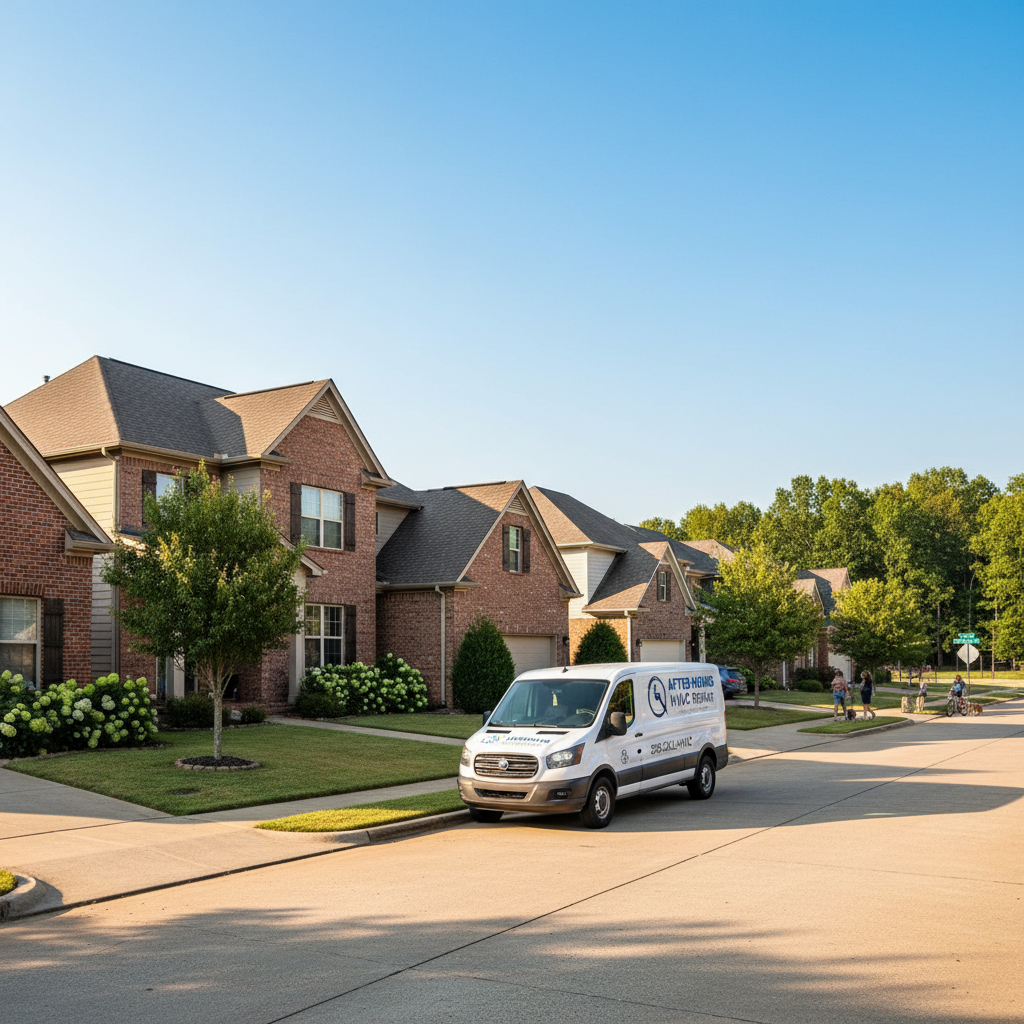
What an Alabaster service call actually looks like.
Alabaster's 1990s ranch homes sit on relatively flat lots with equipment pads on the south or west side — maximum sun exposure for the condenser, which accelerates capacitor degradation faster than the manufacturer's published lifespan in Alabama's climate. NOAA data for Shelby County shows average summer high temperatures above 92°F across multiple months, with ambient temperatures at a south-facing equipment pad easily running 10 to 15 degrees above the air-temperature reading.
When a 1990s Alabaster system stops cooling at 10 PM in July, the condenser is usually the first place to look. A failed run capacitor is the most common finding — replaceable in under an hour with the correct MFD-rated part. A failed compressor on a 30-year-old unit is a different conversation that starts with a written estimate and an honest assessment of system age.
We run a complete diagnostic before recommending any repair. In a 30-year-old system, a single component failure is often accompanied by secondary components already at end of life. The technician's job is to tell you what is actually happening — not just what is visibly broken today.
Alabaster-specific questions.
Where is After Hours HVACR headquartered relative to Alabaster?
After Hours HVACR is headquartered at 2090 Columbiana Rd, Suite 100 in Hoover, Alabama 35216. Alabaster sits directly south along I-65 — roughly 12 miles from our dispatch point. When a call comes in from Weatherly, Forest Lakes, or the Siluria Historic District, the on-call technician heads south on I-65 or US-31 depending on the exact address. The route is a straight shot with no mountain crossings or traffic bottlenecks outside of morning commute hours. Dispatch covers all of ZIP 35007 and the surrounding Shelby County service corridor 24 hours a day, 365 days a year.
Which Alabaster ZIP codes does After Hours HVACR cover?
Alabaster is served by ZIP code 35007, which covers the city proper from the Siluria Historic District in the north through Weatherly, Forest Lakes, Kentwood, Navajo Hills, Mission Hills, Oakland Park, and the newer I-65 corridor subdivisions toward the Calera boundary in the south. Coverage extends into adjacent Shelby County communities including portions of Pelham to the north, Helena to the west, and the Calera boundary to the south as part of our Shelby County dispatch zone. Every address within Alabaster city limits is covered, including the unincorporated Shelby County pockets that share Alabaster mailing addresses and school district boundaries.
How do Alabaster's four growth waves create four different HVAC realities?
Alabaster's housing stock reflects four distinct build eras, each governed by different federal SEER efficiency minimums and builder practices. Pre-1990 homes in the Siluria Historic District and Saginaw area often have equipment that has already been replaced once or twice — original systems are largely gone. The 1990s ranch wave installed builder-grade 10 SEER units that are now 25 to 35 years old and failing at high rates, per DOE equipment lifecycle data. The 2000s master-planned era brought 13 SEER minimums and larger Carrier and Trane systems. Post-2015 EPA mandates pushed the Southeast minimum to 14 SEER. The 2020s variable-speed heat pump wave is only now entering service. Each era fails differently, at different intervals, and requires different diagnostic approaches.
Why are 1990s Alabaster ranches failing faster than 2000s master-planned community systems?
The 1990s ranch subdivisions built along Alabaster's first growth corridor installed predominantly 10 SEER builder-grade condensing units — equipment that the DOE's efficiency standards allowed until SEER minimums rose to 13 in 2006. Those units are now 25 to 35 years old, well beyond the 15 to 20 year design life of compressors and capacitors. In contrast, 2000s master-planned communities like Weatherly and portions of Forest Lakes installed 13 SEER and 14 SEER equipment that is only 15 to 20 years old — approaching but not yet past the steep portion of the failure curve. The 1990s ranches also tend to have original ductwork with unsealed joints, which compounds system stress and accelerates component wear beyond age alone.
Does the Thompson High School district's growth affect HVAC service demand?
Thompson High School serves one of the fastest-growing school populations in Alabama, according to Alabama Department of Education enrollment data, which reflects Alabaster's consistent population growth from under 15,000 in 1990 to 33,284 in the 2020 US Census — more than doubling in 30 years. That growth means a continuous stream of new construction alongside aging 1990s and 2000s housing stock, creating a wide equipment age spread across the district footprint. New families moving into newer I-65 corridor subdivisions have high-efficiency systems under warranty. Families in original Thompson district neighborhoods are dealing with aging 1990s equipment. Both call for emergency service — just for different reasons.
What are the most common after-hours failures in Alabaster?
Run capacitor failure is the most common summer emergency call in Alabaster, consistent with HVAC failure data across Alabama's climate zone 3. Alabama's direct sun on south and west-facing equipment pads stresses capacitors beyond manufacturer ratings, particularly in the aging 1990s Goodman, Rheem, and Carrier units common to Alabaster's ranch-era subdivisions. Contactor burnout, refrigerant loss at factory-brazed joints in older coils, and blower motor seizures follow in frequency. In winter, the dominant calls shift to heat pump defrost-board faults — particularly in Alabaster's newer construction where heat pumps replaced gas furnaces as the default — and ignitor failures in the older gas furnace stock found in Siluria and Saginaw-area homes.
How does the Cahaba River affect humidity in Alabaster homes?
The Cahaba River corridor runs through the western portion of Alabaster, and its riparian zone contributes to elevated relative humidity levels in homes near the floodplain during summer months. NOAA Climate Normal data for the Birmingham-Shelby County area shows average July dew points above 68°F, with valley corridors running slightly higher. Homes within a half-mile of the Cahaba River or its tributaries consistently show higher latent loads on their HVAC systems — meaning the cooling equipment must remove more moisture per hour than a system in the higher-elevation Mission Hills or Kentwood sections of Alabaster. This translates to longer run times, faster capacitor and compressor wear, and elevated indoor humidity complaints even when the thermostat setpoint is reached.
Do 2020s new-construction Alabaster homes have better HVAC reliability?
Generally yes, but with caveats. The post-2023 EPA SEER2 minimum standards pushed new residential systems in the Southeast to a minimum 15 SEER2, and most new Alabaster construction along the I-65 growth corridor installs variable-speed heat pumps with two-stage or inverter compressors. These systems are more efficient and run longer low-speed cycles rather than short high-stress bursts, which extends compressor life. However, new construction brings its own failure mode: commissioning errors, refrigerant charge variations at the factory, and builder-grade thermostat wiring that does not take full advantage of variable-speed staging. The first 2 to 3 years of a new system's life see a distinct set of issues that differ entirely from the aging-component failures in the 1990s and 2000s stock.
HVAC emergency in Alabaster? Call now.
Whether your system is a 1990s ranch-era unit or a 2020s variable-speed install, licensed Alabama technicians dispatch from Hoover south on I-65. Written estimates before any work begins.
call (205) 994-6402