
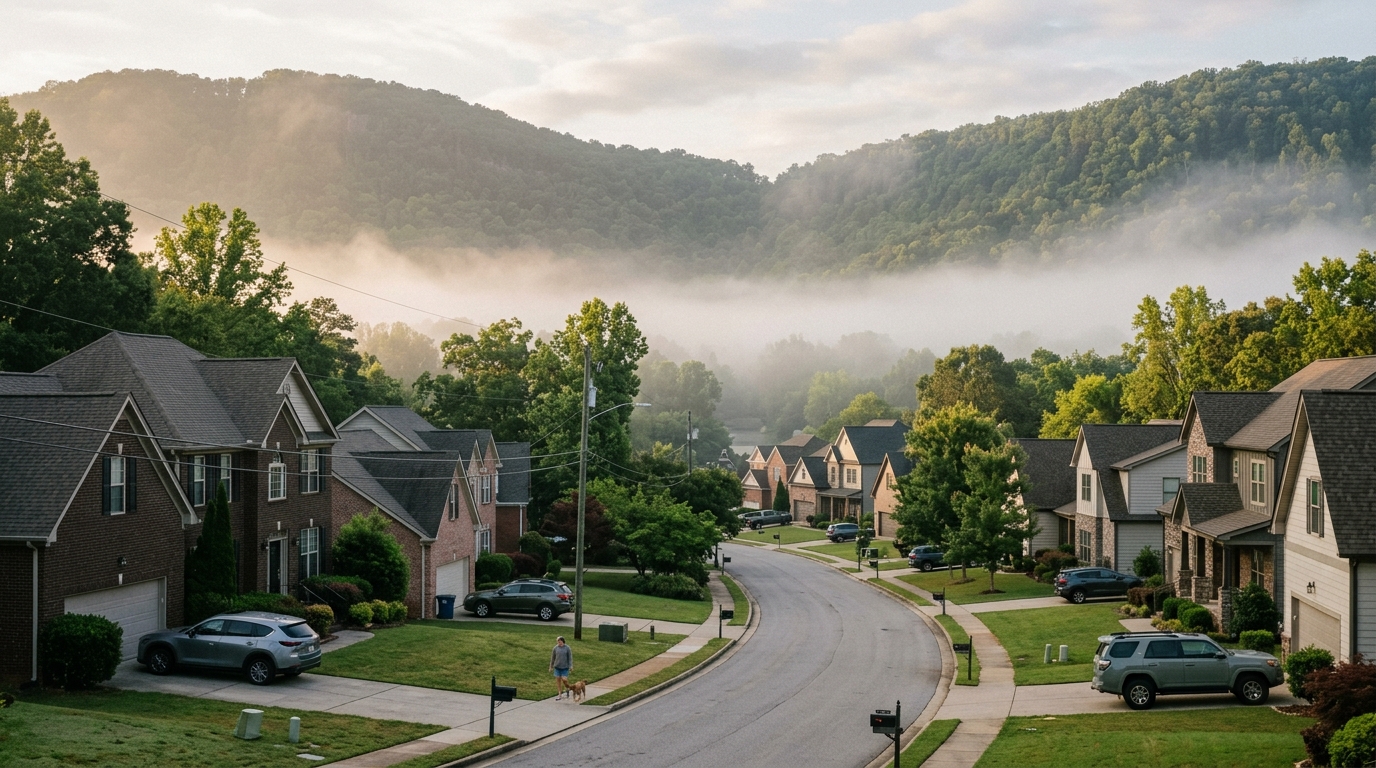
Valley floor humidity
runs 15–25% higher
than the ridge.
Emergency air conditioner repair near me — Pelham, Alabama.
Pelham sits in the valley east of Oak Mountain State Park. Morning fog, overnight condensation, and Cahaba River proximity create HVAC demands that standard service schedules don't account for. We do.
After Hours HVACR dispatches to all Pelham ZIP codes — 35124 and 35043 — 24 hours a day. Valley-floor humidity runs 15–25% higher than ridgetop. Oak Mountain terrain and Cahaba River proximity create unique HVAC demands. Licensed Alabama techs. Call (205) 994-6402.
Pelham's valley geography makes humidity a different problem than anywhere else in the Birmingham metro.
Most Alabama cities deal with summer humidity. Pelham deals with terrain-amplified humidity — and the difference matters for every HVAC system inside city limits.
Overnight relative humidity on the valley floor east of Oak Mountain State Park during summer months. NOAA local climatological data for Shelby County.
Overnight relative humidity at Double Oak Mountain ridgetop elevations — 1,260 feet above sea level per Alabama State Parks records. The 25-point gap drives very different HVAC behavior.
Valley-floor RH excess over ridgetop on summer mornings — the terrain factor that determines condensate load, drain frequency, and coil maintenance intervals.
Why the valley floor traps humidity
Pelham's geography sits in the valley east of Oak Mountain State Park. The ridgeline of Double Oak Mountain — reaching 1,260 feet according to Alabama State Parks records — acts as a terrain barrier that traps Gulf moisture on the valley side. Each night, dense cool air from the forested upper slopes drains downhill into the valley floor, dropping local temperatures 5 to 8 degrees below ridgetop readings by early morning. That temperature inversion holds moisture at ground level, producing the morning fog pockets visible across Pelham's low-lying neighborhoods and the Cahaba River corridor. For HVAC systems, this means evaporator coils see sustained overnight moisture loads that far exceed what manufacturer service intervals are built around. A condensate drain that would last a full season in drier terrain may clog in Pelham within weeks during peak summer, consistent with NOAA valley-fog documentation for north-central Alabama drainage basins.
What morning fog means for your equipment
The morning fog pockets Pelham residents see across the valley floor are visible evidence of the same moisture that is simultaneously loading the evaporator coil inside the air handler. When outdoor humidity approaches or exceeds 70 percent at night — common in valley-floor Pelham from May through September — the coil is working harder than its design baseline assumes. Condensate volume increases, the drain pan fills faster, algae and biofilm establish more aggressively in the drain line, and the float switch trips the system off more frequently. An overnight system shutdown that a homeowner discovers at 6 a.m. in a warming house is almost always a flooded drain pan in valley Pelham — not a compressor failure. Knowing the terrain tells us what component to check first, which means faster resolution and fewer wasted diagnostic steps. Trane, Carrier, Rheem, Lennox, Goodman, American Standard, and Bryant systems all behave the same way in this environment.
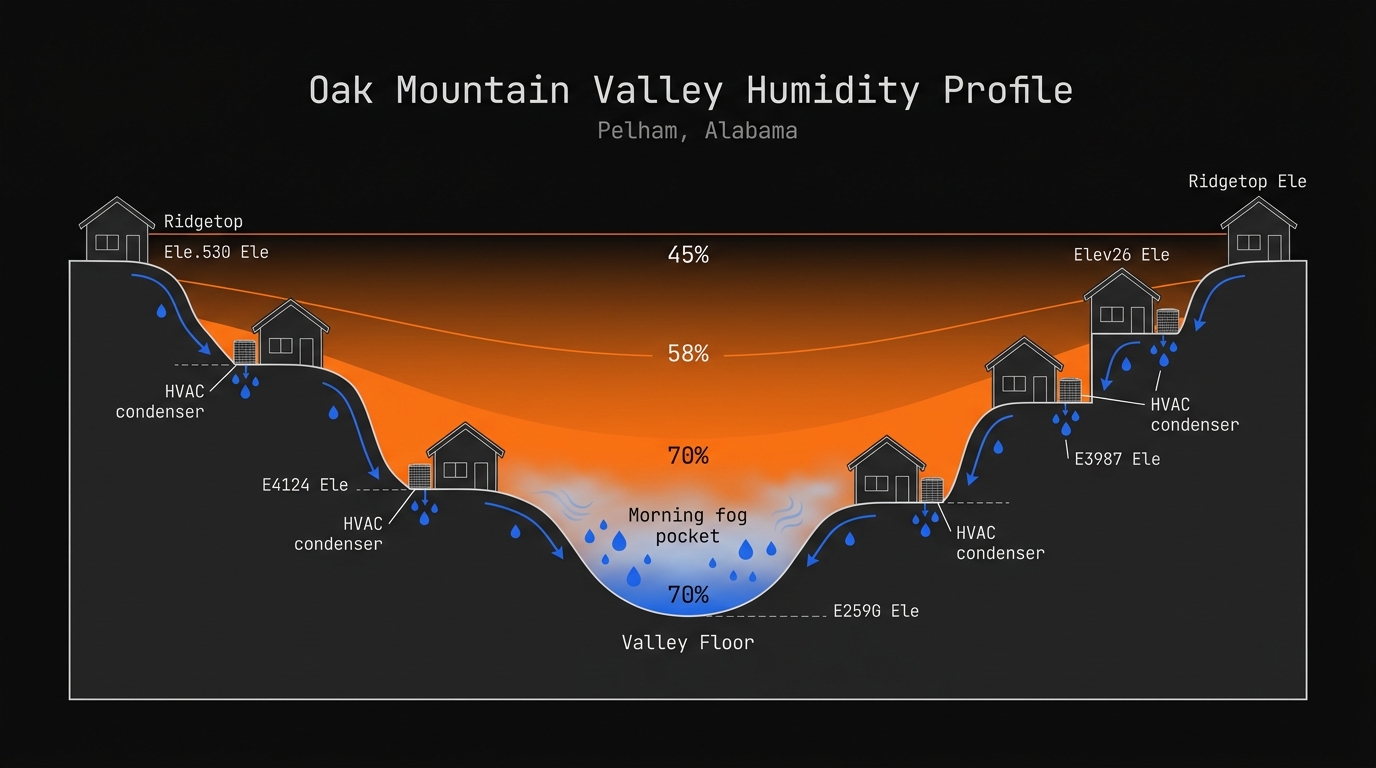
From Double Oak Mountain at 1,260 ft to the Cahaba River corridor below 600 ft — the humidity gradient that separates Pelham's two HVAC realities. Source: NOAA surface observation, Alabama State Parks elevation data.
Both Pelham ZIPs, fully covered.
Pelham operates under two ZIP codes — one primary, one shared with Helena on the southern edge. Both receive identical dispatch priority from our Hoover headquarters via I-65. No secondary service tier, no added wait for the Helena-border neighborhoods.
Pelham proper — Chandalar, Oak Mountain Estates, Indian Springs, Pelham Park, Valley Station, Sunset Lakes, I-65 commercial corridor. US Census Bureau 2020 primary Pelham ZIP.
Southern Pelham fringe shared with Helena. Low-lying Cahaba River corridor neighborhoods, highest valley-humidity exposure in the city. Same dispatch response as 35124.
Coverage extends into neighboring Alabaster and Helena as part of the Birmingham metro dispatch. Call with your address and we confirm coverage before routing a technician.
Valley pockets vs. ridge overlooks: two different HVAC realities within Pelham city limits.
Two homes a half-mile apart in Pelham can present completely different service calls — not because of equipment brand or age, but because of where they sit on the terrain. The valley floor and the ridge are two distinct HVAC environments wearing the same city's name.
Crawl-space mildew and drain overflow territory
Valley-floor homes in Pelham share three HVAC problems that terrain geography drives rather than equipment age. First: crawl-space mildew. Without complete vapor barrier encapsulation, ground moisture from the valley floor enters the subfloor cavity and raises indoor humidity above the system's design assumption. Trane, Carrier, Rheem, Lennox, and Goodman systems alike will run longer and dehumidify harder when the crawl space is open to valley-floor ground vapor. Second: condensate drain overflow. Valley-floor coils produce more condensate per operating hour than ridge coils running the same system at the same thermostat setpoint. A standard drain that clears a full season on the ridge may clog within weeks in the valley. Oversized drain pans and secondary float switches are not optional upgrades here — they are maintenance-tier requirements for valley-floor homes, not luxuries. Third: overnight coil frost risk. When valley air drops into the low 60s by 4 a.m. and the system is still running, low ambient temperature combined with a partially restricted airflow path can freeze the evaporator coil solid before dawn.
- — Drain pan: inspect monthly May–September
- — Crawl-space vapor barrier: mandatory for valley-floor homes
- — Secondary float switch: strongly indicated
- — Coil cleaning: seasonal minimum, not annual
Wind exposure and capacitor stress territory
Ridge-adjacent and higher-elevation Pelham neighborhoods — the Oak Mountain Estates lots that back to the park, the hillside sections of Chandalar, and newer infill on east-facing slopes — run drier and cooler than the valley floor. Valley-floor moisture problems are less severe here. Instead, the dominant failure modes shift. Wind exposure at elevation accelerates outdoor unit vibration fatigue — connection screws, refrigerant line clamps, and outdoor fan blade balance drift faster on elevated, exposed pads. The direct afternoon sun on south-facing ridge homes — without the valley's tree canopy and fog diffusion — runs outdoor condenser temperatures higher during peak load hours, which degrades run capacitors faster than manufacturer lifespan ratings assume. Alabama power companies' transmission voltage variability during summer afternoon peak demand also stresses contactors on ridge homes that sit at the end of distribution lines. Bryant, American Standard, and Goodman systems installed in 2000s-era ridge homes are entering this failure window now.
- — Run capacitor: inspect annually, replace proactively at year 7
- — Contactor: check burn pitting each season
- — Line connections: torque-check after ice storm seasons
- — Outdoor coil: clear debris after Oak Mountain wind events
Rural-edge Pelham: different access, different equipment mix
The eastern and southern margins of Pelham — particularly the low-density lots near Oak Mountain State Park's boundary and the Cahaba River corridor — mix rural-era housing stock with newer infill. Rural-edge homes built in the 1970s and 1980s along lateral streets often have propane furnaces and window-unit AC that was later supplemented with central systems added in the 1990s. Mixed systems of this kind — a Rheem split system added over original propane heat — create diagnostic complexity that brand-specific technicians miss. Our technicians carry multi-brand diagnostic tools and are trained on mixed-fuel homes. Suburban development infill built after 2005 along the same roads runs predominantly Goodman, American Standard, and Bryant heat pumps installed to current Alabama Licensing Board standards. Knowing both equipment generations is the difference between a one-trip repair and a multi-call diagnostic process.
Six Pelham neighborhoods, six HVAC profiles.
Pelham's terrain, build era, and proximity to Oak Mountain State Park and the Cahaba River creates distinct HVAC failure patterns by neighborhood. Knowing where you live tells us what to expect before the truck rolls.
Chandalar
Pelham's oldest established neighborhood. 1970s ranch and split-level homes with original or second-generation ductwork, often undersized for modern equipment. Crawl spaces without complete vapor barriers expose subfloors to valley-floor ground moisture directly. Condensate drain clog calls spike here every June. Trane and Carrier systems from the late 1990s replacement wave are reaching compressor end-of-life now. Duct leakage in original fiberglass board systems can approach 30 percent, per DOE duct research for homes of this era.
Oak Mountain Estates
Backs up to Oak Mountain State Park on the eastern ridge. Higher elevation than Chandalar, drier air profile, but wind exposure from the ridge is more significant. Outdoor units show accelerated vibration wear on refrigerant line clamps and fan blade fatigue. Rheem and Lennox systems from the 2000s build wave are mid-life. Dual-zone systems are more common here than elsewhere in Pelham, so damper and zone-board diagnostics appear in the call mix.
Helena Border / Valley Station
Southernmost Pelham, shared ZIP with Helena. Lowest elevation, closest Cahaba River proximity, highest valley-humidity exposure in the entire city. Condensate drain issues and crawl-space mildew dominate the call type. Homes here need drain-line cleaning on a May–August schedule rather than annual. Builder mix is wide — Goodman, American Standard, and Rheem lead depending on build decade.
Pelham Park
Mid-Pelham residential along the I-65 spine. 1990s-era subdivision homes with builder-grade Carrier and Rheem equipment now 25–30 years into their lifespan. Capacitor and contactor failures are the top summer call type. I-65 road noise causes homeowners to delay calling on systems that announce themselves with sound — by the time we arrive, the failure has often progressed further than an early-stage repair would have required.
Sunset Lakes
Newer infill construction around Sunset Lakes, built 2000–2015. More recent Goodman, Bryant, and American Standard equipment with 5–10 years before major failure windows. Lake-adjacent lots get elevated humidity exposure similar to the valley floor — seasonal coil and drain inspection is warranted even on newer systems near open water. Algae growth in drain pans is the most common call for this age of equipment in this location.
Indian Springs
Rural-character lots east of the park boundary, mixing 1970s original homes with 1990s–2000s infill. Some properties retain original propane heat supplemented by later central AC additions — mixed-system diagnostics require a broader parts inventory. Lot sizes are larger, canopy cover reduces direct sun on outdoor units, but rural road access means longer drive time than central Pelham. Rheem and Trane dominate by brand in this area based on local installation records.
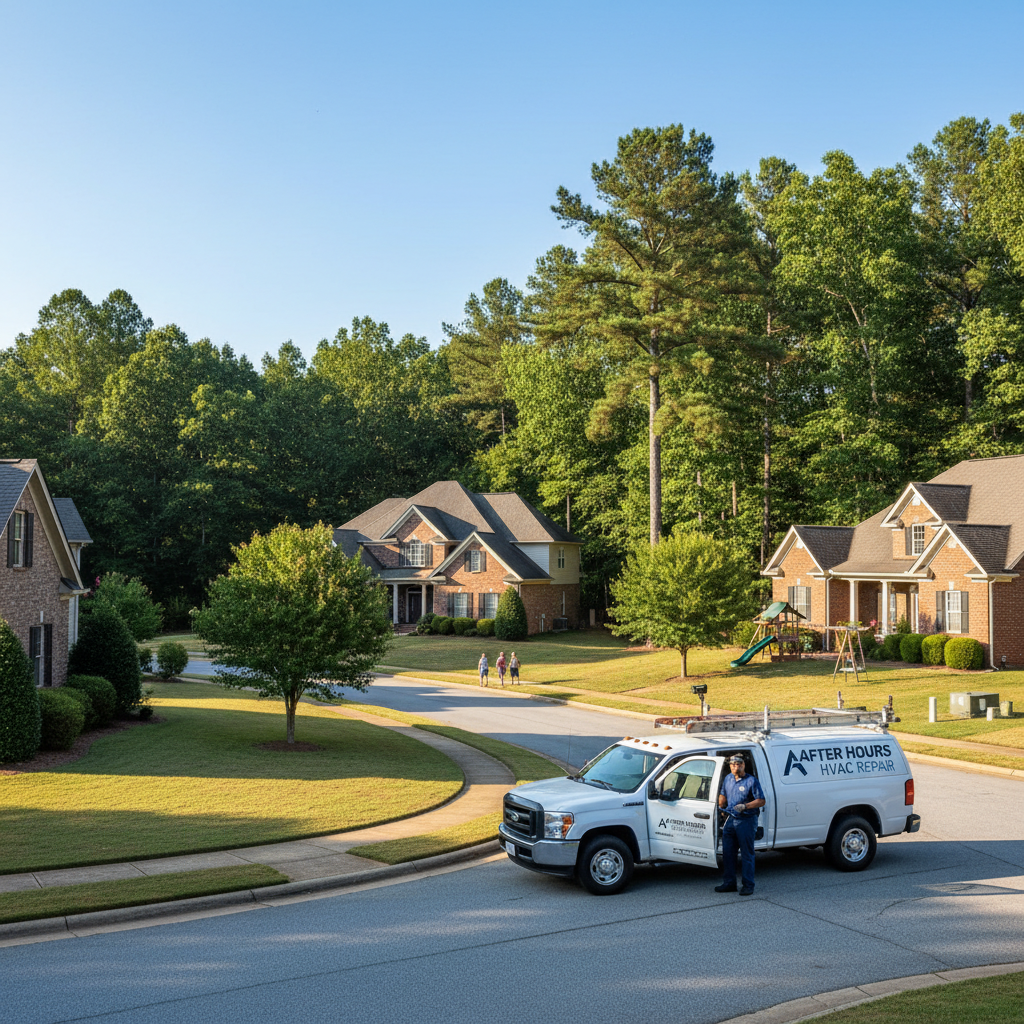
What an after-hours emergency call in Pelham actually looks like.
Most after-hours calls in Pelham follow a predictable summer pattern: the system runs through the evening, the condensate drain line — loaded by valley humidity — clogs and triggers the float switch, and the house starts warming after midnight. The homeowner wakes at 2 a.m. to a 78-degree house and calls. Without terrain knowledge, that call starts with a full diagnostic from scratch. Knowing Pelham's valley-floor geography tells us to check the condensate drain system before anything else.
That shortcut — terrain knowledge applied before we arrive — means faster resolution and fewer wasted steps. We also inspect the evaporator coil for biofilm while we're there, because valley humidity that clogs a drain also feeds coil contamination on the same timeline. Clearing one without addressing the other puts us back at the same address in two weeks.
We carry condensate treatment tablets, coil cleaner, and secondary float switch hardware on the truck. Pelham valley calls don't require a second trip for these items. Licensed Alabama HVAC contractor per the Alabama Licensing Board. Written estimate before any work begins. No pricing, guarantees, or timeframes promised in advance.
Pelham-specific questions.
Where is After Hours HVACR headquartered relative to Pelham?
After Hours HVACR is headquartered at 2090 Columbiana Rd, Suite 100 in Hoover, Alabama 35216 — roughly 8 miles north of Pelham city center via I-65. That puts dispatch inside the Birmingham metro with direct interstate access to every Pelham neighborhood. Chandalar, Indian Springs, Oak Mountain Estates, and Valley Station all fall within our standard service zone. Because the I-65 corridor connects Hoover and Pelham directly, after-hours calls from Pelham reach an on-call technician without cross-county routing delays. Dispatch operates 24 hours a day, every day, including weekends and Alabama state holidays. Licensed Alabama HVAC contractor per the Alabama Licensing Board.
Which Pelham ZIP codes does After Hours HVACR cover?
After Hours HVACR covers both ZIP codes associated with Pelham: 35124 (primary Pelham ZIP) and 35043 (shared with Helena on the southern edge of Pelham). ZIP 35124 covers the bulk of Pelham proper — Chandalar, Oak Mountain Estates, Indian Springs, Pelham Park, and the I-65 commercial corridor. ZIP 35043 covers the southern fringe neighborhoods near the Helena border and portions of Valley Station. Both ZIPs receive identical dispatch priority. The Cahaba River watershed boundary between these two ZIPs does not create any service-tier difference on our end. Per the US Census Bureau, Pelham's 2020 population was 24,590 across Shelby County.
Why do valley-pocket Pelham homes have different HVAC issues than ridge homes?
Pelham's terrain creates a split microclimate within the same city limits. Homes on the valley floor — south and east of the Oak Mountain ridgeline — trap cold, moist air overnight as it drains downhill from Double Oak Mountain's 1,260-foot peak. NOAA surface observation data shows valley-floor relative humidity consistently running 15 to 25 percentage points above ridgetop readings during summer nights. That moisture loads the evaporator coil harder, accelerates biological growth inside the air handler, and demands more frequent condensate drain cleaning. Ridge homes above 800 feet elevation run drier and cooler, meaning their primary failure mode shifts away from moisture problems toward wind-load damage to outdoor units. Two Pelham homes a half-mile apart can present completely different service calls for the same reason.
How does Oak Mountain State Park elevation affect Pelham microclimate?
Oak Mountain State Park is Alabama's largest state park at 9,940 acres, with Double Oak Mountain reaching 1,260 feet above sea level according to Alabama State Parks records. That ridgeline acts as a terrain barrier that shapes Pelham's weather in two ways. First, prevailing southwest winds off the Gulf of Mexico lose moisture as they climb the ridge, creating a relative rain shadow on the northeast slope. Second, cool dense air from the forested upper slopes drains into the valley each night, dropping valley temperatures 5 to 8 degrees below ridge readings by 4 a.m. This temperature inversion traps humidity at the valley floor and creates the morning fog pockets Pelham residents know well. For HVAC systems, the result is heavier overnight condensate loads on evaporator coils than the system's original design assumptions account for.
Does high humidity in valley Pelham cause more evaporator coil failures?
High relative humidity does not directly cause evaporator coil failure, but it accelerates three related problems. First, the coil runs wetter longer, promoting algae and biofilm growth inside the drain pan — a clogged drain pan triggers overflow shutoff and shuts the system down, often at night when the homeowner notices the house warming up. Second, sustained moisture on coil surfaces corrodes aluminum fins faster than in drier climates, reducing heat transfer efficiency over years. Third, biological growth on the coil face restricts airflow the same way a dirty filter does. The DOE notes that every 10% reduction in evaporator airflow reduces system efficiency by approximately 5%. Valley-floor Pelham homes typically need drain-pan and coil cleaning more frequently than HVAC manufacturers' standard maintenance schedules suggest.
What are the most common after-hours failures in Pelham during summer?
The top after-hours emergency call from Pelham in summer is a flooded or clogged condensate drain line — the valley's humidity loads condensate at higher volume than most systems are designed to handle unattended, and the float switch trips the system off overnight. Second is capacitor failure in the outdoor condenser, accelerated by Alabama's direct afternoon sun on south- and west-facing equipment pads. Third is frozen evaporator coil from restricted airflow — a combination of dusty filters and coil biofilm common in valley-humidity homes. Refrigerant loss at factory brazed joints rounds out the top four. Blower motor failures from sustained moisture exposure appear more often in Pelham than in drier northern Birmingham neighborhoods, consistent with valley-humidity operating conditions documented in ASHRAE moisture load guidelines.
Why do Chandalar 1970s homes have unique HVAC challenges?
Chandalar is Pelham's oldest established neighborhood, with the bulk of its housing stock built in the 1970s — before the modern 13 SEER minimum efficiency standard and before current Alabama residential building codes required vapor barriers in crawl spaces. Three problems compound in these homes. First, the original ductwork is often fiberglass duct board or flex duct degraded over 50 years — air leakage rates of 25 to 35 percent of system airflow are common in duct systems of this age, per DOE duct leakage research. Second, original crawl spaces lack modern encapsulation, meaning valley-floor ground moisture enters the subfloor cavity directly, raising indoor humidity loads above what the HVAC system was sized to handle. Third, the equipment has been replaced at least twice, often with systems mis-sized for the original duct restriction.
How does Cahaba River proximity affect humidity in Pelham homes?
The Cahaba River passes through the eastern portion of Pelham before continuing through Helena and Alabaster. Within a quarter-mile of the river corridor, ground-level relative humidity during summer evenings regularly exceeds 85 percent, per NOAA local climatological data for the Birmingham-Shelby County area. Homes in that corridor — portions of Valley Station and the low-lying sections east of I-65 — see heavier overnight condensate loads, higher risk of drain-pan overflow, and a measurably higher rate of crawl-space mildew in homes without complete vapor barrier systems. HVAC systems near the Cahaba corridor benefit from oversized condensate drain capacity, a secondary drain pan float switch, and crawl-space relative humidity monitoring. These are not optional upgrades in a river-proximity home — they are maintenance items that prevent more expensive failures downstream.
Need a technician in Pelham now?
Valley humidity, Oak Mountain terrain, Cahaba River proximity — we know the HVAC variables that make Pelham different. Call and a live dispatcher will route the closest on-call technician to your address. 24 hours a day. Written estimates before any work begins.
call (205) 994-6402