Trussville's
new construction
is aging fast.
Emergency HVAC Service in Trussville, Alabama.
Most of Trussville was built after 2000. That means thousands of builder-grade systems are now in the 10-to-15-year failure window — right when warranty coverage is gone and components fail simultaneously.
After Hours HVACR dispatches licensed Alabama HVAC technicians to Trussville ZIP codes 35173 and 35235, 24 hours a day. We service all brands — Trane, Carrier, Rheem, Lennox, Goodman, American Standard, Bryant. Written estimates before any work begins. Call (205) 994-6402.
Your Trussville system's warranty clock — by year.
Most Trussville homeowners don't know what coverage they actually have — or that it expired years ago. Manufacturer warranty terms vary by brand and registration status, but the DOE-cited industry pattern follows a predictable timeline. Here is what each phase means for a 2010-2025 new-construction system.
Full coverage — if the equipment was registered
Most residential HVAC manufacturers — Trane, Carrier, Rheem, Lennox, Goodman, American Standard, Bryant — include a one-year parts-and-labor warranty from the installation date. This is the only period when a technician callback for a defective component costs the homeowner nothing, provided the original installer is still in business and honors the labor coverage. Trussville new-construction buyers should confirm the equipment was registered at their address, not the builder's office. Unregistered equipment defaults to a shorter base warranty under most manufacturer terms. Per Alabama Board of Heating, Air Conditioning, and Refrigeration Contractors rules, all warranty work must be performed by a licensed contractor.
Labor is gone. Parts coverage narrows to the compressor.
By year five, labor warranty has expired on virtually every residential brand. Parts coverage continues — but typically only on the compressor, which is the most expensive single component. Capacitors, contactors, blower motors, control boards, and coils are out-of-pocket at this stage. For a 2015-era Trussville home, this window closed in 2020. The homeowner has been paying full repair costs for any non-compressor failure since then, often without realizing the coverage shift occurred. Systems in Stockton, Kensington Park, and the Hewitt-Trussville corridor that were built between 2012 and 2017 are squarely in this zone right now.
System output drops measurably below nameplate rating.
U.S. Department of Energy residential HVAC performance data shows that systems operating in high-humidity Southern climates lose measurable cooling capacity as coil fouling accumulates, refrigerant charge drifts, and compressor valve efficiency declines. A 3-ton Trussville system in its tenth summer may deliver 2.6 to 2.7 tons of actual cooling under load — a deficit the homeowner experiences as longer run cycles, higher utility bills, and rooms that never quite reach setpoint. NOAA climate normals for Jefferson County record average summer dew points of 70 to 74°F and 44-plus days above 90°F annually, accelerating wear relative to northern U.S. installations of the same equipment. The Cahaba River corridor compounds this — riverside Trussville locations run two to four degrees higher dew point than upland Jefferson County.
R-22 legacy systems become a financial liability.
Any Trussville system installed before 2010 likely uses R-22 refrigerant, which the EPA banned from production and import under Clean Air Act Section 608, effective January 1, 2020. Reclaimed R-22 stock is the only legal supply, and per-pound costs have escalated significantly. A refrigerant leak on a pre-2010 Trussville system — including any equipment still running in the Cahaba Project Historic District — is a decision point, not a simple repair. The cost of recharging with reclaimed R-22 must be weighed against the cost of system replacement with a modern R-410A unit. Systems that have reached year 12 to 14 and still run R-22 are statistically likely to need this conversation within the next service season.
All coverage gone. Failure probability rises sharply.
The DOE and AHRI cite 15 to 20 years as the design life for residential split-system HVAC equipment under normal operating conditions. In Alabama's climate, practical service life trends toward the lower end of that range. A 2010-vintage Trussville system reaches this threshold in 2025 — right now. Compressor replacement cost at this age frequently approaches 50 to 60 percent of new-system cost, making replacement the more economical path when the compressor fails. Trussville neighborhoods with the highest concentration of systems in this zone include the Stockton corridor, early-phase Village of Cahaba, and older sections of Hewitt-Trussville. We do not pressure replacement decisions, but we do provide the diagnostic data and part-cost comparison needed for an informed choice.
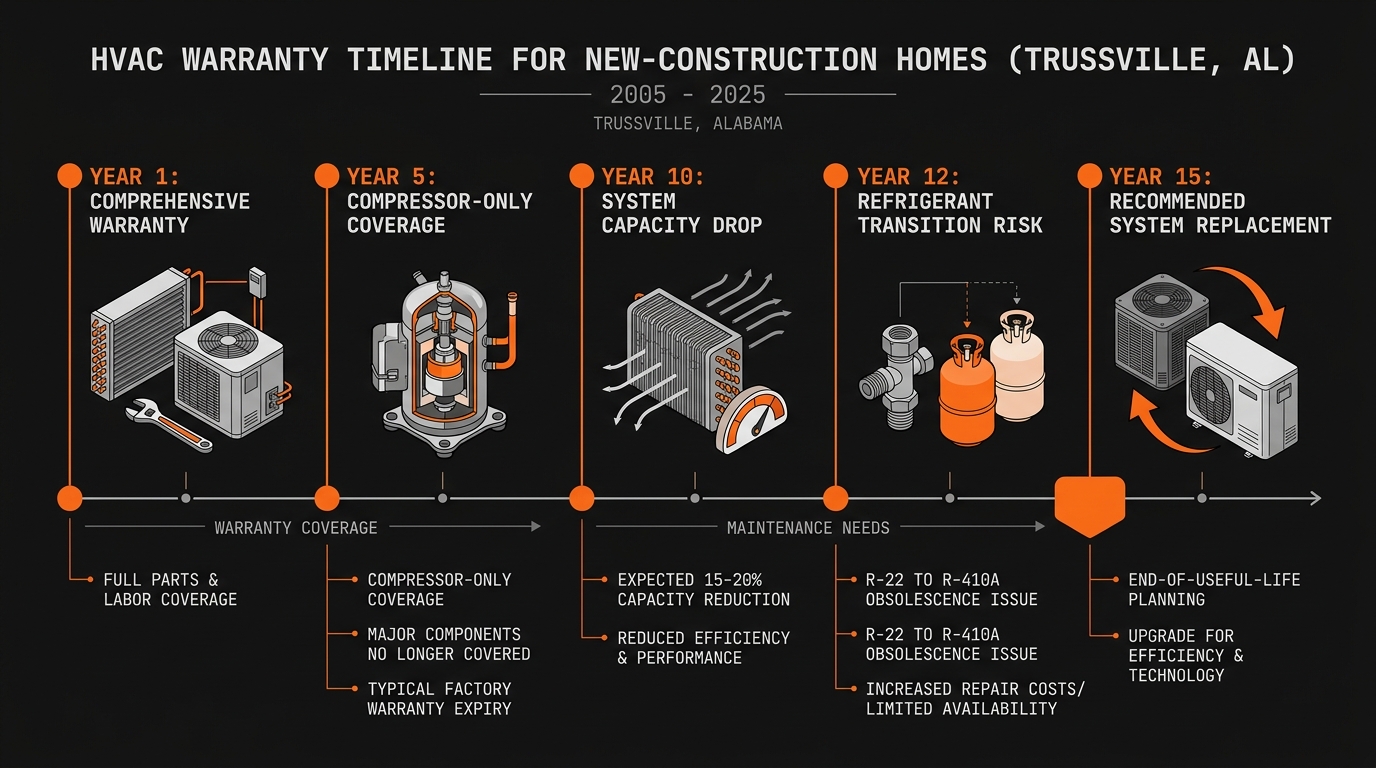
Five phases of residential HVAC warranty coverage. Most 2010-2018 Trussville new-construction systems are currently in the zero-coverage zone — year 10 to 15, where failure costs are fully out-of-pocket.
Both Trussville ZIPs, covered.
Trussville spans Jefferson and St. Clair counties and uses two primary ZIP codes. Dispatch covers both identically — a call from a Stockton-area street in 35173 gets the same 24-hour dispatch as a call from the Chalkville Mountain side of 35235.
Primary Trussville ZIP
Cahaba Project Historic District · Downtown / Main Street · Stockton · Hewitt-Trussville school corridor · The Preserve · Village of Cahaba · Kensington Park · Carrington · Cahaba River corridor
Shared ZIP · NE Birmingham edge
Chalkville Mountain corridor · northeastern Jefferson County fringe communities straddling the Trussville and Birmingham boundary along the I-59 interchange area
What to check at year 10 on a 2015-era Trussville system.
A 2015 new-construction system in Trussville hits its ten-year mark in 2025. This is the most diagnostically active age band — not yet at end of life, but generating measurable wear across four specific failure points. Here is what a competent field inspection looks for at this age.
Capacitor Degradation
Run capacitors in residential condensers are rated in microfarads with a plus-or-minus 6 percent tolerance. A capacitor reading below 90 percent of its rated value under load is degraded and will fail under high ambient temperature — the exact condition that defines a Trussville July afternoon. Standard test equipment measures capacitance directly. A 45/5 MFD capacitor reading 38/4.2 is technically operational but within the failure zone. Replacing it before failure avoids a compressor hard-start event that can shorten compressor life by a full season. Alabama's direct summer sun on south and west equipment pads accelerates this degradation faster than the manufacturer's published lifespan assumes for temperate climates. Per DOE residential equipment data, Alabama's climate zone accelerates capacitor wear relative to northern U.S. installations of identical units.
Contactor Pitting
The contactor is the electromagnetic relay that closes the high-voltage circuit to the compressor and outdoor fan motor every time the thermostat calls for cooling. Over ten Alabama summers — with afternoon thunderstorms, power fluctuations on the I-59 corridor grid, and high-current switching during peak-heat days — the copper contact points develop carbon pitting from arc erosion. A heavily pitted contactor creates resistance in the circuit, causes voltage drop at the compressor terminals, and eventually fails to close or opens mid-cycle. Visual inspection of the contact surface under the relay cover shows the pitting clearly. This is a low-cost replacement when caught before failure and an expensive diagnostic call when it fails during a peak-heat weekend in the Stockton or Hewitt-Trussville corridor.
Refrigerant Leak Inspection
A ten-year-old system has had approximately 100 seasonal startup events — each one a thermal and pressure cycle on every brazed and flared connection in the refrigerant circuit. Factory-brazed joints in the coil are the most common slow-leak origin point on Goodman, Rheem, and American Standard systems of this era, which dominate the Trussville new-construction market. Leak detection with an electronic sniffer at the indoor coil headers, the outdoor coil connections, and the reversing valve on heat pump systems is standard at the year-10 inspection interval. A refrigerant charge that tests 5 to 8 percent below manufacturer spec indicates a slow leak ongoing for several seasons. EPA Section 608 requires that leak sources be repaired before recharging any system of this size.
Coil Microchannel Issues
Many 2010-2018 builder-spec systems, particularly Goodman and American Standard units common in Trussville new construction, used microchannel aluminum outdoor coils as a cost reduction over copper-tube coils. Microchannel coils provide adequate heat rejection when clean, but their narrow channel geometry traps airborne debris — Cahaba River cottonwood fiber, construction dust from ongoing Trussville development along the I-59 corridor, and seasonal oak pollen — more aggressively than traditional fin-and-tube designs. A partially blocked microchannel coil causes elevated head pressure, stressing the compressor. It also resists cleaning with standard coil cleaner; high-pressure rinse from the inside out is required. A coil that cannot be fully restored to clean airflow is a replacement candidate.
Six Trussville neighborhoods, six HVAC stories.
Trussville contains housing from the 1930s Cahaba Project era through 2020s new construction — each neighborhood with its own equipment age, brand mix, and dominant failure pattern. Knowing which neighborhood you are in is half the diagnostic.
Cahaba Project Historic District
Alabama's largest WPA-era New Deal housing concentration, built in the 1930s along the Cahaba River by the Federal Subsistence Homesteads program. Original construction had no central air. Retrofitted systems face narrow wall cavities, masonry construction challenges, and attic depths that complicate standard equipment sizing. Every service call here is a custom diagnostic — the building envelope often outperforms its age, meaning systems may be oversized relative to actual load. Refrigerant work on any pre-2010 equipment requires evaluating R-22 transition options under EPA Section 608.
Stockton
Post-2000 suburban growth along the Trussville I-59 commuter corridor. Typical 2,200 to 3,000 square foot new construction with builder-grade Goodman and Rheem systems now entering the 10-to-15-year failure window. Stockton-area calls lean heavily toward capacitor and contactor failures in summer and heat pump defrost issues in winter. Microchannel coil blockage is a recurring issue given ongoing construction dust from active development nearby and seasonal Cahaba River cottonwood fiber.
Hewitt-Trussville Corridor
The Hewitt-Trussville school district is Trussville's primary growth driver, pulling families northeast along I-59 from Birmingham. Subdivisions here span 2000 to 2020 with a wide mix of Trane, Carrier, American Standard, and Bryant equipment depending on the builder and year. Larger homes in this corridor often have dual-zone systems, where zoning damper failures and staged-compressor diagnostics add complexity to standard service calls. Warranty registration gaps are common — confirm your system's registration status.
Kensington Park
Mid-2010s construction, placing most Kensington Park systems in the 8-to-12-year early degradation window where capacitor readings start dropping and slow refrigerant leaks first become detectable. Equipment here skews toward Lennox and American Standard. Lower-elevation lots near the Cahaba River bottom experience elevated humidity that accelerates condensate drain algae blockage — the drain float switch shutting the system off mid-day is one of the most common Kensington Park calls we receive in summer.
The Preserve
Newer Trussville construction with equipment ranging from 5 to 15 years old depending on build phase. Younger systems here have more runway before major failures, but pollen season along the Cahaba River corridor still clogs outdoor coils annually and the I-59 development corridor generates construction particulate that shortens filter life. Homeowners in The Preserve should verify whether original equipment was registered at installation — builder registration at a corporate address is a common gap that affects extended warranty coverage on Goodman and Rheem units.
Village of Cahaba
Named for the Cahaba River that defines Trussville's western edge. Village of Cahaba spans early 2000s through 2015, placing most systems in the 10-to-20-year failure zone. Proximity to the Cahaba River means elevated humidity at the equipment level — corrosion on outdoor coil fins and condensate drain algae accumulation are more active issues here than in upland Trussville locations. Per NOAA climate data, river-corridor dew points run two to four degrees above the Jefferson County average. Brands vary widely across this neighborhood; we carry parts for all of them.
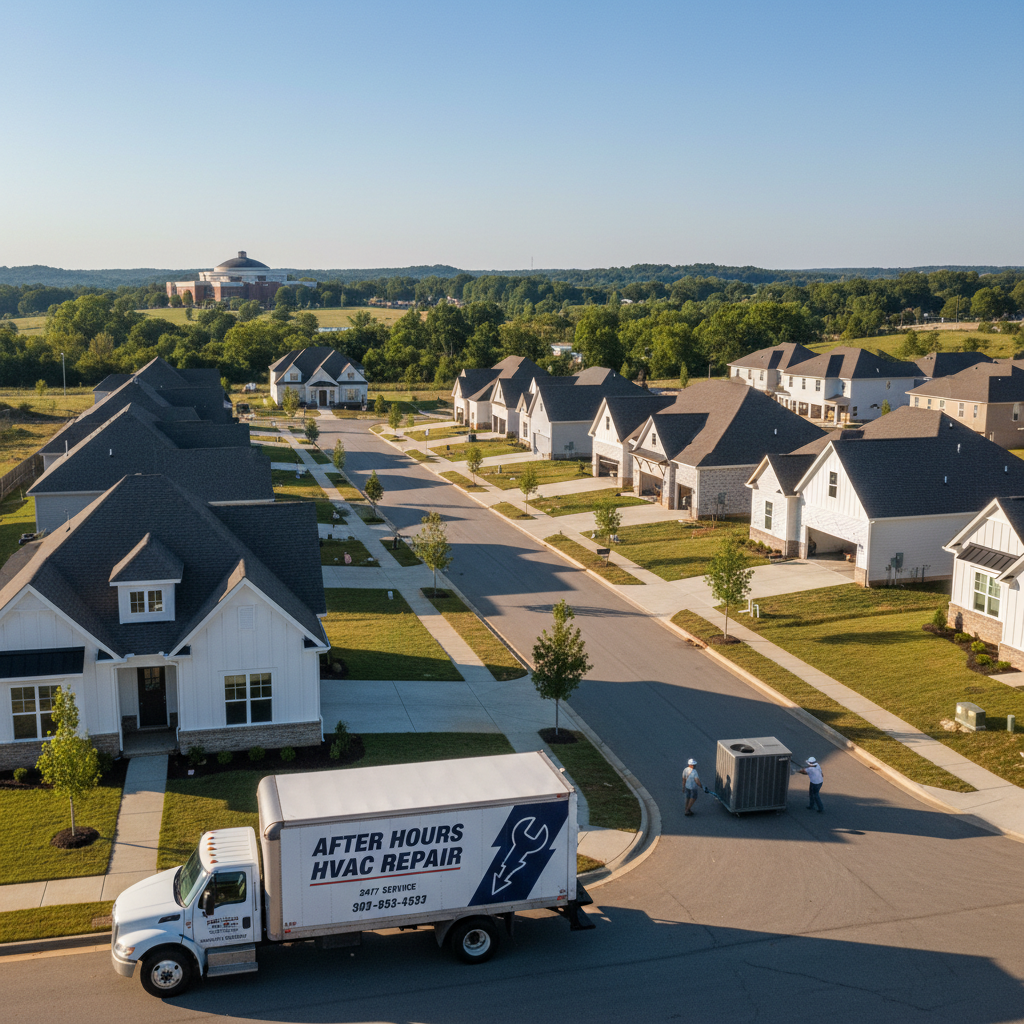
What a year-10 Trussville condenser looks like on the inside.
This is what our technicians encounter regularly on I-59 corridor service calls in Trussville — a builder-grade 14 SEER system, 2012 to 2016 vintage, on a south-facing equipment pad beside a Stockton or Hewitt-Trussville home. Outside the cabinet looks intact. Inside is a different story.
The capacitor reads 12 percent below rated microfarad value. The contactor shows light pitting on one contact face — not failed, but within the next-season failure window. The microchannel coil has a band of Cahaba River cottonwood fiber and construction dust compressed against the inlet face that standard coil spray will not penetrate. Refrigerant subcooling is reading two degrees below manufacturer target range, suggesting slow charge migration over three to four seasons.
None of these findings appear on a thermostat — the system still cools, just less efficiently and with a shorter remaining service life. That is why a diagnostic inspection at year 10 on a Trussville new-construction system provides information that a comfort check cannot.
Trussville-specific questions.
Where is After Hours HVACR headquartered relative to Trussville?
After Hours HVACR is headquartered at 2090 Columbiana Rd, Suite 100 in Hoover, Alabama 35216 — approximately 18 miles southwest of Trussville via I-459 and I-20/59. The I-59 corridor that Trussville sits along is the same interstate our technicians use to reach northeast Jefferson County and the St. Clair County edge of the Trussville service area. Dispatch covers both Trussville ZIP codes — 35173 and 35235 — 24 hours a day, seven days a week. When a call comes in from Main Street, the Cahaba Project neighborhood, The Preserve, or the Stockton corridor, the on-call technician routes northeast along I-59. Licensed Alabama HVAC contractor. Call (205) 994-6402.
Which Trussville ZIP codes does After Hours HVACR cover?
After Hours HVACR covers both active Trussville ZIP codes: 35173, the primary Trussville postal code covering the Historic District, Stockton, Hewitt-Trussville school corridor, The Preserve, Village of Cahaba, and Kensington Park; and 35235, the shared ZIP straddling the Trussville and northeastern Birmingham boundary along the Chalkville Mountain corridor. Both ZIPs receive identical 24-hour dispatch. Service extends into neighboring Springville Road and Clay-Chalkville areas within northeast Jefferson County.
Why do 2010-2015 Trussville new-construction homes start failing at year 10?
Trussville's post-2000 building boom installed large volumes of builder-grade HVAC equipment — primarily Goodman, Rheem, and American Standard systems rated at 13 to 14 SEER — in homes built quickly for a fast-growing commuter population. U.S. Department of Energy residential HVAC lifecycle data shows run capacitors in residential outdoor condensers degrade measurably between years 8 and 12 under sustained Alabama summer load. By year 10, capacitors often operate below rated microfarad tolerance, causing the compressor to draw excess current on startup. That stress accelerates compressor wear and begins a failure cascade. Contactors pitted from repeated high-current switching, microchannel coil corrosion from Cahaba River humidity, and refrigerant migration through factory-brazed joints compound simultaneously in the year 10 to 13 window. NOAA records show Jefferson County averages 44 days above 90°F annually, accelerating every one of these degradation mechanisms.
Does the R-22 to R-410A transition matter for Trussville homes?
Yes, significantly for any Trussville home with HVAC equipment installed before 2010. The U.S. Environmental Protection Agency completed the R-22 phaseout under Clean Air Act Section 608, and as of January 1, 2020, the production and import of R-22 refrigerant was prohibited in the United States. Remaining R-22 supplies are reclaimed stock only, and per-pound costs have risen dramatically. Trussville homes in the Cahaba Project Historic District that have retained older equipment, or any home with a system manufactured before 2010, may still run R-22. A refrigerant leak on one of these systems is not a straightforward recharge — it requires evaluating whether the system is a retrofit candidate for a drop-in refrigerant or whether replacement with a modern R-410A unit is the more practical path. The Alabama Board of Heating, Air Conditioning, and Refrigeration Contractors requires all refrigerant work to be performed by a licensed contractor.
What makes Cahaba Project WPA-era homes different for HVAC service?
The Cahaba Project Historic District is one of the largest concentrations of New Deal-era WPA housing in Alabama, constructed in the 1930s by the Federal Subsistence Homesteads program on the Cahaba River. These homes were originally designed without mechanical cooling — thicker exterior walls, larger eave overhangs, and cross-ventilation layouts predated central air by two decades. Retrofitting modern HVAC into a WPA-era Cahaba Project home presents distinct challenges: original wall cavities are narrower than modern framing, attic depths can be limited, and masonry construction makes duct routing more complex than in stick-frame new construction. Equipment sizing must account for the original building envelope, which often performs better thermally than comparable new construction — meaning a system right-sized for actual load may be smaller than a generic square-footage estimate suggests.
Why are new-construction warranty claims often denied?
Most residential HVAC manufacturers — including Trane, Carrier, Rheem, Lennox, Goodman, American Standard, and Bryant — require product registration within 60 to 90 days of installation to activate the extended warranty period. An unregistered system defaults to the base warranty: typically five years on parts and one year on labor rather than the advertised ten-year coverage. Trussville homeowners who purchased new construction in the 2008 through 2018 boom frequently received equipment registered by the builder rather than themselves, meaning registration may have lapsed at the builder's address. Additionally, warranty terms commonly require all service work to be performed by a licensed contractor and that original maintenance records be available. A single undocumented service event can void coverage under many manufacturer terms.
What are the most common after-hours failures in Trussville?
The dominant after-hours emergency in Trussville during summer is run capacitor failure in the outdoor condenser — Alabama's combination of high ambient temperature and direct afternoon sun on south- and west-facing equipment pads degrades capacitor dielectric material faster than the manufacturer's rated lifespan. The second most common call is contactor failure, where the electromagnetic relay that powers the compressor develops pitted contacts from repeated high-current switching during thunderstorm power fluctuations common along the I-59 corridor near Chalkville Mountain. Refrigerant leaks at factory-brazed joints are the third category, appearing most often in the year 10 to 14 window on 2010-2020 new-construction equipment. Winter calls from Trussville lean toward heat pump defrost board failures during hard freezes, when overnight lows drop into the teens along the Cahaba River bottom.
How does Cahaba River humidity affect Trussville HVAC equipment?
The Cahaba River runs directly through the Trussville service area, and the river corridor produces measurably elevated relative humidity compared to upland Jefferson County locations. NOAA climate normals for the Birmingham metro record average summer dew points of 70 to 74°F, with river-bottom locations often running two to four degrees higher. That sustained moisture load affects equipment in several ways. Evaporator coil microbial growth is more aggressive in high-dew-point environments, reducing airflow and heat transfer efficiency over time. Outdoor condenser fins in riverside locations show accelerated oxidation. Condensate drain lines in lower-elevation Trussville lots near the Cahaba River flood plain see higher flow volumes and are more prone to algae blockage, which triggers the drain safety float switch and shuts the system down — one of the most common preventable after-hours calls we receive from the Trussville ZIP codes.
Need a technician in Trussville now?
Call and a live dispatcher will route the closest on-call licensed Alabama technician to your Trussville address. Written estimates before any work begins. We service all brands.
call (205) 994-6402