24 Hour Emergency
HVAC Service.
Emergency AC repair in Vestavia Hills, Alabama — the ridge runs different.
Vestavia Hills sits 136 feet above Birmingham's valley floor on Shades Mountain. That elevation changes everything about how an HVAC system runs — and what breaks first. Our techs know the ridge.
After Hours HVACR dispatches licensed Alabama technicians to all six Vestavia Hills ZIP codes 24 hours a day, nights, weekends, and holidays. Emergency AC and heating service for Cahaba Heights, Liberty Park, Rocky Ridge, and all ridge neighborhoods. Call (205) 994-6402.
Shades Mountain creates its own HVAC environment.
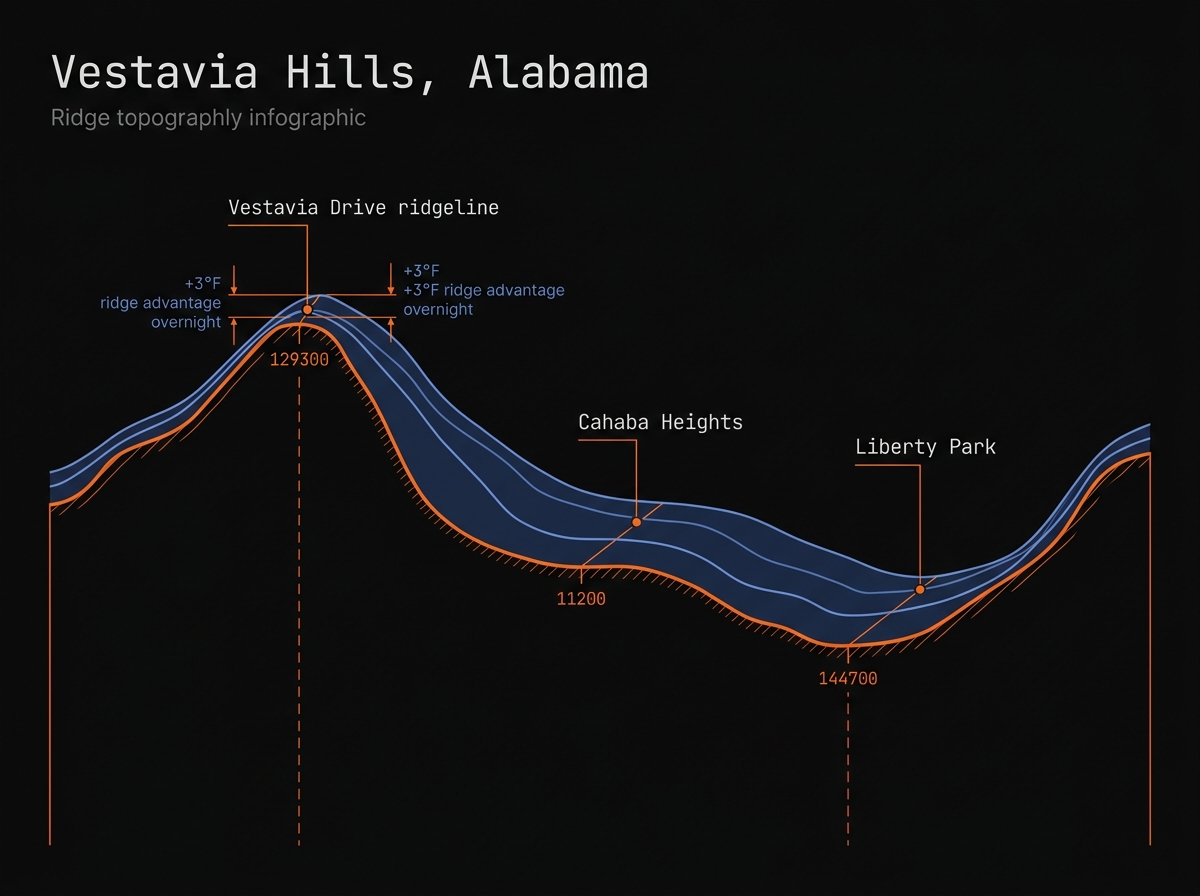
According to NOAA climate records, the Vestavia Hills ridge on Shades Mountain consistently runs three to four degrees Fahrenheit cooler at night than the Birmingham valley floor. That gap drives a condensation cycle that no valley-home HVAC technician encounters regularly — but our techs see it every week on this ridge.
Overnight temperature differential between Vestavia Hills ridge (~780 ft) and Birmingham valley (~644 ft), per NOAA climate records. The gap widens during cold-air drainage events in winter.
The overnight differential creates a morning condensate cycle on evaporator coils. Coils that absorbed cool night air accumulate dew at sunrise — more moisture load than valley systems see, year-round.
Vestavia Hills at ~780 ft sits 136 feet above Birmingham's valley floor at 644 ft. That is enough elevation to produce a measurable microclimate separating the ridge's HVAC environment from everything below it.
After Hours HVACR is a licensed Alabama HVAC contractor that specializes in after-hours and emergency service across Jefferson County and the greater Birmingham metro. On the Vestavia Hills ridge, the combination of elevated terrain, south-facing slope solar exposure, and NOAA-documented overnight cooling differential produces a repeating thermodynamic cycle that accelerates wear on specific HVAC components. Evaporator coils on ridge homes gather surface condensation during the cool night window, then face a rapid warm-up when morning sun hits south-facing slope exposures along US-31, Rocky Ridge Road, and Columbiana Road. The daily expansion-and-contraction cycle on coil solder joints and refrigerant line fittings is more aggressive than what valley systems experience on comparable Birmingham metro homes.
The result is a statistically higher rate of coil micro-leak development in ridge homes compared to Birmingham valley homes of equivalent age. Condensate drain blockages are also more common, because the higher overnight moisture load delivers more water to the drain pan every morning cycle. Homeowners on the ridge who notice their drain pan filling faster than expected, or who see moisture staining around the air handler, are experiencing this effect directly. We document this condition in our Vestavia Hills service records and flag it at each visit as a ridge-specific maintenance interval that differs from what valley-home techs typically schedule.
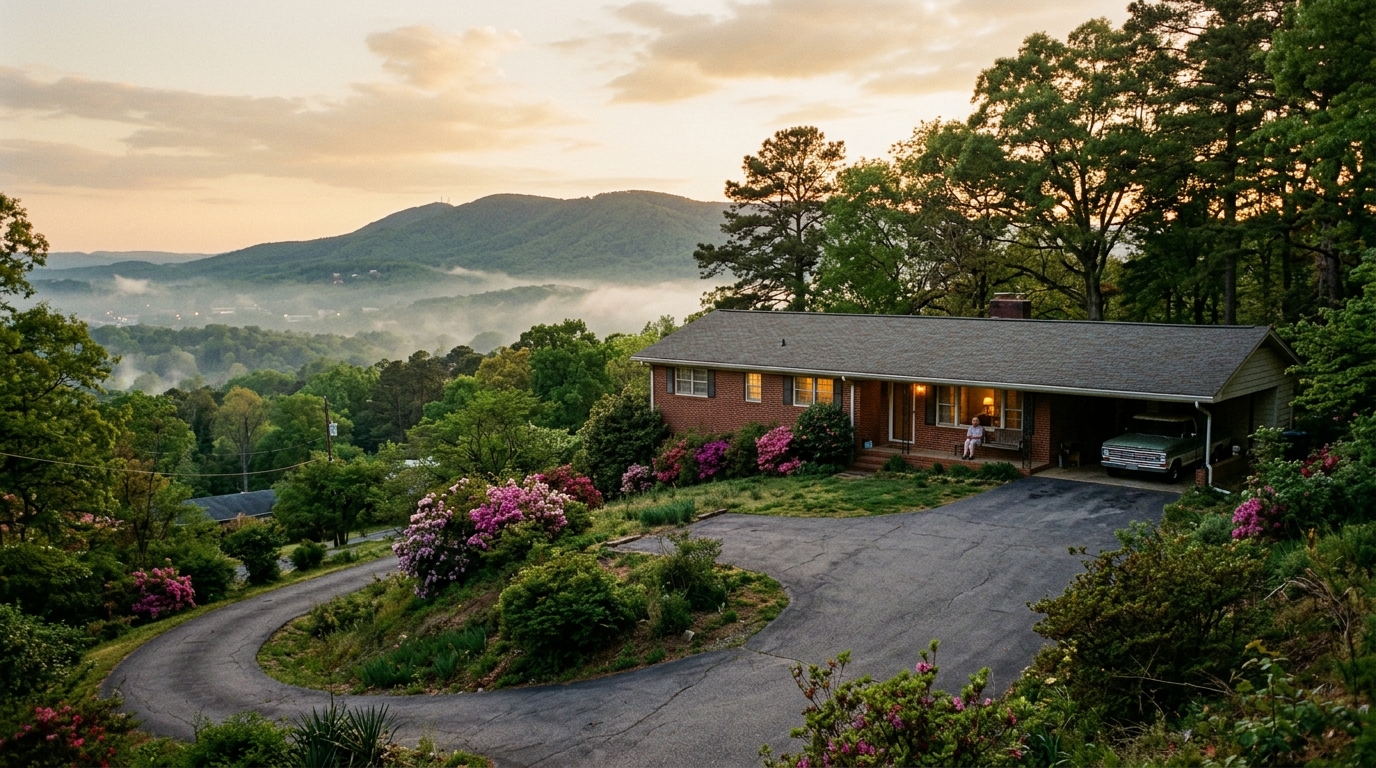
Vestavia Hills on the Shades Mountain ridge — 136 feet above Birmingham's valley floor. That elevation gap is the source of the overnight differential documented by NOAA climate records.
Every Vestavia Hills ZIP, covered.
Vestavia Hills spans six ZIP codes across Jefferson County — from the Homewood border near US-31 to the Liberty Park master-planned communities off I-459. Dispatch covers every one 24 hours a day, including nights, weekends, and all holidays.
Homewood border, US-31 corridor, western Vestavia
Historic ridge core, Vestavia Forest, Altadena Park
Vestavia / Hoover overlap, Columbiana Rd, I-65 corridor
Shades Mountain ridge, Rocky Ridge, Bluff Park edge
Liberty Park, Cahaba Heights, I-459 east
Liberty Park north, Cahaba River corridor, Mountain Brook edge
Ridge-home HVAC reality: why 2-stage condensers win at altitude.
Single-stage condensers operate at one speed: full throttle. They shut off completely when the thermostat is satisfied and restart at full capacity the next cycle. On a valley home where overnight temperatures remain warm, the refrigerant inside the system stays evenly distributed, and restart is smooth.
On the Vestavia Hills ridge, where overnight temperatures drop measurably according to NOAA climate data, the refrigerant inside a single-stage system migrates toward the coldest surface during the shutdown window. When the compressor restarts into that unevenly distributed charge, it experiences a brief liquid slug event — pressurized liquid refrigerant entering the compressor head before it fully vaporizes. Repeated daily across Alabama summers, this stresses compressor valve reeds over a 7-to-12 year period and accelerates failure relative to valley installs.
Two-stage condensers run their low stage first on startup, which allows pressure to equalize before the compressor moves to full capacity. The low-stage startup effectively buffers the liquid slug risk. At Vestavia Hills ridge elevations, where the overnight humidity differential is also higher than valley readings, the low-stage operation carries a second benefit: shorter cycle times at altitude allow the evaporator coil to shed the morning condensate load gradually rather than shock-loading the drain pan. Brands with strong 2-stage track records in Vestavia Hills service calls include Trane XR series, Carrier Comfort series, and Lennox XC series units.
Full-power restart into uneven refrigerant charge from overnight migration. Liquid slug risk on first cycle of each day.
Low-stage startup equalizes pressure before full capacity. Charge distributes before compressor loads fully.
Full-power operation saturates drain pan quickly in high-condensate ridge mornings. Overflow risk in summer.
Gradual low-stage operation sheds condensate incrementally. Lower peak drain pan volume each morning cycle.
Valve reed fatigue from daily liquid slug cycles shortens compressor life on the ridge vs. valley installs.
Buffered startup extends compressor life. DOE efficiency standards also favor 2-stage at variable Alabama cooling loads.
Six Vestavia Hills neighborhoods, six HVAC stories.
From the 1950s mid-century ranches on the original Vestavia Hills ridge to the 2000s Liberty Park master-plan, each neighborhood installed its own era of equipment — and each era has its own failure pattern.
Cahaba Heights
A dense, established community off US-31 and Columbiana Road in the Cahaba River corridor. Mix of 1970s brick ranches, 1980s traditional two-stories, and 2000s townhomes. Retrofit ductwork in the older ranches is the recurring challenge — original crawl-space chases were not designed for modern tonnage. Trane and Carrier dominate the install base, with Goodman common in the townhome tier.
Liberty Park
Master-planned community off I-459, developed in phases from the mid-1990s through the 2010s. Larger homes with dual-zone systems were more common from the start than in older Vestavia ridgeline construction. Rheem, Lennox, and American Standard are the dominant brands. Systems from the first Liberty Park phases are now 25-30 years old and entering the active failure window for compressors and outdoor fan motors.
Rocky Ridge
The Rocky Ridge Road corridor south of US-31 along the Shades Mountain ridgeline. Classic Alabama ranch homes on large wooded lots, built in the 1960s through 1980s. This is the heart of the ridge microclimate zone — south-facing equipment pads and the overnight cooling differential hit Rocky Ridge homes harder than anywhere else in Vestavia Hills. Carrier and Trane retrofits from the 1980s are still running here.
Vestavia Forest
One of the original Vestavia Hills neighborhoods developed shortly after the city incorporated in 1950, named for the Vestavia Temple estate of former Birmingham mayor George B. Ward. Original ridge-top ranches with slab-on-grade construction and retrofit central air from the 1970s-1980s. Hidden refrigerant lines under slabs make leak diagnostics more complex than in homes with accessible crawl spaces.
Altadena Park
Established subdivision along the US-31 and I-65 interchange zone in Vestavia Hills. Mix of 1980s traditional brick construction and 1990s-2000s newer builds. Proximity to I-65 puts these homes in a higher road-vibration zone, which can loosen refrigerant line connections at the condenser fitting over time. Rheem and Bryant are common in the 1990s build tier here.
Cahaba River
The Cahaba River corridor along the eastern Vestavia Hills boundary near Mountain Brook. Larger estate-style homes on wooded lots, many with three-zone HVAC systems or separate systems for finished basements. The river corridor's higher ambient humidity elevates condensate drain maintenance frequency above ridge averages. Goodman, Lennox, and American Standard are common in the 2000s-era builds in this zone.
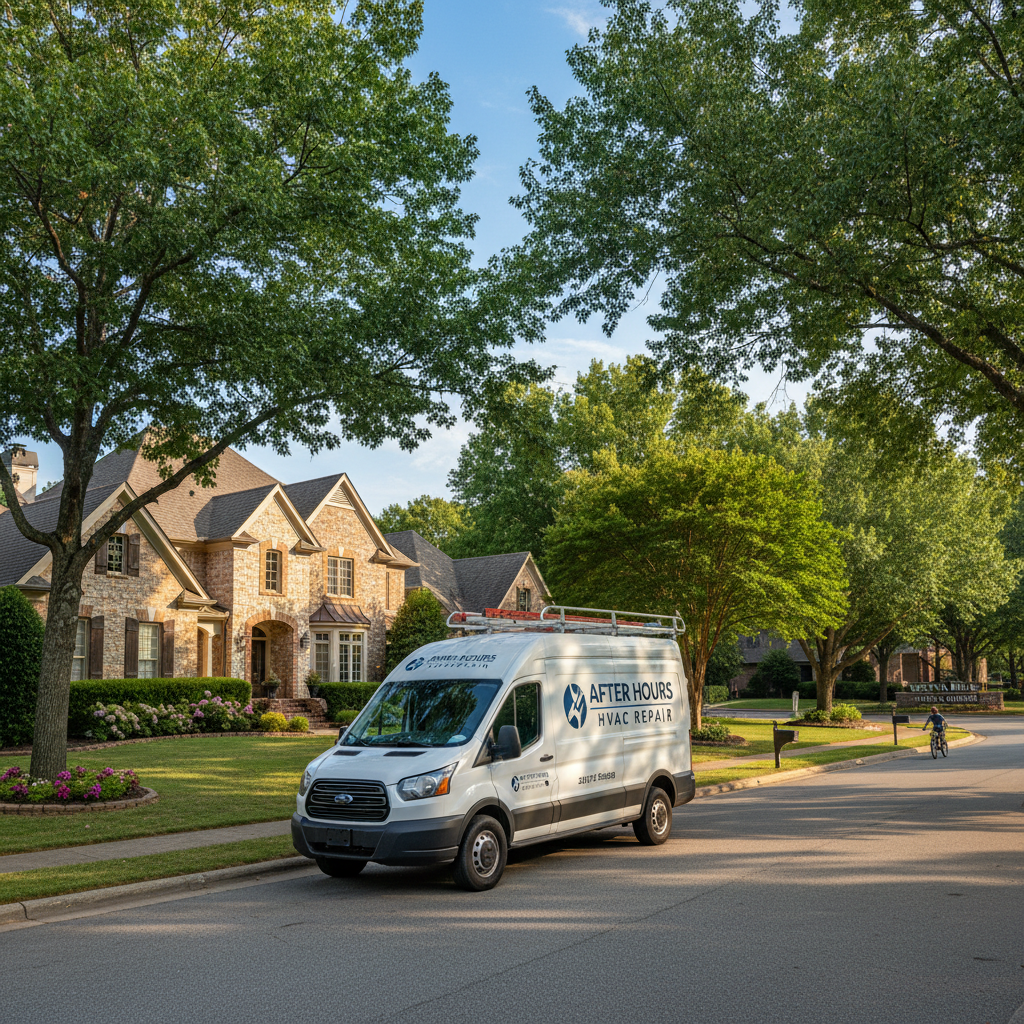
The kind of call that comes in at 10 PM on a July night in Vestavia Hills. Ridge lot, mature hardwoods, a condenser that has been running since before the iPhone existed. We see this every week.
Why Vestavia Hills needs a specialist, not a generalist.
After Hours HVACR is a licensed Alabama HVAC contractor that operates exclusively in the emergency and after-hours service lane — nights, weekends, and holidays when most contractors are unavailable. In Vestavia Hills, that lane is busier than in most Jefferson County cities because of the ridge microclimate documented by NOAA climate records. The city's position on Shades Mountain at approximately 780 feet above sea level creates a morning condensation cycle that degrades evaporator coils faster than in valley communities. Vestavia Hills incorporated in 1950, and its population of approximately 39,102 according to the 2020 US Census spans a wide range of housing eras — from the original mid-century ranches near the Vestavia Temple site on US-31 to the Liberty Park master-plan communities off I-459. Each era installed a different generation of HVAC equipment, and each generation is now at a different point in its failure curve.
The Alabama Licensing Board for General Contractors requires all HVAC technicians operating in Alabama to hold a valid state license — and After Hours HVACR technicians serving Vestavia Hills carry that license to every call. Residents on Rocky Ridge Road, Columbiana Road, and along the I-459 Liberty Park corridor can verify contractor licensing through the Alabama Licensing Board. The Vestavia Hills service territory connects to the broader Birmingham metro via I-65, I-459, and US-31 — the same road corridors our dispatch routes use to reach ridge neighborhoods efficiently. Vestavia Country Club, Vestavia Hills High School — known citywide as the reason Vestavia Hills is called "The City of Schools" — and the Vestavia Hills City Center along Montgomery Highway are all within the core dispatch zone. Equipment brands our technicians service routinely in Vestavia Hills include Trane, Carrier, Rheem, Lennox, Goodman, American Standard, and Bryant — covering the full install spectrum from 1980s retrofits through recent construction.
Vestavia Hills-specific questions.
Where is After Hours HVACR headquartered relative to Vestavia Hills?
After Hours HVACR is headquartered at 2090 Columbiana Rd, Suite 100 in Hoover, Alabama 35216 — directly adjacent to Vestavia Hills along the US-31 corridor. The office sits less than five miles from the heart of Vestavia Hills via I-65 or Columbiana Road, putting dispatch inside Jefferson County and within close range of every Vestavia Hills neighborhood. After Hours HVACR is a licensed Alabama HVAC contractor that dispatches technicians 24 hours a day, seven days a week, including all major holidays. Vestavia Hills is one of the highest-priority dispatch zones because of the proximity of the HQ to the Vestavia Hills city limit. Technicians serving Vestavia Hills are familiar with the ridge-elevation housing stock and the specific failure modes common to mid-century ranch homes on Shades Mountain, newer Liberty Park construction, and the townhome density in Cahaba Heights.
Which Vestavia Hills ZIP codes does After Hours HVACR cover?
After Hours HVACR covers all six ZIP codes that include Vestavia Hills addresses: 35209, 35213, 35216, 35226, 35242, and 35243. These ZIPs span the full geography of Vestavia Hills — from the Homewood boundary near US-31 in 35209, through the historic ridge neighborhoods in 35213 and 35226, into the Liberty Park master-planned communities in 35242 and 35243. ZIP 35216 overlaps Vestavia Hills and Hoover and is serviced directly from the After Hours HVACR headquarters on Columbiana Road. Dispatch treats all six ZIPs identically — a call from the Cahaba River corridor gets the same 24-hour-a-day coverage as a call from Altadena Park or Rocky Ridge Road. There is no premium charge or extended wait for any Vestavia Hills address.
Why do ridge-elevation Vestavia homes have different HVAC issues than valley homes?
Vestavia Hills sits on Shades Mountain at approximately 780 feet above sea level — roughly 136 feet higher than Birmingham's valley floor at 644 feet, according to NOAA topographic data. That elevation differential produces a consistent microclimate effect: the ridge stays three to four degrees cooler at night than the surrounding valleys, but daytime solar gain on south-facing ridge slopes is comparable to or greater than valley readings. The overnight temperature swing creates a morning condensation cycle that stresses evaporator coils more than in valley homes where temperatures stay relatively stable. According to NOAA climate records, this diurnal temperature range is more pronounced at Vestavia Hills elevations than at Birmingham's city center. The result is accelerated coil corrosion over time, more frequent refrigerant loss from flex connection micro-cracks, and higher rates of condensate drain blockage in mid-summer. Valley homes in Homewood or downtown Birmingham experience less coil moisture stress because overnight temperatures remain higher.
Are 1950s-1960s mid-century Vestavia ranches harder to service?
Yes, significantly. The original mid-century ranch homes built on the Vestavia Hills ridge from the 1950s through the early 1970s — shortly after Vestavia Hills incorporated in 1950 — were constructed before central air conditioning was standard. Most were retrofitted with add-on cooling systems during the 1970s and 1980s using the existing square footage as a rough load calculation rather than a proper Manual J analysis. That means ductwork was squeezed into crawl spaces and attic chases that were never designed for it. The duct runs are often undersized for the tonnage now connected to them, and flex duct transitions from the original sheet metal are frequently kinked or partially collapsed. Additionally, the slab-on-grade construction common in 1950s Vestavia Hills ranches can hide refrigerant line sets beneath the floor, making leak diagnosis more time-intensive. HVAC brands common in this era include Carrier, Trane, and Rheem retrofits installed by Birmingham-area dealers in the 1975-1990 window.
Does Vestavia Hills get cold enough at 780 ft elevation to need emergency heat service?
Absolutely. Vestavia Hills' ridge elevation of approximately 780 feet above sea level, as documented by NOAA topographic records, means the city runs measurably colder than the Birmingham valley during cold-air drainage events. During January cold snaps — which occur several times per winter in Alabama — the ridge neighborhoods including Rocky Ridge Road, Vestavia Forest, and Altadena Park can see overnight lows that drop two to five degrees below what the National Weather Service reports for Birmingham proper, because cold air drains from the ridge into the valley overnight and the ridge surface stays exposed. Heat pump emergency calls spike during these events, particularly when overnight lows fall below 35°F and the heat pump's supplemental strip heat engages continuously. Gas furnace ignitor and flame-sensor failures also increase sharply in cold weather. After Hours HVACR keeps common heating parts in stock including ignitors, flame sensors, pressure switches, and defrost control boards for heat pumps.
What are the most common after-hours failures in Vestavia Hills during summer?
The most common summer emergency calls from Vestavia Hills fall into four categories. First, run capacitor failures in the outdoor condenser — the ridge's combination of strong afternoon sun on south-facing equipment pads and cool morning condensation cycling degrades capacitors faster than the manufacturer's published lifespan. Second, contactor burnout from repeated summer thunderstorm power fluctuations along the I-459 and US-31 corridors. Third, evaporator coil freeze-up caused by the overnight condensation cycle — coils that accumulate excess moisture from the ridge's morning dew differential are more prone to ice formation when airflow is even slightly restricted by a dirty filter. Fourth, condensate drain blockages amplified by the higher moisture load on Vestavia ridge systems. Brands most commonly found at failure in summer service calls include Trane, Carrier, Goodman, and Rheem systems ranging from 10 to 22 years old, consistent with the Vestavia Hills housing stock built from the 1990s through the 2010s.
What HVAC brands appear most often in Vestavia Hills homes?
Vestavia Hills' three distinct housing eras each installed a different brand mix. The 1950s-1970s mid-century ranches on the original Vestavia Hills ridge, named for the Vestavia Temple estate of former Birmingham mayor George B. Ward, were typically retrofitted during the 1970s-1980s with Carrier and Trane split systems — the dominant brands sold by Birmingham-area dealers at that time. The 1990s-2010s master-planned Liberty Park development leaned heavily on Rheem, Lennox, and American Standard as builders consolidated purchasing. The 2000s Cahaba Heights townhome wave added Goodman and Bryant to the mix. After Hours HVACR technicians service every one of these brands without exclusivity. Parts inventory is stocked for Trane, Carrier, Rheem, Lennox, Goodman, American Standard, and Bryant equipment, which covers more than 95% of the Vestavia Hills residential install base.
Why do overnight temperature differentials matter for ridge homes?
The overnight temperature differential at Vestavia Hills ridge elevation — approximately three degrees Fahrenheit cooler than the Birmingham valley floor at night, according to NOAA climate records — creates a thermodynamic stress cycle that valley homes do not experience. When a condenser shuts off at night on a cool ridge, the refrigerant inside the system migrates toward the coldest surface. On the ridge, the larger temperature drop means refrigerant can pool in the liquid line and evaporator coil overnight. When the compressor restarts in the morning, it briefly operates with an irregular refrigerant distribution — a condition called liquid slugging — that stresses compressor valve components over time. Two-stage condensers tolerate this better than single-stage units because the low-stage startup reduces the pressure spike from uneven refrigerant distribution. This is the primary mechanical reason why two-stage equipment outperforms single-stage on the Vestavia Hills ridge over a 10-to-15 year ownership window, per DOE efficiency guidelines for variable-load residential HVAC applications.
Need a technician in Vestavia Hills now?
Ridge microclimate or valley call — dispatch routes the closest on-call licensed Alabama technician to your address. 24/7, nights, weekends, and all holidays. Written estimates before any work begins.
call (205) 994-6402