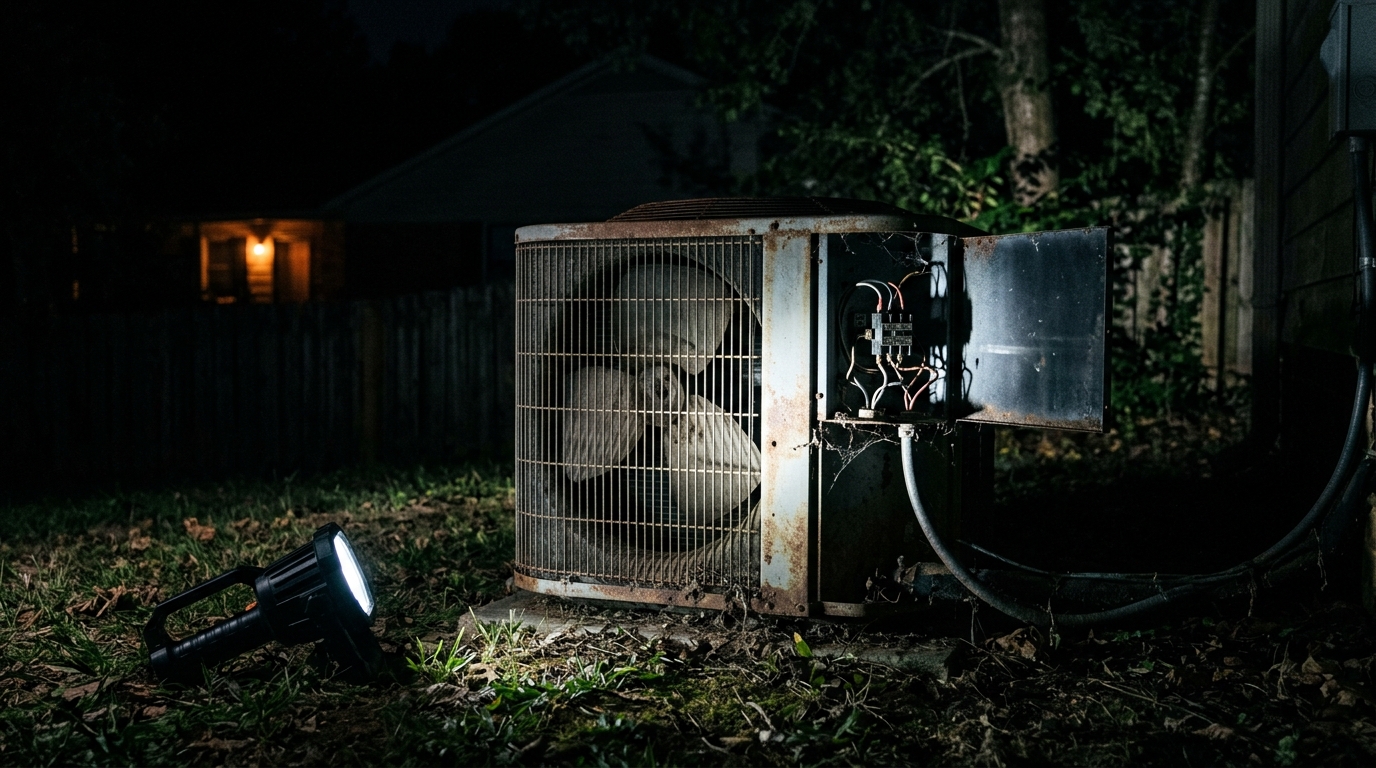
AC Compressor Not Turning On: Seven Causes a Birmingham Tech Checks
Inside the house, the blower is running fine. Outside, the condenser is dead silent. The fan is not spinning, the compressor is not humming, and your house is climbing fast in Alabama afternoon heat. Here is the order a tech runs through to find the dead link in the chain — starting with the things you can check yourself.
1. How the Compressor Gets the Start Signal
Knowing this 60-second chain saves you hours of guessing. The cooling call goes:
- Thermostat senses temperature above setpoint, sends 24-volt signal down the Y wire to the air handler.
- Air handler control board energizes the blower and sends the same 24V down the Y wire to the outdoor unit.
- At the outdoor unit, that 24V hits the contactor coil. The contactor pulls in.
- Contactor closes 240V high-voltage contacts. Power flows to the run capacitor and from there to the compressor and condenser fan motor.
- Compressor and fan start, refrigerant cycles, your house cools.
If the indoor blower works but the outdoor unit is dead, the chain broke between step 2 and step 5. Every cause below maps to one of those broken links.
2. Cause #1: Tripped Breaker or Disconnect
Most homeowners forget there are two power sources for the AC. Breaker in the indoor electrical panel labeled "AC" or "Air Conditioner" or "Condenser" — and a separate disconnect within sight of the outdoor unit, usually a small gray metal box mounted on the wall next to it. Either one being off kills the compressor.
DIY Fix
- At the indoor panel: find the AC breaker. A tripped breaker sits in the middle position, not fully ON or OFF. Push it firmly all the way to OFF. Pause 30 seconds. Push it firmly to ON.
- At the outdoor disconnect: open the cover. There may be a pull-out fuse block or a switch. Make sure it is fully engaged. Some disconnects have visible cartridge fuses — if you see a blackened or melted fuse, that is your problem.
- Turn the thermostat to OFF, wait 60 seconds, then back to COOL with setpoint 5 degrees below room temp. Listen for the contactor click outside.
Important
If the breaker trips again immediately, do not keep resetting it. A repeated trip means there is a short, a seized compressor, or a stuck contactor pulling locked-rotor amps. Resetting risks fire and dead components. Call a tech.
3. Cause #2: Dead Thermostat Batteries
A thermostat with weak batteries can keep the display lit but lose the strength to send a clean 24V cooling call. Some smart thermostats also draw power from the C wire (common wire) of the HVAC system. If that C wire is missing or loose, the thermostat brownouts intermittently and call signals get dropped.
DIY Fix
Replace the AA or AAA batteries in the thermostat. If it is a smart thermostat without batteries (Nest, Ecobee, etc.), check our Nest and Ecobee emergency override for the manual R-to-Y jumper test that bypasses the thermostat entirely. If jumping R-to-Y at the air handler starts the outdoor unit, the thermostat or its wiring is the problem, not the AC equipment.
4. Cause #3: Blown 24V Transformer Fuse
Air handler control boards include a 3-amp or 5-amp glass fuse on the low-voltage circuit. A short in the thermostat wire (rodent damage, staple through wire, water in the wall) blows that fuse. Once it is blown, the thermostat can call all day — no power reaches the contactor.
How to Check
Open the air handler service panel (after shutting off power at the breaker). Look for a small glass fuse on the control board. It will be labeled like "F1 3A" or "FUSE 3A" near the low-voltage terminals. A blown fuse looks dark inside or has a visibly broken filament.
Replacing the fuse is straightforward but does not fix the underlying short. The fuse will blow again within seconds of restoring 24V power if the short is still present. A tech with a meter traces the short — sometimes it is a chewed thermostat wire in the attic, sometimes a corroded terminal at the contactor coil. Birmingham humidity rots low-voltage wire insulation faster than dry climates.
5. Cause #4: Weak Run Capacitor
The run capacitor is the most common single failure in residential AC systems. It is a cylindrical or oval component inside the outdoor service panel, typically silver or black with two or three terminals on top. Its job is to give the compressor and outdoor fan motor the kick they need to start running.
When a capacitor weakens, the compressor tries to start but cannot. You may hear a humming sound from the outdoor unit (compressor pulling locked-rotor current), then silence (overload trips). Birmingham humidity is hard on capacitors — we replace them on a six-to-eight-year cycle here vs ten-plus in dry climates.
Visual Signs
- Bulged top — capacitor should be perfectly flat. A domed top is end-of-life.
- Oily residue on outside or pooling at the base.
- Visible burn marks or discoloration.
- Smell of burnt electronics near the unit.
Why This Is Tech-Required
Capacitors hold lethal voltage even with the unit unplugged and the disconnect off. They must be discharged with an insulated tool — a screwdriver with an insulated handle bridging the terminals — before being touched. Doing it wrong has killed people. The part is $15-$30, the safe replacement is a 15-minute job for someone who knows the procedure. We do dozens per Birmingham summer.
6. Cause #5: Stuck or Burned Contactor
The contactor takes a beating. Every time the AC cycles, those contacts close under load — and Birmingham humidity makes the silver-plated contact surfaces pit and burn. Eventually they either weld together (compressor runs continuously even when the thermostat is satisfied) or develop enough resistance that they cannot close cleanly anymore.
Symptoms of contactor failure:
- Compressor runs constantly even with thermostat off — welded contacts.
- Loud buzzing from the outdoor unit when the thermostat calls — coil energized but contacts not closing.
- Visible burnt black residue on the contactor face when service panel is opened.
- Insects (ants are the worst in Birmingham) building nests inside the contactor and physically blocking it from closing.
Tech Fix
Contactors are $20-$40 parts. Replacement is straightforward for a tech: power off, photo the wire connections, swap part, restore wires, restore power. Always replaced as a matched pair with a weak capacitor — the failure modes interact.
Compressor still silent? We dispatch nights and weekends.
Call (205) 994-64027. Cause #6: Tripped Compressor Overload
Compressors include a thermal overload switch wired into the windings. When the compressor overheats — from low refrigerant, dirty condenser coil, weak capacitor making it work harder than it should, or extreme outdoor temperatures — the overload opens and shuts the compressor down to prevent burnout.
Once the windings cool (typically 30 to 60 minutes), the overload resets automatically and the compressor will try to start again. If the underlying cause is still present, it overheats and trips again. Repeated overload trips kill compressors permanently — every restart attempt under stress damages the windings.
How to Tell
If the compressor is hot to the touch (carefully — do not burn yourself) but not running, and the fan also is not running, an overload trip is likely. Wait an hour. If the system starts back up but cycles off again within 10-30 minutes of running, the overload is being triggered repeatedly. Get a tech out before you cook the compressor — replacement compressors run thousands of dollars and are why we tell people to not keep trying a tripping system.
8. Cause #7: Failed Start Components
On older compressors or hard-starting systems, you may have additional start components: a start capacitor (separate from the run capacitor), a potential relay, or a hard-start kit. Any of these failing prevents the compressor from getting the startup boost it needs.
Symptoms: compressor sounds like it tries to start (loud humming, thump, click) then nothing. Distinct from the silent failure of a dead contactor — you can hear it making an effort.
A tech with a clamp meter can read the compressor's locked-rotor amperage during a start attempt. Numbers tell us whether the compressor itself is salvageable or whether the windings are shot. Sometimes adding a hard-start kit ($60-$120 part) extends a marginal compressor's life by another season or two — buying time before a planned replacement. See our discussion of repair vs replace for the cost-benefit math.
Compressor Will Not Start in Alabama Heat?
Every hour without AC adds 15-20 degrees to a Birmingham home in July. Capacitors and contactors are quick fixes for a tech with the right parts on the truck. We dispatch nights and weekends across Hoover, Vestavia, Mountain Brook, Trussville, Pelham, Helena, and the rest of metro Birmingham.
call (205) 994-6402FAQ: AC Compressor Not Turning On
Why is my outdoor AC unit silent but my indoor blower runs?
The cooling call is dying between the thermostat and the contactor. Common causes: dead capacitor, stuck contactor, tripped breaker on the outdoor disconnect, blown low-voltage fuse, smart-thermostat C-wire issue, or tripped compressor overload.
How do I check if the outdoor breaker is tripped?
Two breakers feed your AC — one in your main panel and a separate disconnect near the outdoor unit. Check both. A tripped breaker sits in the middle. Push fully to OFF, then back ON. If it trips again immediately, do not keep resetting — call a tech.
What does the AC contactor do?
It is the relay that closes 240V power to the compressor when the thermostat sends a 24V cooling call. A failed contactor means no power reaches the compressor.
Can I tell if my run capacitor is bad without a meter?
Sometimes — bulged top, leaking oil, burn marks are dead-obvious failures. Certainty needs a microfarad reading. Capacitors hold lethal voltage even off — do not test or replace without training.
How long should I wait before calling for service?
Check breakers, thermostat batteries, and air filter. If the compressor stays silent for 30+ seconds after a cooling call, you need test equipment. Birmingham summer afternoons add 15-20 degrees per hour to a home without AC. Call same-day.
Will the compressor turn back on by itself if it tripped on overload?
Yes, after windings cool — 30-60 minutes. But if the underlying cause is still there it will trip again. Repeated overload trips permanently damage compressors.
Sources & Citations
U.S. Department of Energy — Central Air Conditioning — Federal guidance on system operation and component lifespans
EPA Section 608 Refrigerant Regulations — Federal certification required for refrigerant handling
OSHA — Electrical Safety Standards — Lockout/tagout and capacitor discharge protocols
NFPA 70 — National Electrical Code — Disconnect, breaker, and wiring requirements for HVAC
ACCA — Air Conditioning Contractors of America Standards — Industry technical manuals
ENERGY STAR — Heating & Cooling Equipment — Performance and efficiency benchmarks
Why Trust This Story
Written and reviewed by Alabama-licensed HVAC technicians with EPA 608 Universal credentials. The After Hours HVACR field crew runs hundreds of "outdoor unit silent" calls per Birmingham summer. Every diagnostic step in this article is the order we run on a real service ticket. Capacitors and contactors are the most common single-call fixes in our market — homeowners deserve to know which checks they can do safely and which require a meter and trained hands. See our editorial standards.
Disclaimer: This article describes residential HVAC electrical diagnostic steps for educational purposes. Capacitors hold lethal voltage even with power disconnected. Always shut off power at both the indoor breaker AND outdoor disconnect before opening service panels. Do not service capacitors, contactors, or compressor wiring without proper training and PPE. After Hours HVACR is a licensed Alabama HVAC contractor.
Read Next
Keep going. These pair well with what you just read.
AC Compressor Failure Signs: When to Call in Hoover, AL
Catch a dying compressor in Hoover before peak heat finishes it off.
AC REPAIRAC Freezing Up in Birmingham AL? Causes & Fixes
Ice on the indoor coil means a cause — not a fluke. Diagnose it right.
AC REPAIRFrozen AC Line Set in Alabama: Emergency Diagnosis Guide
A frozen line set is a refrigerant warning. Read it correctly.