When to Replace vs Repair Your AC in Birmingham, AL
In This Guide
Your AC breaks down on a Saturday afternoon in July. The technician arrives and gives you two options: a repair that gets you running again today, or a full system replacement that takes a few days to schedule. The repair is cheaper right now, but your system is getting old and this is the third time something has gone wrong this year. Which option actually saves you money in the long run? For Birmingham homeowners, the answer depends on several factors that are specific to living and cooling a home in central Alabama. This guide walks through every consideration so you can make an informed decision rather than a panicked one.
Quick Answer
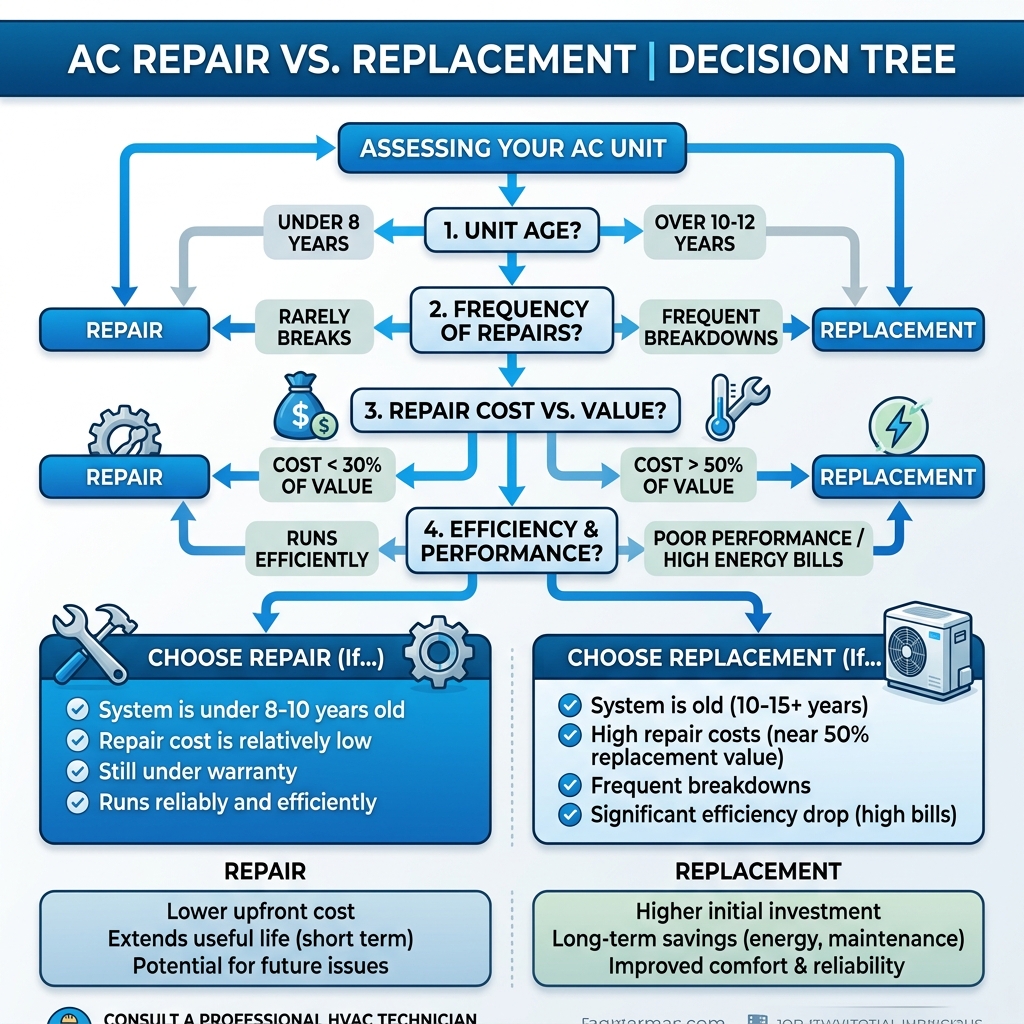
Under 8 years old: repair it (unless the compressor failed). 8-12 years: repair minor issues, seriously consider replacing for major ones. Over 12 years in Birmingham: every major repair should be weighed against replacement. If the repair costs more than 50% of a new system, replace it.
The Repair vs Replace Decision Is Not Always Obvious
The internet is full of oversimplified advice about when to replace your AC. The reality is more nuanced, especially in a market like Birmingham where cooling is not a luxury but a necessity for more than half the year. A system that might have several good years left in Portland or Seattle is under a fundamentally different level of stress in Birmingham. Our summers start in May and do not let up until late September, with temperatures regularly hitting the mid-90s and a heat index that pushes well past 100 degrees. That extended runtime means components wear out faster, refrigerant systems work harder, and electrical parts endure more thermal cycling than in milder climates. The decision to repair or replace should account for your system's age, its repair history, its efficiency rating, the type of refrigerant it uses, and the specific demands that Birmingham's subtropical climate places on cooling equipment. No single factor makes the decision for you, but taken together, they paint a clear picture.
How Your AC's Age Affects the Decision
The average lifespan of a central air conditioning system in the United States is 15 to 20 years. In Birmingham, that number is closer to 10 to 15 years. The difference comes down to usage. In a northern state, an AC might run actively for four months per year. In Birmingham, your system is working from April through October, and even during the milder months of November through March, it still cycles on during warm spells that are common in central Alabama. That seven-month cooling season means your compressor, fan motors, capacitors, and contactors accumulate roughly twice the operating hours of a unit in the upper Midwest. If your system is under 8 years old and has been maintained with annual tune-ups, a repair almost always makes sense unless the compressor itself has failed. Between 8 and 12 years, the decision becomes situational: a minor repair like a capacitor or contactor replacement is worth doing, but a major repair involving the compressor, evaporator coil, or condenser coil warrants serious consideration of replacement. Beyond 12 years in Birmingham's climate, every major repair should be evaluated against the cost and benefits of a new system. You are approaching the end of the unit's practical service life, and investing heavily in aging equipment often leads to another failure within a year or two.
Key Takeaway
Birmingham systems accumulate roughly twice the operating hours of units in northern states. A 12-year-old system here has the wear equivalent of an 18-20 year old system up north. Factor that accelerated aging into every repair-vs-replace decision.
The 50 Percent Rule Explained
The 50 percent rule is the most widely used guideline in the HVAC industry for making the repair vs replace decision. It states: if the cost of the repair exceeds 50 percent of the cost of a new system, replace rather than repair. The logic is straightforward. When you spend more than half the cost of a new system on repairing an old one, you are putting significant money into equipment that has already proven unreliable, has no warranty protection on the repaired component in most cases, and continues to operate at lower efficiency than modern equipment. For Birmingham homeowners, applying this rule requires knowing the approximate range for a new system installation in the local market. A standard residential AC replacement in the Birmingham metro area, including the outdoor condenser, indoor evaporator coil, refrigerant line set, and labor, varies based on the size of the home and the efficiency level selected. A qualified HVAC contractor can provide a specific estimate based on your home. Once you have that number, any repair estimate that exceeds half of it should trigger a serious conversation about replacement rather than repair. Some technicians use an even more aggressive version of this rule for older systems: multiply the age of the system by the repair cost, and if the result exceeds the cost of a new system, replace it. For a 13-year-old system facing a major repair, this formula almost always points toward replacement.
When Frequent Repairs Signal Replacement
One breakdown per summer is frustrating but not necessarily a red flag. Two repairs in the same cooling season is a pattern. Three or more repairs within a 12-month period is your AC system telling you it is entering its end-of-life phase, where components are failing in sequence because they have all accumulated similar wear. This is particularly common in Birmingham because our extended cooling season puts sustained stress on every part of the system simultaneously. When one component fails and is replaced, the surrounding components that have been under the same stress for the same number of years are often close behind. HVAC technicians in Birmingham see this pattern constantly: a homeowner replaces the capacitor in June, the contactor fails in July, and the compressor starts hard-starting in August. Each repair is individually reasonable, but the cumulative cost over a single summer can approach or exceed the threshold where replacement would have been the better investment from the beginning. If you find yourself on a first-name basis with your HVAC technician because they have been to your home multiple times in the past year, it is time to discuss replacement. Track your repair costs over the past two years. If the total exceeds 30 to 40 percent of the cost of a new system, the financial case for replacement is strong regardless of the age of your current unit.
Need help deciding? We'll give you the honest answer — even if it's "just fix it."
Call (205) 994-6402Key Takeaway
Three or more repairs in a single cooling season is a pattern, not bad luck. When components start failing in sequence, the remaining parts are under the same wear. The total repair cost over one summer often approaches what a new system would have cost.
Energy Efficiency and Rising Utility Bills
Your electricity bill during Birmingham's summer months is one of the most reliable indicators of your AC system's health and efficiency. If your July and August electricity costs have been climbing steadily year over year despite no changes in your thermostat settings, your home's insulation, or Alabama Power's rates, your AC system is losing efficiency. All air conditioning systems lose efficiency over time as components wear, refrigerant levels slowly decline through micro-leaks, and coils accumulate years of buildup that reduces heat transfer. In Birmingham, this degradation happens faster because the system runs more hours and handles more moisture than in drier climates. A system that was 14 SEER when it was installed ten years ago may be operating at an effective 10 SEER or lower today. Replacing that degraded system with a modern 16 SEER unit can reduce your cooling costs by 30 to 40 percent. In Birmingham, where cooling accounts for the majority of your summer electricity bill, that efficiency gain translates to real monthly savings. Over the 12 to 15 year lifespan of a new system, those savings offset a meaningful portion of the replacement cost. The math is even more compelling if you are replacing a very old system. Homes in established Birmingham neighborhoods like Mountain Brook, Crestwood, Forest Park, and Roebuck that still have AC systems from the early 2000s or late 1990s may be running at 8 to 10 SEER. Upgrading from 10 SEER to 16 SEER cuts your cooling energy consumption by approximately 37 percent. At Birmingham summer electricity rates, that is a substantial monthly reduction.
The R-22 Refrigerant Factor
If your AC system uses R-22 refrigerant, commonly known by the brand name Freon, the repair vs replace equation shifts dramatically toward replacement. R-22 was phased out of production in the United States on January 1, 2020, as part of the Montreal Protocol to protect the ozone layer. No new R-22 is being manufactured, and the remaining supply is limited to existing stockpiles and reclaimed refrigerant from decommissioned systems. The cost of R-22 has increased sharply as supply has dwindled, and Birmingham HVAC contractors report paying several times what they did five years ago for the same refrigerant. If your R-22 system develops a refrigerant leak, the cost of the refrigerant alone to recharge the system can be substantial. And that recharge only addresses the symptom; the leak itself must be found and repaired, which adds significant labor cost. Even after all that expense, you still have an aging system running on a refrigerant that will only become more scarce and expensive with each passing year. If your system was manufactured before 2010, it almost certainly uses R-22. Check the data plate on the outdoor unit to confirm. If you see R-22, HCFC-22, or Freon listed as the refrigerant, any major repair, particularly one involving the refrigerant circuit, should be weighed against the cost of a new system using R-410A or the newer R-454B refrigerant. The newer refrigerants are readily available, environmentally compliant, and supported by current equipment warranties.
Why Birmingham's Climate Changes the Math
Every repair vs replace calculator you find online uses national averages, but Birmingham is not an average climate. Understanding how our specific conditions affect your AC system helps you make a better decision. Birmingham sits in the intersection of extreme heat and extreme humidity, a combination that makes air conditioning systems work harder than in cities that have only one or the other. Phoenix is hotter, but its dry desert air is easier to cool. Chicago has humid summers, but they last only three months. Birmingham delivers both punishing heat and oppressive humidity for five to six continuous months, creating what HVAC engineers call a high-latent-load environment. This means your AC system is constantly working to remove both heat (sensible load) and moisture (latent load) from the indoor air. That dual workload accelerates wear on compressors, increases stress on electrical components, and drives higher energy consumption. Homes in areas like Hoover, Vestavia Hills, Homewood, and Mountain Brook that are built on the ridges and hills surrounding the Birmingham valley may experience slightly different conditions than homes down in the valley floor neighborhoods like Avondale, Woodlawn, and East Lake, where the bowl shape of the valley traps heat and humidity, making afternoon temperatures feel even more oppressive. The practical impact: a system that might have three to four good years left in Nashville or Charlotte may only have one to two reliable years left under Birmingham conditions. When Birmingham HVAC technicians recommend replacement over repair for an older system, they are not being aggressive; they are factoring in the reality that our climate does not give aging equipment the same grace period that milder markets do.
Signs You Should Repair Your AC
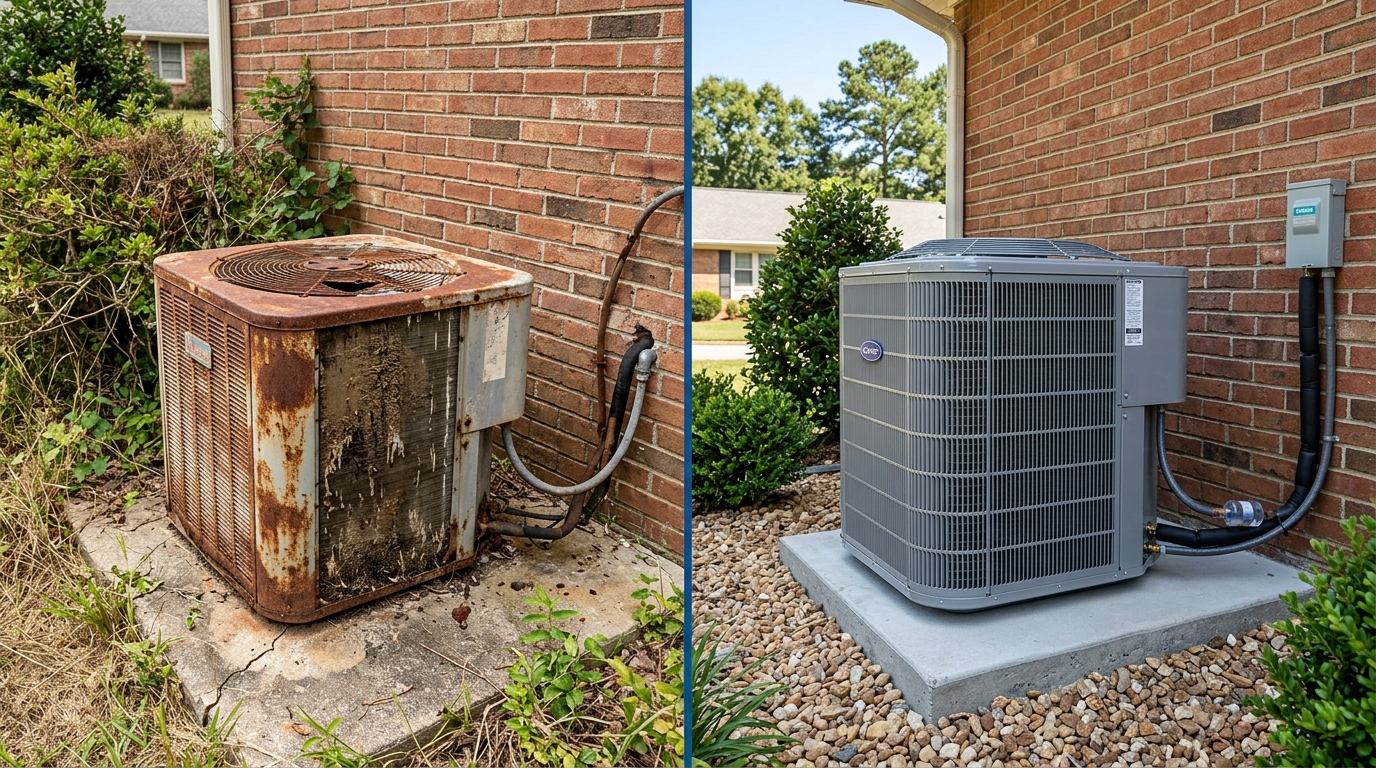
Not every breakdown means replacement. There are clear situations where repairing your current system is the right financial decision. Repair makes sense when your system is under 8 years old and has been regularly maintained, when the repair is a common wear item like a capacitor, contactor, fan motor, or thermostat replacement, when this is the first significant repair the system has needed, when the repair cost is well below 50 percent of the cost of a new system, when the system still uses R-410A refrigerant and the repair does not involve the sealed refrigerant circuit, and when your energy bills have remained stable, indicating the system is still operating near its rated efficiency. Minor component failures happen to even the best-maintained AC systems in Birmingham. A capacitor that fails during the first week of 95-degree weather is one of the most common service calls in the Birmingham metro area, and replacing it is a routine, relatively inexpensive repair that returns your system to full operation. Similarly, a clogged condensate drain line, a worn contactor, or a failed run capacitor are all repairs that make financial sense on a system that otherwise has years of service life remaining. The key question to ask your technician: is this a wear item that failed on schedule, or is this a sign of broader system degradation?
Signs You Should Replace Your AC
Certain situations make replacement the clearly better choice, even if the sticker shock of a new system is significant. Replace when your system is over 12 years old and facing a major repair involving the compressor, evaporator coil, or condenser coil. Replace when the system uses R-22 refrigerant and has developed a leak in the refrigerant circuit. Replace when you have spent more than 30 to 40 percent of the cost of a new system on repairs in the past two years. Replace when your summer electricity bills have increased by 20 percent or more over the past three years with no other explanation. Replace when the system runs continuously during Birmingham's peak heat without reaching the set temperature, which indicates it is undersized or has lost substantial cooling capacity. Replace when the system produces uneven cooling, with some rooms comfortable and others sweltering, that has worsened over time. Replace when you hear grinding, banging, or rattling noises that indicate internal mechanical damage. And replace when the system short-cycles, turning on and off every few minutes, which indicates a serious compressor or electrical problem. In Birmingham, the consequences of an AC failure during peak summer are more severe than in most markets. If you are facing a major repair on an aging system in May or June, the risk of that repaired system failing again in July or August when every HVAC company in the Birmingham metro is booked out for days should factor into your decision.
Understanding SEER Ratings for Birmingham
SEER stands for Seasonal Energy Efficiency Ratio, and it measures how efficiently an AC system converts electricity into cooling. Higher SEER numbers mean less electricity used per unit of cooling delivered. The current federal minimum for the Southeast region, which includes Alabama, is 15 SEER for new installations. Systems manufactured before 2006 may have SEER ratings as low as 10, and systems from the early 2000s or late 1990s could be even lower. When evaluating replacement options for your Birmingham home, the SEER rating directly affects your long-term operating costs. A 16 SEER system uses approximately 6 percent less energy than a 15 SEER system, and a 18 SEER system uses approximately 17 percent less than a 15 SEER unit. In a climate like Birmingham where the AC runs for six or more months per year, those percentage differences translate to meaningful dollar amounts on your monthly Alabama Power bill. The sweet spot for most Birmingham homeowners is a 16 to 18 SEER system. Below 16 SEER, you are barely meeting the minimum and leaving savings on the table in a market where cooling costs dominate your electricity budget. Above 18 SEER, the upfront cost premium increases significantly and the payback period extends to the point where it may not make financial sense for all homeowners. Variable-speed and two-stage systems in the 16 to 18 SEER range offer an additional benefit that is particularly valuable in Birmingham: better humidity control. These systems run at lower capacity for longer periods, which removes more moisture from the air and keeps indoor humidity at a more comfortable level. In Birmingham's 70 to 85 percent outdoor humidity, this moisture removal capability makes a noticeable difference in how comfortable your home feels, even at the same thermostat setting.
Best Time of Year to Replace Your AC in Birmingham
If you have decided that replacement is the right move, timing your purchase strategically can save you money and hassle. The worst time to replace your AC in Birmingham is during a heat wave in July when your old system has just died. You are making a rushed decision under pressure, the HVAC companies are at peak demand and may have limited scheduling availability, and equipment inventory may be constrained. The best time for a planned AC replacement in the Birmingham market is during the shoulder seasons: late February through April, or October through November. During these months, HVAC contractors have more availability for installation scheduling, equipment distributors have full inventory with the widest selection of models and sizes, you can take your time comparing estimates from multiple contractors without the urgency of living without cooling, and many manufacturers and distributors offer promotional pricing during the shoulder seasons to encourage off-peak sales. Spring replacement is particularly strategic in Birmingham because it ensures your new system is installed, tested, and running perfectly before the first scorching week of Alabama summer. You get peace of mind knowing you have a brand-new system with a full manufacturer warranty heading into the most demanding months of the year. If your current system is showing warning signs like rising energy bills, increasing repair frequency, or inconsistent cooling, and it is currently late fall or winter, use the mild months to plan and execute a replacement before the next summer season arrives.
Your Next Steps
Whether you are facing an immediate repair decision or planning ahead for a replacement, having a professional assessment of your current system gives you the information you need to make the right call. A qualified HVAC technician can evaluate your system's current condition, measure its actual operating efficiency, check refrigerant type and levels, assess the condition of major components, and give you an honest recommendation based on what they find. At After Hours HVACR, we serve homeowners across the Birmingham metro area, including Hoover, Vestavia Hills, Homewood, Mountain Brook, Trussville, Pelham, and Alabaster. Our technicians will give you a straightforward assessment and a written estimate before any work begins, so you can decide what is best for your home and your budget. No pressure, no gimmicks, just professional advice from licensed technicians who know Birmingham's climate and what it does to cooling equipment.
Need a Professional Assessment?
Our licensed Birmingham technicians will evaluate your system and give you an honest recommendation. Ask for a written estimate before any work begins.
call CALL NOW (205) 994-6402Call for a professional estimate on repair or replacement
Download Our Birmingham HVAC Homeowner Guide
Seasonal checklists, troubleshooting steps, and maintenance schedules built for Alabama's climate. Written by licensed HVAC technicians.
call Call (205) 994-6402Sources & Citations
EPA — Indoor Air Quality — Federal standards for indoor environmental quality and HVAC systems
U.S. Department of Energy — Air Conditioning — Energy efficiency standards and maintenance guidance
ASHRAE — American Society of Heating, Refrigerating and Air-Conditioning Engineers technical standards
ENERGY STAR — Heating & Cooling — Certified equipment ratings and efficiency benchmarks
NATE — North American Technician Excellence — HVAC technician certification standards
Alabama Board of Heating, Air Conditioning & Refrigeration Contractors — State licensing authority
About the After Hours HVACR Editorial Team
Our content is written and reviewed by Alabama-licensed HVAC technicians with NATE certification and EPA 608 Universal credentials. The After Hours HVACR team has decades of combined field experience diagnosing and repairing residential and commercial systems across Hoover, Vestavia Hills, Pelham, Homewood, and Mountain Brook. Every article reflects real-world troubleshooting knowledge from Birmingham's unique climate — not recycled advice from a national template.
Read Next
Keep going. These pair well with what you just read.
$5000 Rule for HVAC Birmingham AL
The repair-or-replace math every Birmingham homeowner should run before signing.
COSTEmergency AC Repair Cost Birmingham AL 2026
A 2026 cost framework so you know what reasonable looks like.
EMERGENCYAC Died at Night Birmingham? What to Do
What to do when the AC quits at 2 AM — before, during, and after the call.
Related Resources for Birmingham Homeowners
AC Blowing Warm Air? What to Check First
5 troubleshooting steps to try before calling for emergency service.
Emergency AC Repair Costs in Birmingham
What to expect when you need emergency AC service in the Birmingham area.
Birmingham Summer HVAC Survival Guide
Monthly maintenance checklist to prevent AC problems before they start.
After Hours HVACR Emergency Services
24/7 emergency HVAC service across the Birmingham metro area.