HVAC Maintenance Checklist for Birmingham Homeowners
When your HVAC system fails, you need fast, professional service. This is the checklist we wish every homeowner had before summer. Not a generic national template — one calibrated specifically for Birmingham's climate, housing stock, and the specific failure modes we see most often. Some of these tasks you can do yourself. Some need a licensed technician. The list tells you which is which.
Quick Answer
Monthly: replace filter, bleach the drain line, clear debris from outdoor unit. Spring: schedule professional tune-up before summer. Summer: check filter monthly, monitor drain line. Fall: switch to heating mode and test before cold weather. Annual: professional coil cleaning, refrigerant check, electrical inspection.
1. Monthly Tasks (DIY)
These take about 10 minutes total once a month. Do them consistently and you eliminate the most common preventable failures.
During cooling season (May-September), check monthly. Replace if gray or darker. Don't wait until it's black. In Birmingham, monthly replacement is standard during summer due to pollen and dust load. Year-round, check every month and replace every 1-3 months.
Mix 1 cup bleach with 1 gallon water. Pour down the condensate drain access port (a capped pipe near the air handler, usually in the attic or utility closet). This kills algae before it forms a clog. Takes 2 minutes. Prevents water backup and potential ceiling damage.
Remove leaves, grass clippings, and any debris that's accumulated around the outdoor unit. Keep a clear 18-24 inch clearance on all sides. Trim any vegetation that has encroached since last month.
Make sure furniture hasn't been moved to block supply or return registers. Blocked returns starve the system of airflow. Blocked supply vents create pressure imbalances. Takes 60 seconds to walk the house and look.
Key Takeaway
Four tasks, ten minutes a month: replace the filter, bleach the drain line, clear debris from the outdoor unit, and check that no vents are blocked. These four things prevent the majority of preventable HVAC failures in Birmingham.
2. Spring Checklist (March–April)
Spring is the most important maintenance window of the year for Birmingham homeowners. Before you need cooling, you want the system inspected, cleaned, and cleared of any issues.
DIY Tasks
If you covered the outdoor unit over winter, remove the cover completely before running the system. Never run the AC with a cover in place.
Turn on AC for 15-20 minutes on a mild day. Listen for unusual sounds. Check that cool air is coming from registers. Verify the thermostat is working. Better to find problems now than when it's 95 degrees.
First bleach treatment of the season. More important than any other month because algae has had all winter to establish in any standing water in the pan.
The refrigerant lines from the outdoor unit to the house are wrapped in foam insulation. Check visible sections for cracks, tears, or missing insulation. Damaged insulation causes condensation and moisture problems.
Professional Service (Schedule March–April)
Coil cleaning, refrigerant pressure check, capacitor and contactor testing, electrical inspection, drain line service, blower motor check, thermostat calibration verification.
Spring tune-up season is now. Schedule before the rush.
Call (205) 994-6402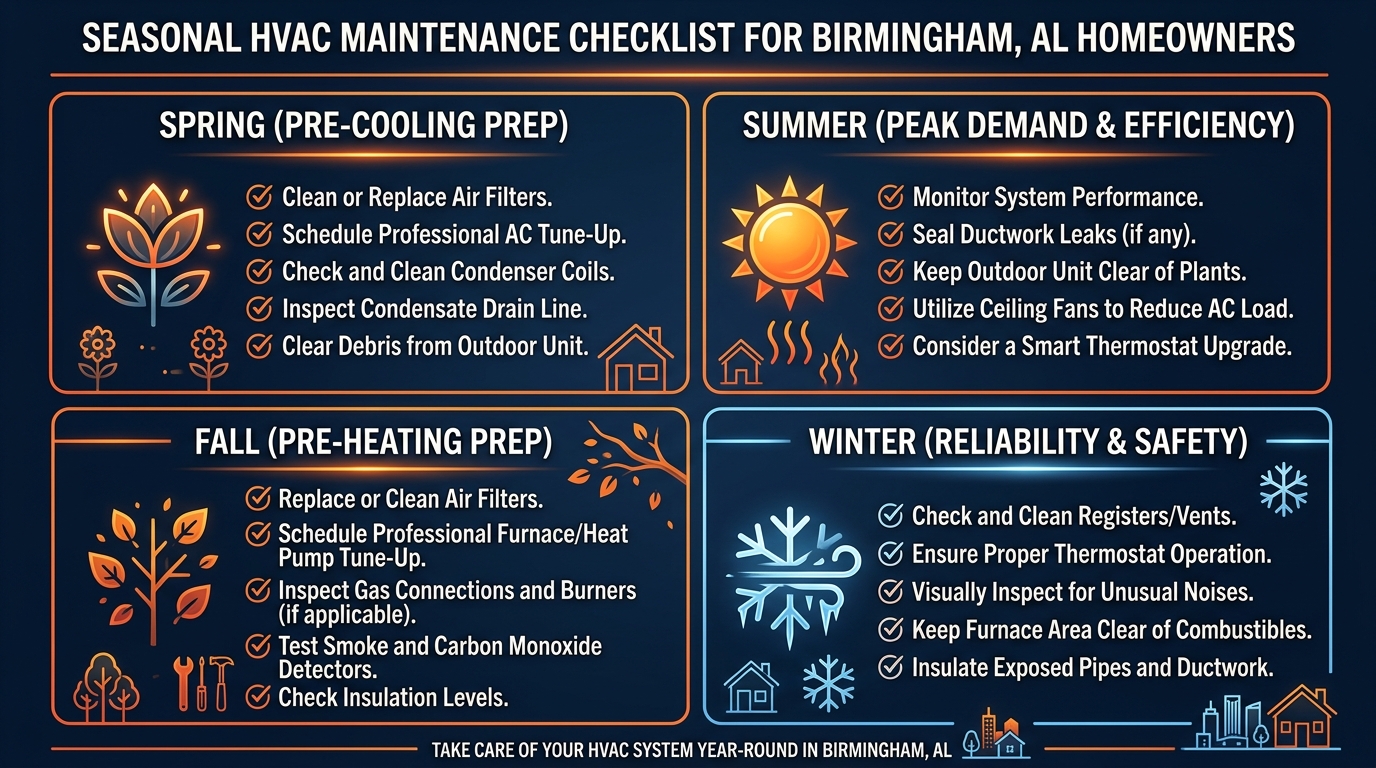
3. Summer Checklist (May–September)
During peak cooling season, your job is monitoring and maintaining good practices. The professional work was done in spring.
Summer pollen and dust loads are highest. Check every two weeks, replace when gray. Don't wait a full month during peak summer.
Bleach solution down the condensate drain every month throughout summer. The warmer it is, the faster algae grows.
System running longer than usual, warm spots, unusual sounds, higher energy bills. Act on these instead of hoping they go away. See our warning signs article.
Storms can deposit debris inside the outdoor unit, knock the unit off its pad, or damage the disconnect. Check after significant weather events.
Set setback temperatures when away. Letting the house get to 82 when empty and cooling to 76 when you return saves energy. Setting it below 72 when it's 95 outside just strains the system.
4. Fall Checklist (October–November)
DIY Tasks
Turn on heat when it's 60 degrees outside — not when it's 28. You want to find out it doesn't work while it's mild, not during the first cold snap.
Battery-powered thermostats fail at inconvenient times. Replace batteries every fall on a schedule rather than waiting for failure.
Replace CO detector batteries before heating season. Non-negotiable in any home with gas appliances.
Professional Service (October)
Igniter testing, heat exchanger inspection, burner cleaning, flue inspection, pressure switch test, gas valve check (gas systems). Heat pump: reversing valve operation, defrost board test, refrigerant check.
Key Takeaway
Test your heat when it's still 60 degrees outside, not during the first freeze. Finding out your furnace doesn't work during a mild October afternoon is inconvenient. Finding out at midnight in January with the house at 45 degrees is an emergency.
5. What Should Happen During a Professional Tune-Up
A legitimate professional maintenance visit does all of this. If a contractor shows up and spends 20 minutes hose-rinsing the outdoor unit and calls that a tune-up, that's not what you paid for.
Cleaned with coil cleaner, not just hosed. Fins straightened where needed.
Inspected and cleaned of dust buildup.
Tested for actual capacitance value vs. rated value. Flagged if below 80% of rating.
Measured and compared to manufacturer specs for outdoor temp.
Flushed and tested for flow. Pan inspected for standing water or algae.
All terminals inspected for corrosion and tightness.
Amperage tested. Bearings checked for noise or wear.
Verified to be reading and controlling accurately.
6. Birmingham-Specific Considerations
Standard maintenance guidance isn't always calibrated for Alabama. Here's what's different here:
- Coil cleaning twice a year. Spring and fall, not just once. The pollen and cottonwood season in spring plus the fall leaf drop justify double cleaning in Alabama.
- Monthly drain line treatment all summer. Algae growth in Birmingham condensate drains is aggressive. Monthly bleach treatment prevents clogs that cause water damage.
- Filter changes more frequently than the package says. Most filters say 90 days. In Birmingham, 30 days during summer is the practical interval.
- Watch for moisture intrusion in attic air handlers. Humid attics in summer stress air handlers and can cause condensation on the outside of ducts and equipment. Inspect attic systems for moisture signs annually.
- Schedule earlier than you think you need to. By May, every HVAC company in Birmingham is at capacity. Get on the spring maintenance schedule in March.
Schedule Your Spring Maintenance
Don't wait until summer. Schedule now while the calendar is open.
call (205) 994-6402HVAC Maintenance FAQ
What can I do myself vs. what needs a pro?
DIY: filter changes, drain line bleach treatment, clearing debris from outdoor unit, checking registers. Pro: coil cleaning, refrigerant check, capacitor testing, electrical inspection, heat exchanger inspection. The line is electrical components and refrigerant — those need proper tools and certification.
When should I schedule professional maintenance in Birmingham?
March or April for spring. October for fall. Earlier is better — May appointments are hard to get without waiting in line behind emergency calls.
How often should I change my filter in Birmingham?
Monthly during May-September. Every 1-3 months the rest of the year. Check it every month regardless — if it's gray, replace it.
Does maintenance actually prevent breakdowns?
It prevents most of the common ones. Capacitor failure, refrigerant issues, clogged drains — these are all caught during maintenance and addressed before they cause a failure. Some failures are random and not preventable. But in our experience, most emergency summer calls involve systems that didn't have spring maintenance.
What's the most important maintenance task?
Keeping the condenser coil clean. In Alabama's heat, a dirty coil that reduces heat rejection makes the compressor work much harder, shortens its life, and drives up energy bills. Annual spring coil cleaning is the highest-return maintenance investment.
Download Our Birmingham HVAC Homeowner Guide
Seasonal checklists, troubleshooting steps, and maintenance schedules built for Alabama's climate. Written by licensed HVAC technicians.
call Call (205) 994-6402Sources & Citations
EPA — Indoor Air Quality — Federal standards for indoor environmental quality and HVAC systems
U.S. Department of Energy — Air Conditioning — Energy efficiency standards and maintenance guidance
ASHRAE — American Society of Heating, Refrigerating and Air-Conditioning Engineers technical standards
ENERGY STAR — Heating & Cooling — Certified equipment ratings and efficiency benchmarks
NATE — North American Technician Excellence — HVAC technician certification standards
Alabama Board of Heating, Air Conditioning & Refrigeration Contractors — State licensing authority
About the After Hours HVACR Editorial Team
Our content is written and reviewed by Alabama-licensed HVAC technicians with NATE certification and EPA 608 Universal credentials. The After Hours HVACR team has decades of combined field experience diagnosing and repairing residential and commercial systems across Hoover, Vestavia Hills, Pelham, Homewood, and Mountain Brook. Every article reflects real-world troubleshooting knowledge from Birmingham's unique climate — not recycled advice from a national template.
Read Next
Keep going. These pair well with what you just read.
Birmingham Summer HVAC Checklist
A monthly Birmingham checklist to prevent breakdowns before they start.
AC REPAIRAC Drain Line Clogged in Birmingham? Fix It Tonight
Why a clogged condensate line shuts the whole system down.
DUCTWORKDuct Cleaning Birmingham AL — Is It Worth It?
When duct cleaning helps, when it does not, and what scams to avoid.