Signs Your AC Is About to Break Down
Most AC failures in Birmingham don't come out of nowhere. The system gives you warnings. The problem is that most homeowners don't know what to look for — or they notice something but hope it goes away. It doesn't go away. It gets worse. Here are the signs to watch for, and what each one usually means.
Quick Answer
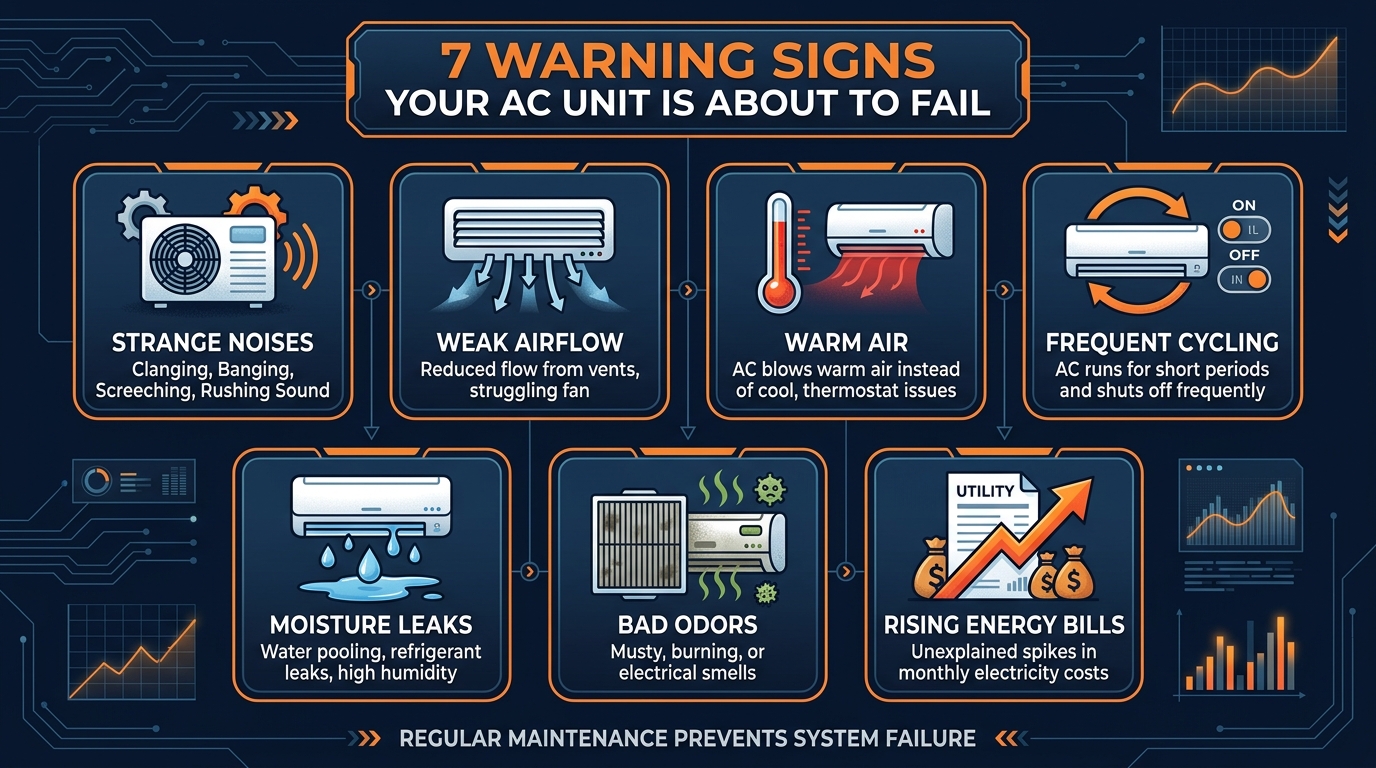
The 7 biggest warning signs your AC is failing: longer run times, warm air from vents, strange noises, increased humidity indoors, tripping breakers, ice on refrigerant lines, and unexplained energy bill spikes. Any one of these caught early is a manageable repair. Ignored, each one leads to a complete system failure.
1. The System Runs Longer Than It Used To
This is the most consistent early warning sign, and it's easy to miss because the change is gradual. Your system used to cool the house down in 20 minutes on a 90-degree afternoon. Now it runs for 45 minutes and barely gets there. You tell yourself it's just hot outside — but it's the same temperature as last year.
What's actually happening: the system has lost efficiency. The most common causes in Birmingham are a dirty condenser coil (reducing heat rejection), a refrigerant leak (reducing cooling capacity), or a capacitor degrading (making the compressor work harder to start and run). All of these are fixable when caught early.
Left alone, a system straining to cool eventually fails completely — usually on the hottest day of the year, when every HVAC company in town is booked out. Getting a diagnostic call in April or May is the smart play.
2. Warm Air from the Vents
Hold your hand over a supply vent when the AC is running. It should feel noticeably cooler than room temperature — typically 15-20 degrees below the air entering the return. If what comes out is room temperature or slightly cool but not cold, something is wrong.
Warm air from running AC is almost always one of three things: low refrigerant, a failing compressor, or the outdoor unit isn't running at all (the indoor blower is moving air but nothing is conditioning it). Check that the outdoor unit is actually running — you should hear the compressor and see the fan spinning. If the outdoor unit is silent, start there.
Don't run the system for hours trying to get the house to cool down when it's putting out warm air. A failing compressor working against a refrigerant problem can burn out completely. Turn it off and call.
Key Takeaway
If your vents are blowing room-temperature air while the system runs, turn the AC off immediately. Running a struggling compressor against a refrigerant problem can turn a moderate repair into a full system replacement.
3. Strange Noises from the Outdoor Unit
A properly functioning outdoor unit makes a consistent hum — the compressor and the condenser fan running. Deviations from that baseline are worth paying attention to:
- Clicking when starting or stopping — normal in small amounts, but repeated clicking that goes on for a while before the unit starts can mean a failing capacitor or contactor
- Grinding or screeching — fan motor bearing failure. Don't ignore this. Bearings fail fast once they start making noise.
- Banging or clanking — loose fan blade hitting something, or debris inside the unit. Shut the unit down and look before running it further.
- Rattling — often loose panels or duct connections, occasionally something inside the unit vibrating loose.
- Hissing or bubbling — refrigerant leak. Hissing is refrigerant escaping under pressure; bubbling is refrigerant in liquid form with gas bubbles from a low charge.
Noise is your system telling you something. Take the communication seriously.
4. Your House Is More Humid Than Usual
Air conditioning does two things: it cools your air and it dehumidifies it. The dehumidification happens as a byproduct of the cooling process — warm humid air passes over the cold evaporator coil, moisture condenses out, and the condensate drains away.
In Birmingham's climate, a system that can't dehumidify properly makes the house feel much more uncomfortable than the temperature number suggests. That sticky, clammy feeling at 74 degrees when the thermostat is satisfied means your system isn't doing its full job.
Common causes: an oversized system that short-cycles (doesn't run long enough to pull humidity), a system with very low refrigerant (reduces the dehumidification capacity), or a dirty evaporator coil. Humidity issues that develop after years of normal operation usually indicate a maintenance problem rather than an oversized system.
Noticing any of these warning signs? Don't wait for a full breakdown.
Call (205) 994-64025. The Circuit Breaker Is Tripping
An AC that repeatedly trips its breaker is not a breaker problem — it's a system problem. The breaker is doing exactly what it's supposed to do: protecting the circuit from overcurrent. The question is what's causing the overcurrent.
In order of likelihood: a failing compressor drawing more current than it should as it ages, a seized fan motor, a short in the wiring, or a failing capacitor causing hard starts that spike current draw. All of these require a technician with proper tools to diagnose safely.
The wrong move is resetting the breaker repeatedly without finding the cause. Each overcurrent event stresses the wiring and components further. If your AC is tripping the breaker, reset it once and call for service. If it trips again, leave it off until someone looks at it.
6. Ice Forming on the System
Ice on an air conditioning system seems counterintuitive — it's already cold, right? But ice on the refrigerant lines or evaporator coil is actually a symptom of something going wrong, not the system working well.
The evaporator coil should be cold, but not cold enough to freeze the moisture condensing on it. When it ices up, either the airflow across the coil has been restricted (most often by a severely clogged filter) or the refrigerant level is so low that the coil temperature drops below freezing.
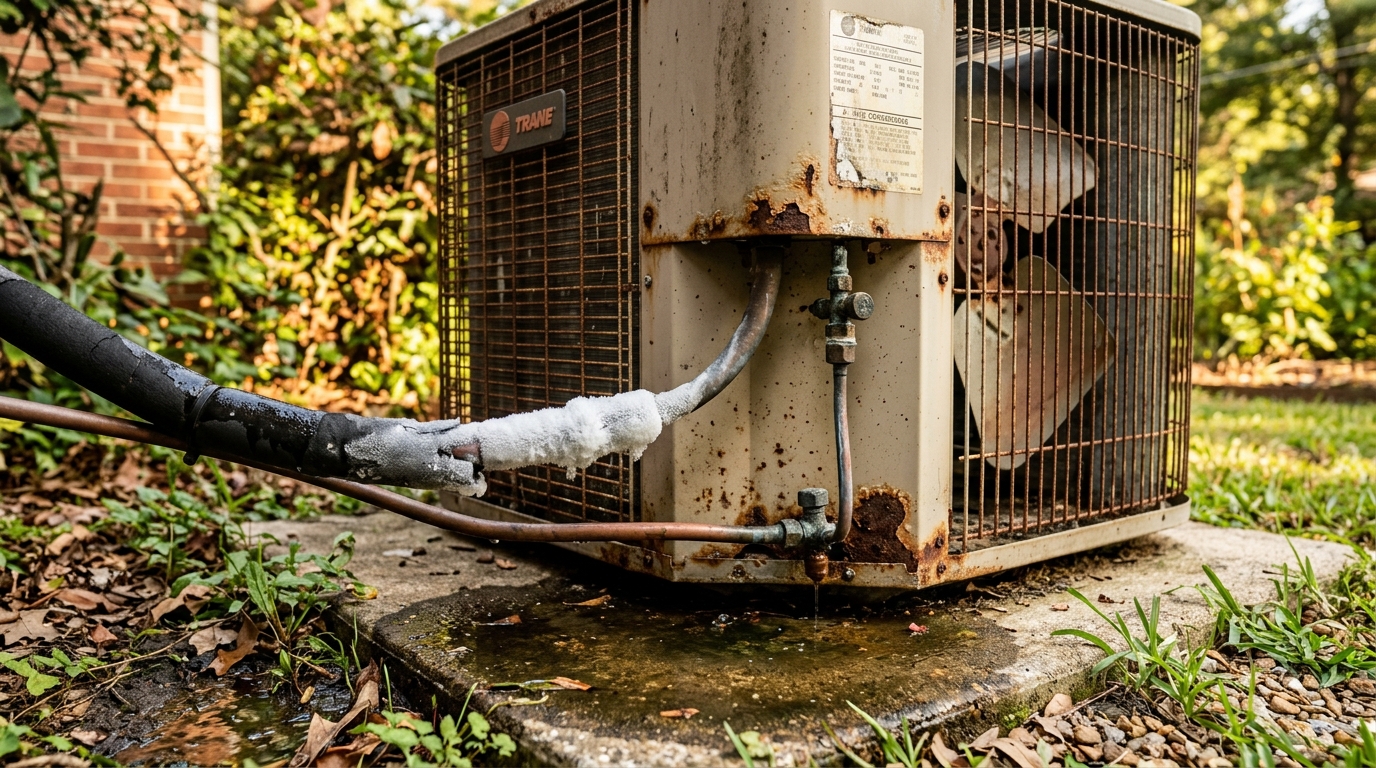
If you see ice on the refrigerant lines coming out of the air handler, or on the outdoor unit: turn the system to fan-only mode (not AC) and let it thaw. Do not run AC with a frozen coil — it will damage the compressor. Check your filter first. If a clean filter doesn't resolve it, call us — you likely have a refrigerant leak.
Key Takeaway
Ice on your AC is never normal. Switch to fan-only mode and let it thaw completely before doing anything else. A clogged filter is the most common cause, but if a fresh filter doesn't fix it, you're likely looking at a refrigerant leak that needs professional attention.
7. Energy Bills Spiking Without Explanation
Compare your July and August bills this year to the same months last year. If your usage is up 15-20% with no change in how you use the house, your HVAC system is the first place to look. It's the single largest energy consumer in most homes.
A system working harder than it should — dirty coils, low refrigerant, degraded components — consumes more electricity to deliver the same or lesser cooling. This inefficiency shows up as higher bills before it shows up as a complete failure.
Rule out other explanations first: a guest staying for a month, a new appliance, unusual usage patterns. If nothing else explains the increase, get the HVAC system checked.
Every one of these warning signs is cheaper to address now than in the middle of summer. A degrading capacitor caught during a scheduled maintenance visit is a routine fix. That same capacitor failing at 10pm in July — with a house full of people and every HVAC company in Birmingham slammed — is a different conversation entirely. Do not ignore the warnings.
Notice a Warning Sign?
Call us before it becomes an emergency. Scheduled diagnostic visits are easier on everyone than midnight breakdowns.
Download Our Birmingham HVAC Homeowner Guide
Seasonal checklists, troubleshooting steps, and maintenance schedules built for Alabama's climate. Written by licensed HVAC technicians.
call Call (205) 994-6402Frequently Asked Questions
What's the most common AC warning sign in Birmingham?
The system running longer than it used to without reaching temperature. It's subtle enough that most people dismiss it, but it's almost always a sign of declining system efficiency that will eventually result in complete failure.
How long do I have if my AC is showing warning signs?
It varies by cause. A tripping breaker could be days away from a complete failure. Gradually declining performance might continue for a season. The only way to know how much time you have is to get it diagnosed. Don't wait if it's spring — get it looked at before summer.
Can I prevent my AC from breaking down?
Annual maintenance significantly reduces failure probability. Clean filters, cleared outdoor units, and prompt attention to warning signs help too. No system lasts forever, but most premature failures are preventable.
What should I do when I notice a warning sign?
Call a licensed tech for a diagnostic visit. Don't wait. A proactive repair is almost always cheaper than an emergency midnight call.
Is a tripping breaker dangerous?
Yes. Reset it once, and if it trips again leave it off and call for service. Repeatedly resetting a tripping breaker risks wiring damage and compressor failure.
Sources & Citations
EPA — Indoor Air Quality — Federal standards for indoor environmental quality and HVAC systems
U.S. Department of Energy — Air Conditioning — Energy efficiency standards and maintenance guidance
ASHRAE — American Society of Heating, Refrigerating and Air-Conditioning Engineers technical standards
ENERGY STAR — Heating & Cooling — Certified equipment ratings and efficiency benchmarks
NATE — North American Technician Excellence — HVAC technician certification standards
Alabama Board of Heating, Air Conditioning & Refrigeration Contractors — State licensing authority
About the After Hours HVACR Editorial Team
Our content is written and reviewed by Alabama-licensed HVAC technicians with NATE certification and EPA 608 Universal credentials. The After Hours HVACR team has decades of combined field experience diagnosing and repairing residential and commercial systems across Hoover, Vestavia Hills, Pelham, Homewood, and Mountain Brook. Every article reflects real-world troubleshooting knowledge from Birmingham's unique climate — not recycled advice from a national template.
Read Next
Keep going. These pair well with what you just read.
AC Compressor Failure Signs: When to Call in Hoover, AL
Catch a dying compressor in Hoover before peak heat finishes it off.
AC REPAIRAC Drain Line Clogged in Birmingham? Fix It Tonight
Why a clogged condensate line shuts the whole system down.
AC REPAIRAC Running But Not Cooling? Birmingham Fix Guide AfterHours HVACR
Air is moving but the house is not cooling. Run this checklist first.