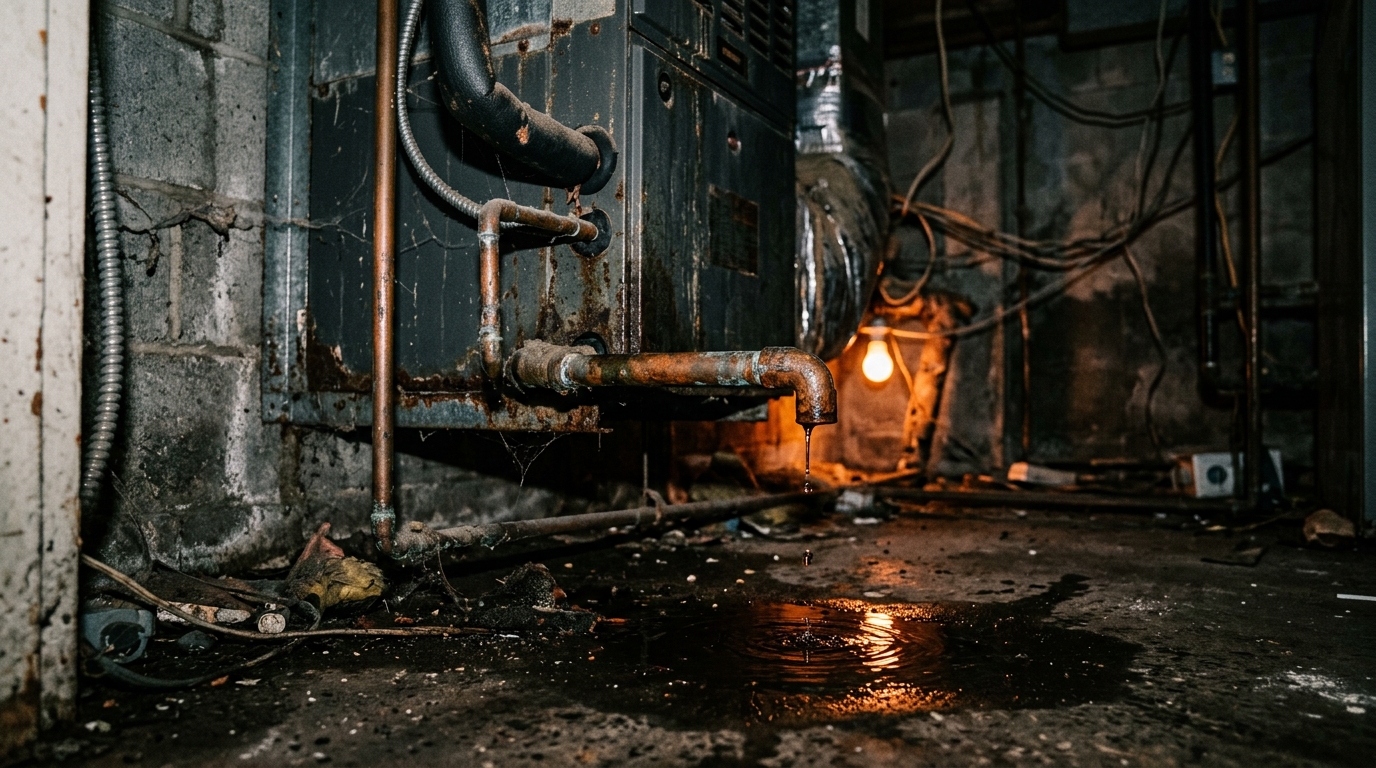
Why Is My AC Leaking Water Inside? A Birmingham Tech's Field Guide
You found a puddle under the air handler at 11 PM in July. Or worse — water spreading through the ceiling under your attic unit. Here is what is actually happening, what to do in the next ten minutes, and which of the six common causes is bleeding into your house tonight.
1. What to Do in the Next Ten Minutes
Before you start diagnosing anything, stop the bleed. Every minute the system runs while leaking is more water spreading through your floor or attic insulation.
- Set the thermostat to OFF (not just up — fully off).
- Walk to your electrical panel and flip the breaker labeled "AC," "Air Handler," or "Furnace." Both the indoor and outdoor breakers if you have them.
- Lay every old towel you have under the air handler. Move boxes, holiday decorations, anything stored within five feet.
- If the leak is in the attic and you see ceiling staining downstairs, get a bucket under the worst spot and gently poke the bulge with a screwdriver to drain it controlled. A bulging wet ceiling is going to give way — better on your terms than at 3 AM.
- Take photos. Insurance and any future contractor will want them.
Now you have time to work the list. The system will not heal itself, but it also will not get worse while it is off.
Birmingham reality check
A Birmingham AC running through July humidity pulls 10 to 20 gallons of water out of your indoor air every day. That is the water volume looking for a way out. If the drain is blocked, that is what spills into your house.
2. Cause #1: Clogged Condensate Drain Line
This is the cause about 70% of the time. The condensate drain is a 3/4-inch PVC pipe running from the drain pan under the evaporator coil out to your yard, a sink trap, or a condensate pump. It carries everything the AC pulls from the air, plus dust, biofilm, and the occasional dead bug.
In Birmingham's heat and humidity, algae and slime grow inside that line in weeks. The bowl-geography of Birmingham traps moisture, and outdoor humidity above 80% from May through September means your AC pulls water continuously — perfect feedstock for a slime colony inside a dark, warm pipe.
How to Tell
Walk outside and find the drain line termination — typically a 3/4-inch white PVC stub poking out of an exterior wall, often near the AC condenser. If you see no water dripping out of it on a hot day with the AC running (before you shut it off), the drain is clogged. A working drain in Alabama summer drips constantly.
DIY Fix
- Find the drain access tee — a T-shaped fitting with a removable cap on the line near the air handler. It is usually capped with PVC or rubber.
- Pour one cup of distilled white vinegar (or 1 cup bleach mixed with 1 gallon water) into the open access port. Wait 30 minutes.
- If that does not clear it, take a shop vacuum to the outdoor drain termination. Seal the vac hose around the pipe with a rag, run for 90 seconds, repeat three times. The slime plug will appear in your vac canister.
Pour another cup of vinegar through the system after clearing it. Then mark your calendar to repeat monthly during cooling season. Birmingham drains need this. Phoenix drains do not. We do not control the climate.
3. Cause #2: Frozen Evaporator Coil
When the evaporator coil freezes, ice forms on the fins and the drain pan. Once you shut the system off, that ice melts — fast — and overwhelms the drain. Even a perfectly clean drain cannot handle a 30-pound block of ice melting in twenty minutes. The pan overflows and the leak appears around the air handler.
A frozen coil is itself a symptom. The underlying cause is one of three things: low refrigerant (leak), restricted airflow (dirty filter, blocked return), or a failing blower motor. None of those self-correct.
How to Tell
Open the air handler access panel. If you see ice on the copper coil itself, the suction line (the larger insulated copper pipe), or visible frost in the drain pan, the coil was or is frozen. Sometimes you can see ice on the outdoor refrigerant line set as well — frost on the suction line at the condenser is a dead giveaway.
DIY Fix
Leave the system off but turn the thermostat fan to ON for two to four hours. The blower will move room-temperature air across the coil and thaw it without burning out the compressor. Replace the filter while you wait. Once thawed, run the system for 30 minutes and check whether the cold air is actually cold (under 60°F at the supply register). If it is, you bought time but you still have a refrigerant or airflow problem to address. We cover the deeper diagnosis in our why your AC freezes up in Alabama summer post.
If the coil refreezes within an hour of restart, the refrigerant charge is low. That is an EPA 608-licensed repair — Section 608 of the Clean Air Act prohibits anyone without that certification from handling refrigerant. Call us.
4. Cause #3: Rusted-Through Drain Pan
Most residential air handlers have two drain pans. The primary pan is built into the coil assembly and catches condensate as it drips off the evaporator coil. The secondary pan sits beneath the entire air handler as a safety catch. Both can rust through.
In Birmingham humidity, drain pans corrode faster than they do in dry climates. We see rusted primary pans on systems as young as ten years old in homes near Shades Creek, the Cahaba River bottoms, and lower-elevation parts of Pelham and Helena. Galvanized steel pans go first. Plastic pans crack but rarely rust.
How to Tell
Pull the access panel and look at the pan directly under the coil. Active rust looks like orange-brown crust with pitting. A cracked plastic pan will show a hairline split, often along a stress edge. If you can see daylight through the pan from underneath, it is replacement time.
Fix
A rusted primary pan is not a DIY fix in most systems. Replacing it requires pulling the evaporator coil, which means disconnecting refrigerant lines (EPA-licensed work) and a new pan-coil assembly. On older systems, a rusted pan often signals it is time to discuss whether the whole evaporator coil should be replaced. Get a tech out to assess. Our AC repair page covers what we look for.
5. Cause #4: Dead Condensate Pump
If your air handler is in a basement or below the level of where the drain line exits the house, gravity cannot move the water. A condensate pump — a small plastic box with a float switch and a tiny pump — does that work. It fails. They are not built to last forever, and Birmingham humidity is hard on them.
Common in finished basements in Mountain Brook, Vestavia Hills, and Homewood where the air handler sits in a utility closet below grade. Also common in older Crestline and Forest Park homes with retrofitted central air.
How to Tell
Look for a small plastic reservoir near the air handler with a clear discharge tube running up and out. If the reservoir is full of water and the pump is silent, it is dead. Sometimes you can hear them try to start and fail — a faint clicking. Lift the lid and check for slime; sometimes the float is just stuck.
DIY Fix
Unplug the pump. Lift the lid. Clean the float chamber with a paper towel and dilute bleach. Plug it back in. If it still does not run, the motor is dead. A replacement pump runs $40-$80 at any home center. Wiring is straightforward — they typically use a standard 120V plug. Match the discharge head height of the original (most are rated 15-20 feet of vertical lift).
6. Cause #5: Dirty Air Filter
A dirty filter is the gateway drug to half the AC problems we get called for. Restricted airflow drops the coil temperature below freezing, the coil ices over, the ice melts after shutoff, and you have a leak. The fix is a $5 filter you should have changed two months ago.
Birmingham's pollen, red clay dust, and humidity load filters faster than national averages. The "90 day filter" the manufacturer claims is closer to 30-45 days here in cooling season. Pet households and homes with hardwood floor remodels in progress need monthly changes minimum.
How to Tell
Pull the filter. Hold it up to a light. If you cannot see light clearly through the pleats, it is too clogged. If it looks gray or brown across the entire surface — replace.
Fix
Replace with the same dimensions and a MERV rating between 8 and 11 for residential. Avoid MERV 13+ filters unless the system was designed for them — they choke airflow on standard residential systems. The Department of Energy's air conditioner maintenance guidance backs the monthly-check, every-90-days-replace cadence at minimum.
Water still spreading? Don't wait for daylight.
Call (205) 994-64027. Cause #6: Float Switch Issues
A float switch is a small safety device — a magnet that floats up when the secondary drain pan or condensate pump reservoir fills with water. When it lifts, it cuts power to the air handler so the system stops adding water. Two failure modes: the switch failed to trip (and the system kept running, flooding your house), or the switch tripped (and the system is stuck off).
If the AC is silent and you also see water around the air handler, check the float switch first before you assume the compressor is dead. They are easy to miss because they look like a small black plastic clip on the drain line.
DIY Fix
Find the float switch — typically clipped onto the drain pan or in-line on the condensate pump. If the float is jammed up by debris, gently free it. After the underlying water issue is resolved (drain unclogged, pan emptied), the switch resets. If it does not reset, check the wiring connection at the air handler control board. Test the switch by lifting it manually and seeing if the air handler shuts off — if it does not, the switch is bad and the system has been running with no safety.
8. Why This Happens More in Birmingham Than Other Cities
We get this call more often than techs working in dry climates. The reason is climate-mechanical, not bad luck.
Per NOAA Birmingham climate records, summer dewpoints sit in the high 60s to low 70s for months. Dewpoint above 65 is what feels muggy. Above 70 is oppressive. That moisture all has to come out of the air through your evaporator coil and out through your drain line. Multiply that by 100 days and you have a drain handling a small lake.
Drain lines clog faster. Drain pans rust faster. Filters load faster. Coils freeze easier when oversized AC systems short-cycle in our climate. Every weakness in the system gets stress-tested by Alabama summer. The fix is not to install a different system — it is to maintain the system you have on a Birmingham-aware schedule, not the schedule the manufacturer printed for the national average.
If you are in Hoover, Vestavia Hills, Mountain Brook, or anywhere else across our coverage area, we run drain-line treatment as part of our spring tune-up. It is the cheapest insurance policy against the call you just made.
Active Leak in the House?
Shut the system off, lay towels, and call. We dispatch nights and weekends. Water damage compounds — getting a tech to you tonight is cheaper than the drywall, flooring, and mold remediation tomorrow.
call (205) 994-6402FAQ: AC Leaking Water
Is it safe to keep running my AC if it is leaking?
No. Shut it off at the thermostat and breaker. Running a leaking AC risks electrical damage, ceiling collapse on attic systems, and complete coil freeze. The five minutes of inconvenience now prevents a five-figure water-damage claim later.
How much water should an AC produce normally?
5 to 20 gallons per day during peak Birmingham summer. All of it should exit outside through the condensate drain line. None should pool indoors.
Will pouring vinegar in the drain line fix the leak?
Sometimes. One cup of distilled white vinegar in the drain access port, wait 30 minutes. If water still backs up, the clog is too dense — use a shop vac at the outdoor termination.
Why is water dripping from a ceiling vent under my attic AC?
The secondary drain pan is full and condensate is overflowing into the duct system. Float switch failed to shut the system down. Shut off immediately — call a tech same day.
Can a dirty filter cause an AC water leak?
Yes. Restricted airflow freezes the coil, and the meltwater overflows. Replace the filter, let the coil thaw fully, and watch for repeats.
How long can I wait to fix an AC water leak?
Hours, not days. Drywall stains in under scheduleds. Mold establishes in 24-48 hours. Subfloor rots in two days. Treat as urgent.
Sources & Citations
U.S. Department of Energy — Maintaining Your Air Conditioner — Filter, coil, and drain maintenance guidance from the federal energy authority
EPA Section 608 — Refrigerant Handling Certification — Federal law on who can legally service refrigerant systems
NOAA National Weather Service — Birmingham Climate Records — Local humidity and dewpoint data we cite for context
ENERGY STAR — Heating & Cooling Equipment — Efficiency benchmarks and operating guidance
ACCA — Air Conditioning Contractors of America Manuals — Industry technical standards including Manual J load calculation
EPA — Mold Prevention — 24-48 hour mold establishment timeline guidance
Why Trust This Story
Written and reviewed by Alabama-licensed HVAC technicians with EPA 608 Universal credentials. The After Hours HVACR field crew has decades of combined service experience across Hoover, Vestavia Hills, Pelham, Homewood, Mountain Brook, Trussville, and the broader Birmingham metro. Every troubleshooting step in this article reflects what we actually do on a service call when the homeowner finds water — not recycled advice from a national content farm. See our editorial standards.
Disclaimer: This article describes common residential HVAC failure modes for educational purposes. Specific diagnoses depend on system type, age, and installation conditions. EPA Section 608 of the Clean Air Act requires certification for refrigerant handling. Always shut off power at the breaker before opening an air handler access panel. After Hours HVACR is a licensed Alabama HVAC contractor. Calling (205) 994-6402 connects you with our dispatch.
Read Next
Keep going. These pair well with what you just read.
AC Running But Not Cooling? Birmingham Fix Guide AfterHours HVACR
Air is moving but the house is not cooling. Run this checklist first.
AC REPAIRAC Blowing Warm Air Birmingham AL
Five things to check yourself before paying for an emergency call.
AC REPAIRAC Drain Line Clogged in Birmingham? Fix It Tonight
Why a clogged condensate line shuts the whole system down.