What Does SEER Mean for Your AC? A Birmingham Buyer's Guide
When a salesman tells you a 20 SEER unit will cut your power bill in half, he is selling you the rating, not the reality. SEER is real, the math is simple, and the answer for most Birmingham homes lands between "yes worth it" and "wildly oversold" depending on three numbers — your bill, your tenure, and your installer. Here is what the rating actually means and what it should mean for your next AC buying decision.
1. SEER, Defined
SEER stands for Seasonal Energy Efficiency Ratio. It is a single number that tells you how much cooling work an air conditioner does compared to how much electricity it consumes — measured across a simulated full cooling season, not just a peak instant.
The math: total BTUs of cooling produced over a season divided by total watt-hours of electricity used. The Department of Energy and AHRI specify the test conditions so all manufacturers measure the same way. The result is a number you can compare directly between systems.
Real numbers for context: a 14 SEER unit produces 14 BTUs of cooling per watt-hour. A 20 SEER unit produces 20. That sounds like a 43% efficiency improvement on paper. In real Birmingham operation, the gap closes some — duct losses, oversize-induced short cycling, and humidity load all dilute the rated efficiency. But the direction is correct: higher SEER means lower power bills for the same amount of cooling delivered.
SEER is a single-system measurement
It does not account for your ductwork, your home's insulation, or your installer's skill. A 20 SEER unit installed badly performs worse than a 15 SEER installed correctly. The number on the box is a starting point, not a guarantee.
2. SEER vs SEER2 — The 2023 Change
On January 1, 2023, the Department of Energy adopted a new testing standard called SEER2. The change was about realism — the old SEER test ran equipment at 0.1 inches of water column external static pressure, which is barely any duct restriction. Real residential systems run at 0.3 to 0.5 IWC. The old test overstated efficiency in homes with normal ductwork.
SEER2 fixes this by testing at 0.5 IWC — closer to typical real-world conditions. As a result, SEER2 numbers run 4-5% lower than the old SEER for the same physical equipment. A unit that rated 16 SEER on the old test rates approximately 15.2 SEER2 on the new test. Nothing about the equipment changed. The measurement got more honest.
Equivalence Cheatsheet
| Old SEER | Roughly Equals SEER2 |
|---|---|
| 14 | 13.4 |
| 15 | 14.3 |
| 16 | 15.2 |
| 18 | 17.0 |
| 20 | 19.0 |
Per the DOE standards page, all new central AC equipment manufactured after January 2023 is rated in SEER2. Equipment manufactured earlier is rated in old SEER. Both are legal to install — the manufacturing date is what matters for compliance.
3. Federal Minimums by Region
The federal government splits the country into three regions for AC efficiency rules: North, South, and Southwest. Alabama is in the South. Southern minimums are higher than Northern minimums because we run our ACs longer.
Current Minimums (As of 2023)
| Region | Split AC Minimum | Heat Pump Minimum |
|---|---|---|
| North | 13.4 SEER2 | 14.3 SEER2 / 7.5 HSPF2 |
| South (Alabama) | 14.3 SEER2 | 14.3 SEER2 / 7.5 HSPF2 |
| Southwest | 14.3 SEER2 | 14.3 SEER2 / 7.5 HSPF2 |
In real terms: if you replace your AC in Alabama in 2026, the absolute floor is 14.3 SEER2 (about 15 SEER under the old rating). Manufacturers cannot legally sell new equipment below that floor in our region. Anyone offering you a "13 SEER unit" for installation in Alabama is either selling old stock manufactured before 2023 (legal but ill-advised) or misinformed.
Federal source: ENERGY STAR central AC standards. Higher tiers — ENERGY STAR Most Efficient — sit at 16+ SEER2 with additional dehumidification and quietness requirements.
4. Payback Math for Birmingham
Here is the calculation that matters. Take your annual cooling cost, multiply by the efficiency improvement percentage, divide the equipment premium by the annual savings. That is your payback in years.
Birmingham Average Numbers
- Typical 2,000 sq ft Birmingham home cooling cost per year: $800-$1,500.
- Going from 14 SEER2 to 16 SEER2 saves roughly 12% — about $100-$180 per year.
- Going from 14 SEER2 to 18 SEER2 saves roughly 22% — about $175-$330 per year.
- Going from 14 SEER2 to 20 SEER2 saves roughly 28% — about $225-$420 per year.
Equipment Premiums (Approximate)
- 14 SEER2 to 16 SEER2: $400-$800 more.
- 14 SEER2 to 18 SEER2: $1,200-$2,000 more.
- 14 SEER2 to 20 SEER2: $2,000-$3,500 more.
Resulting Payback Periods
- 14 → 16 SEER2: 4-6 years payback. Easy yes for almost anyone.
- 14 → 18 SEER2: 6-9 years payback. Yes if you plan to stay 10+ years.
- 14 → 20 SEER2: 8-12 years payback. Worth it for long-tenure owners and homes with heavy cooling demand. Marginal for everyone else.
Average HVAC system lifespan in Birmingham humidity is 12-15 years. So a 20 SEER unit may pay back its premium right around the time you are looking at replacement. The math sometimes works, sometimes does not — depends heavily on your power bill and your tenure plans.
5. SEER vs Humidity Performance
Birmingham summer dewpoints sit in the high 60s to low 70s for months per NOAA Birmingham climate data. SEER does not measure how well a system handles that moisture. It measures temperature reduction efficiency.
In our humidity, dehumidification matters as much as cooling. A house at 75°F and 70% relative humidity feels worse than a house at 78°F and 50% humidity. Variable-speed and two-stage equipment — which tend to score higher SEER — usually dehumidify better because they run longer cycles at lower output, giving the coil more contact time with indoor air.
A high-SEER single-stage unit oversized for the home will short-cycle, hit the temperature target fast, and shut off before pulling much moisture. The house ends up cool and clammy. We have replaced perfectly-functioning 16 SEER systems with 14 SEER two-stage systems where the homeowners reported the lower-rated equipment "feels much better" — because it runs longer and dehumidifies more effectively.
If humidity is your specific concern, prioritize variable-speed or two-stage equipment over chasing the highest possible SEER. We covered this in how Birmingham humidity destroys your HVAC system.
Need someone honest to walk through your replacement options?
Call (205) 994-64026. Why Proper Sizing Beats SEER
An ACCA Manual J load calculation tells you what tonnage of equipment your specific home actually needs. Birmingham's design temperature is 94°F. Square footage, insulation, window glazing, orientation, infiltration, and internal heat sources all factor in.
An oversized 20 SEER system delivers worse comfort than a properly-sized 15 SEER system because it short-cycles. A undersized system at any SEER never satisfies the thermostat on Alabama's hottest days. Sizing is the precondition for SEER's promised efficiency to materialize in your power bill.
Per ACCA Manual J standards, residential load calculations require measuring window areas, insulation R-values, attic conditions, and air infiltration rates. A salesman who quotes you a system replacement based only on the size of your old unit ("we'll just match what you have") is skipping the most important step. The "rule of thumb" of one ton per 500 square feet is wrong about half the time in Birmingham — sometimes by a full ton in either direction.
If a contractor will not perform a Manual J calculation, find one who will. See our AC installation service page for what proper sizing looks like.
7. Finding Your Current Unit's SEER
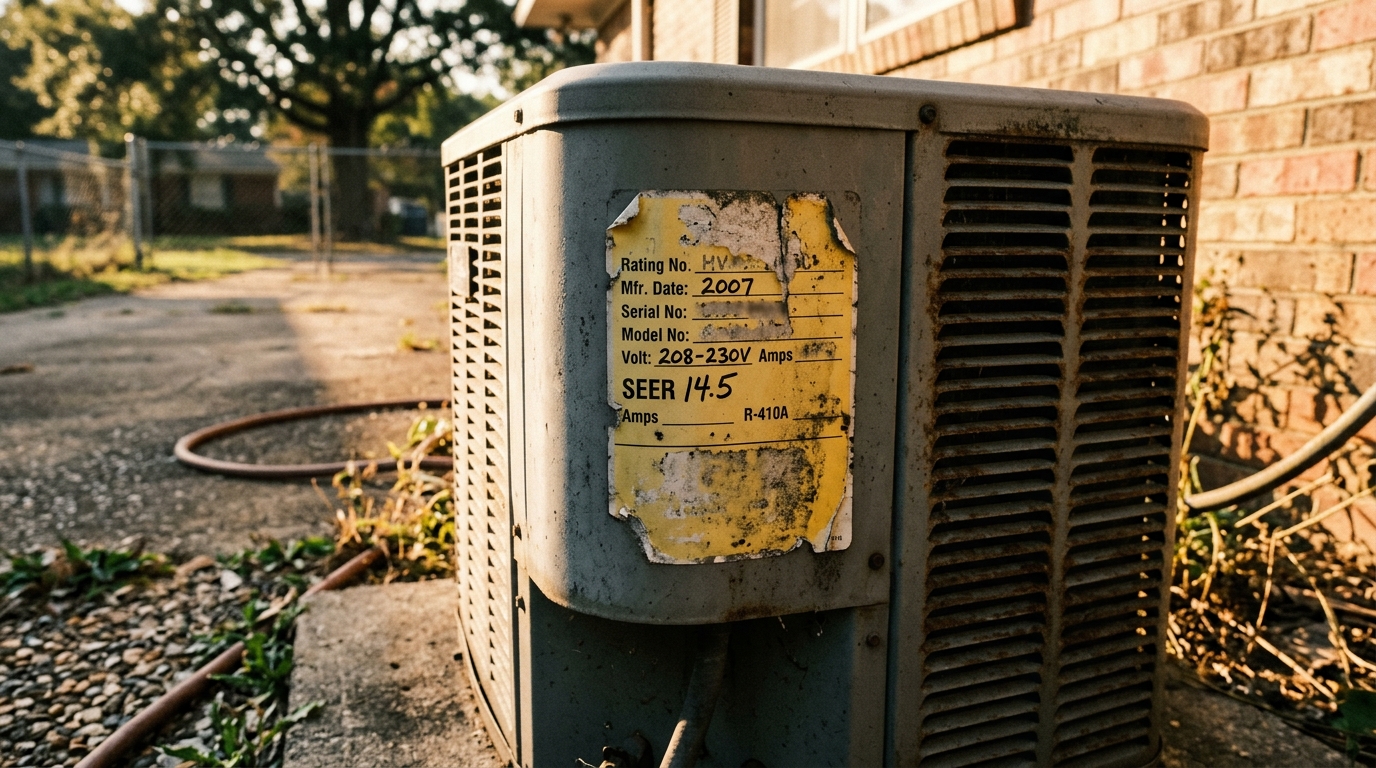
Walk outside to your condenser unit. Look at the rating plate (a metal sticker on the side of the unit). You should see a yellow ENERGY GUIDE sticker too — sometimes peeling or faded. SEER is listed prominently on both.
If the SEER is not listed, your unit predates 2006 — those systems were typically 10-12 SEER and are well past the average lifespan. You are due. From 2006 to 2014, the southern minimum was 13 SEER. From 2015 through 2022, 14 SEER. After January 2023, 14.3 SEER2.
If you cannot find the rating plate (faded out, missing, or in a hard-to-reach spot), the model number tells you everything. The first two digits after the brand prefix typically indicate SEER. Cross-reference at AHRI Directory using your full model and serial numbers — they list every certified system back to 2010.
8. What I'd Actually Buy in Birmingham
Different households make different decisions. Here is the framework we use when a homeowner asks us straight.
Tight budget, plan to move within 5 years
14.3 SEER2 single-stage. Federal minimum, lowest cost, you do not capture long-tail efficiency savings before you sell. Make sure sizing is right (Manual J, not "match the old one"). The next owner inherits a perfectly fine system.
Long-term homeowner, average bills, average comfort priorities
15-16 SEER2 two-stage. Best balance of premium and payback for most Birmingham homes. The two-stage operation handles humidity better than single-stage at the same SEER. Payback in 4-6 years on most homes.
Big house, high cooling load, comfort-focused, plan to stay 10+ years
17-19 SEER2 variable-speed. Significant comfort upgrade — quiet operation, excellent dehumidification, lower bills. Premium pays back in 6-10 years. Worth it for the long haul.
20+ SEER2
Niche use case. Very high power bills (large homes, all-electric setups, off-peak rates that make summer cooling expensive), aggressive cooling habits, or 15-20 year tenure plans. Premium is real and the payback math is genuine but extended. Not the default recommendation for an average Birmingham home.
Across all tiers — proper sizing and quality installation matter more than the rating number. We have seen $12,000 high-SEER installations underperform $7,000 mid-SEER installations because the second one had Manual J done correctly. The expensive paper rating means nothing if the equipment is fighting bad ductwork or wrong tonnage.
Replacement Quote Coming Up?
We give honest tonnage assessments using ACCA Manual J — not "match the old unit" guesswork. Free in-home estimates across Birmingham metro. We will tell you when 14 SEER2 is enough and when stepping up makes financial sense.
call (205) 994-6402FAQ: SEER Ratings
What does SEER mean in plain English?
Seasonal Energy Efficiency Ratio — total cooling output divided by electricity consumed across a season. Higher number = lower power bills. A 20 SEER unit produces 20 BTUs of cooling per watt-hour vs 14 BTUs for a 14 SEER unit.
What is the difference between SEER and SEER2?
SEER2 is the updated DOE testing standard from January 2023. Tests at 0.5 IWC instead of 0.1 IWC, more accurate to real ductwork. SEER2 numbers run 4-5% lower than the old SEER for the same equipment. 16 SEER ≈ 15.2 SEER2.
What is the minimum SEER allowed in Alabama?
14.3 SEER2 (about 15 SEER on the old scale) for new split-system ACs and heat pumps. Enforced at the manufacturer level. Any new equipment installed after January 2023 in our region is at or above this floor.
Is a 20 SEER AC worth the extra money in Birmingham?
Depends on your bill, tenure, and cooling habits. Typical Birmingham home saves $200-$400/yr going from 14 to 20 SEER2. Premium runs $1,500-$3,000. 5-10 year payback. Yes if you plan to stay 10+ years.
What SEER rating do I have now?
Yellow ENERGY GUIDE sticker on your outdoor condenser. Pre-2006 systems often were 10-12 SEER. 2006-2014 minimum 13. 2015-2022 minimum 14. 2023+ minimum 14.3 SEER2.
Does higher SEER mean better dehumidification?
Not directly. SEER measures temperature efficiency; dehumidification is separate. Variable-speed and two-stage equipment (which often scores higher SEER) usually dehumidifies better through longer cycles. But sizing and stage matter as much as SEER number in Birmingham humidity.
Sources & Citations
U.S. Department of Energy — Standards and Test Procedures — Federal authority for SEER and SEER2 testing methodology
ENERGY STAR — Central Air Conditioners — Federal efficiency tier definitions and ENERGY STAR Most Efficient criteria
ACCA Manual J — Residential Load Calculation — Industry-standard sizing methodology
AHRI Directory — Certified Equipment Performance — Independent third-party performance database for HVAC equipment
NOAA — Birmingham Climate Records — Local design temperature and humidity data
EIA — Residential Energy Consumption Survey — Federal data on regional cooling costs and electricity usage
Why Trust This Story
Written and reviewed by Alabama-licensed HVAC technicians with EPA 608 Universal credentials. The After Hours HVACR field crew installs and services both economy and high-efficiency systems across Birmingham metro. The payback math in this article reflects what we see in real Birmingham power bills, not manufacturer marketing claims. We pick mid-SEER two-stage over high-SEER single-stage in our own Alabama homes — there is a reason. See our editorial standards.
Disclaimer: This article describes federal HVAC efficiency ratings for educational purposes. Energy savings vary by climate, home construction, ductwork condition, installation quality, and operating habits. Manufacturer rated efficiencies are tested under standardized lab conditions and may not match real-world performance. After Hours HVACR is a licensed Alabama HVAC contractor.
Read Next
Keep going. These pair well with what you just read.
Heat Pump vs Central Air in Hoover AL
Which makes sense for a Hoover home — and which one wins the energy bill.
AC REPAIRAC Running But Not Cooling? Birmingham Fix Guide AfterHours HVACR
Air is moving but the house is not cooling. Run this checklist first.
HUMIDITYHigh Humidity HVAC Problems Birmingham AL
Why Birmingham summer humidity makes a healthy AC feel broken.