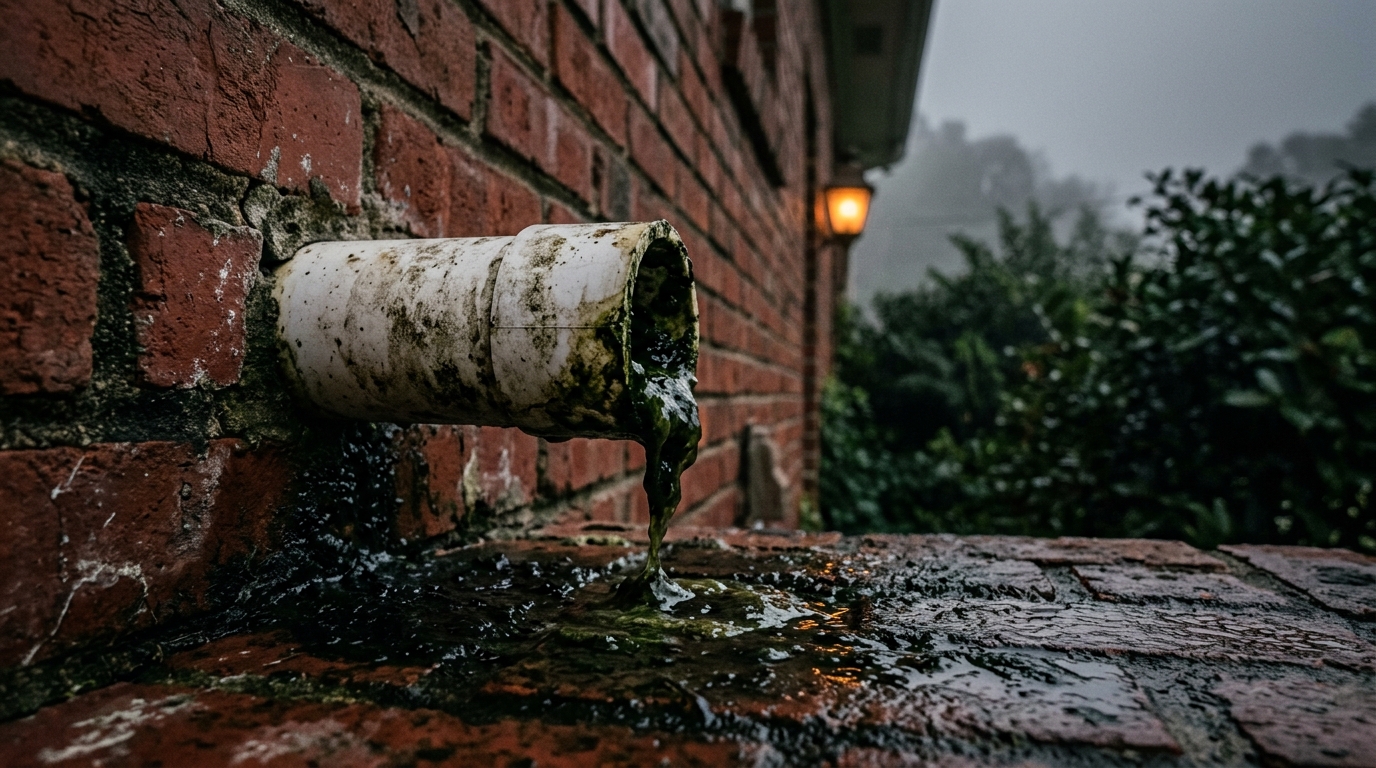
AC Drain Line Clogged in Birmingham: A Tech's Step-by-Step Fix
Standing water in the drain pan. Float switch shutting the system off. Maybe a damp ceiling stain spreading under your attic unit. The drain line is plugged with green slime, and Alabama humidity is the reason. Here is the shop-vac procedure that fixes it tonight, the vinegar flush that keeps it from coming back, and the rare cases where you need a tech instead of a hose.
1. Why AC Drain Lines Clog in Alabama
Your AC pulls water out of indoor air. In Birmingham summer, that is 10 to 20 gallons per day for a typical 2,000 square foot home. Every drop of that water condenses on the evaporator coil, drips into a drain pan beneath, and travels through a 3/4-inch PVC pipe to the outside.
That PVC pipe is dark inside, warm (it is in your conditioned space or attic), and constantly wet during cooling season. Three of the perfect conditions for algae and biofilm growth. Add organic matter — dust pulled through the air handler, dead skin cells, pollen, drywall sanding dust from a remodel — and you have a slime farm.
Per NOAA Birmingham climate records, summer dewpoints sit in the high 60s to low 70s for months. That is the moisture all flowing through your drain line. A drain line in Phoenix sees a fraction of that volume. A drain line in Birmingham handles a small lake every summer.
The clogs are biological, not mechanical. Roots, debris, and crushed pipe cause clogs in some climates. In Alabama, 95% of the calls we run for this issue are slime — you can sometimes pull it out in one stringy mass that looks like green-black snot. That is the colony.
Birmingham reality
A drain line that is clean in May will be partially clogged by July without any preventive flushing. The biofilm grows from the pipe walls inward. By the time water visibly backs up, the line is 70-90% blocked.
2. How to Tell Your Drain Is Clogged
Five reliable signs:
- No water dripping outside. On a hot humid Birmingham afternoon with the AC running, your outdoor drain stub should be dripping or trickling continuously. If it is bone dry, the line is blocked.
- Standing water in the secondary drain pan. Open the air handler closet. The big metal pan beneath the air handler should be dry. Water in it means the primary drain backed up far enough to overflow into the safety pan.
- AC suddenly stops working. Many systems have a float switch that cuts power when the drain pan fills. The system shuts off completely and the homeowner thinks the AC died — actually the safety did its job.
- Water dripping from a ceiling vent. On attic systems, an overflowing pan dumps water into the duct system. It comes out at the closest supply register. Drywall stains around vents on a humid day are this.
- Musty or sour smell when AC runs. The slime is alive and pungent. If your house smells like a wet basement when the system kicks on, the drain line and pan are growing things.
3. The Shop-Vac Fix (Most Effective)
This is the same procedure a tech runs first on a service call. It works because the suction at the outdoor end is the most direct path to pulling the slime plug straight out without forcing it deeper.
What You Need
- Wet/dry shop vacuum (any 5+ gallon model — borrow if you do not own one).
- An old rag or duct tape to seal the vac hose around the drain stub.
- A bucket and rubber gloves.
Procedure
- Set the thermostat to OFF. Keep the system shut down for the entire procedure.
- Find the outdoor drain termination — a 3/4-inch white PVC stub poking out of an exterior wall, typically near the AC condenser, sometimes near a window or eave.
- Press the shop vac hose against the stub. Wrap an old rag tightly around the connection to seal it. Duct tape if needed. The seal does not have to be perfect, just good enough that suction transfers.
- Turn on the vacuum. Run for 90 seconds. You should hear water and air sucking through.
- Turn off the vacuum. Wait 15 seconds. Run again 90 seconds. Repeat three times total.
- Open the vacuum canister. The slime plug is usually in there — black-green stringy mass, sometimes 6-12 inches long, smells terrible. That is what was blocking the line.
- Test by walking inside, looking at the drain pan. If it is empty (or you see fresh water actively flowing), you fixed it. If still backed up, repeat steps 4-5 another two cycles.
Total time: 15 minutes if you have the shop vac on hand. Cost: zero. This is the fix that keeps you out of a service call.
4. The Vinegar Flush (Maintenance and Mild Clogs)
For partial clogs and monthly preventive flushing, vinegar at the indoor access port is the go-to. It does not have the suction power of the shop vac for fully blocked lines, but it kills the biofilm chemically and prevents future clogs.
Find the Drain Access Tee
Look at the PVC plumbing coming out of your air handler. Within a few feet of the cabinet, you will see a T-shaped fitting with a removable cap on top — sometimes a threaded PVC cap, sometimes a rubber cap. That is the access port.
If you do not see one, your installer skipped it (a code violation in many jurisdictions but common on older systems). The next-best access is the float switch port if your system has one, or you can carefully cut and install a tee yourself with PVC primer and cement — straightforward DIY for an afternoon.
Procedure
- Remove the cap. Keep the AC OFF during this.
- Pour 1 cup of distilled white vinegar slowly into the access port.
- Wait 30 minutes. The vinegar dissolves biofilm and kills active algae.
- Pour 1 cup of warm water to flush the dissolved gunk through.
- Replace the cap. Restart the AC.
Repeat monthly during cooling season. Mark your calendar. This single habit is the highest-leverage HVAC maintenance any Birmingham homeowner can practice.
5. Bleach vs Vinegar — When to Use Each
Both work. They have different tradeoffs.
| Factor | Vinegar | Bleach |
|---|---|---|
| Kills algae | Yes | Yes (faster) |
| Safe for PVC | Yes | Yes (diluted) |
| Safe for metal drain pans | Yes | No — corrodes |
| Smell during use | Mild | Strong |
| Pet/child safe contact | Higher | Lower |
| Cost per use | $0.30 | $0.20 |
Default to vinegar. Use bleach (1 cup bleach to 1 gallon water) only if you have a stubborn established colony that vinegar is not clearing. Never mix the two. The reaction produces chlorine gas which is genuinely dangerous in an enclosed utility closet.
Active leak in the house already? Don't keep the AC running.
Call (205) 994-64026. Monthly Routine to Prevent Reclogs
A working tech sees the same Birmingham homes calling year after year for the same drain clog. The fix is dirt simple — and most homeowners never adopt it because nobody told them.
Birmingham Cooling Season Drain Routine
- First of each month, May through October: Pour 1 cup distilled white vinegar into the drain access port. Wait 30 minutes. Run the AC.
- Drop in a biocide pan tablet: $5 for a six-pack, lasts a month each. Place in the drain pan. They release slow-action biocide that prevents biofilm establishment. Available at any Lowes or Home Depot in the HVAC aisle.
- Walk outside on a hot day with the AC running: Confirm the drain stub is dripping or trickling. Takes 10 seconds. Catches problems before they back up.
- Check the secondary pan once a month: Open the air handler closet. The pan should be dry. Water means the primary drain has been overflowing.
Total monthly time: under 5 minutes. Annual cost: under $30. The alternative is a $200-$400 emergency drain clearing service call when the float switch trips at midnight in July.
7. When to Call a Tech Instead
Most drain clogs are DIY territory. A few situations call for professional help:
- Active water damage in the home. Stained drywall, water dripping from ceiling vents, pooling around the air handler — beyond the drain itself, you may have damaged ductwork, mold, or insulation that needs assessment.
- Repeated clogs every two weeks. Suggests the slope on the drain line is wrong (line was installed flat or back-pitched), the drain pan has rusted through and is dumping into a duct, or you have a deeper coil contamination problem feeding constant biological load.
- No outdoor drain termination visible. Some installations route to a sink trap, condensate pump, or floor drain. Each has its own failure modes — pump motor dead, trap dry and flooded, sink overflow.
- Smell does not clear after flushing. Established mold colonies in the air handler cabinet need EPA-grade cleaning, not just a drain flush. See our coverage of how Birmingham humidity creates HVAC mold.
- Drain line goes through a wall and you cannot access it. Older Birmingham homes with retrofit AC sometimes have buried or wall-routed condensate lines that need pipe-camera inspection to diagnose.
For everything else, the shop-vac and vinegar method is the standard. We use the same procedure on service calls — the difference is we have the gear in the truck and can be there at midnight when your float switch tripped on the hottest night of July.
Already Past the DIY Window?
If water is in the drywall or the system has been off for hours, get a tech out same-day. We dispatch nights and weekends across Birmingham, Hoover, Vestavia Hills, Homewood, Mountain Brook, Trussville, Pelham, and Helena.
call (205) 994-6402FAQ: AC Drain Line Clogged
How do I unclog an AC drain line at home?
Wet/dry shop vacuum at the outdoor termination, sealed with a rag, run 90 seconds three times. Then 1 cup distilled white vinegar in the indoor access port, wait 30 minutes. Restart system.
What does a clogged AC drain line look like?
Standing water in the secondary pan, water dripping from ceiling vents under attic systems, no drip from the outdoor PVC stub on a hot day, AC suddenly off (float switch tripped), or musty smells.
Why does my AC drain line keep clogging?
Birmingham humidity. Your AC pulls 10-20 gallons per day in summer through a dark, warm pipe — perfect algae conditions. Without monthly flushing, slime builds up. Phoenix drains do not have this issue. Birmingham drains do.
Will bleach hurt my AC drain line?
Diluted bleach (1:1 with water) is safe for PVC. Avoid it if you have a metal drain pan — chlorine corrodes metal. Use vinegar instead with metal pans. Same effect.
What happens if I ignore a clogged AC drain line?
Float switch trips, AC shuts off, you have no cooling. If no float switch (older systems), water overflows the pan into ductwork, drywall, ceilings. Mold establishes in 24-48 hours per EPA guidance.
How often should I flush my AC drain line in Birmingham?
Monthly during cooling season — May through September minimum. One cup distilled white vinegar in the drain access port, two minutes of effort. Highest-leverage HVAC maintenance task you can do here.
Sources & Citations
U.S. Department of Energy — Maintaining Your Air Conditioner — Federal maintenance guidance including drain line care
EPA — Mold Prevention — 24-48 hour mold establishment timeline in damp HVAC components
EPA — Indoor Air Quality & HVAC Cleaning — Guidance on biological contamination in HVAC systems
NOAA — Birmingham Climate Records — Local humidity and dewpoint data we cite
ACCA — Air Conditioning Contractors of America Manuals — Industry installation and service standards
ASHRAE Standards — Engineering standards for residential drain pan and condensate handling
Why Trust This Story
Written and reviewed by Alabama-licensed HVAC technicians with NATE certification and EPA 608 Universal credentials. The After Hours HVACR field crew clears dozens of drain line clogs every Birmingham summer across Hoover, Vestavia, Pelham, Mountain Brook, Trussville, and Helena. The shop-vac procedure in this article is the same one we run on service calls — we just have the gear in the truck. See our editorial standards.
Disclaimer: This article describes residential HVAC maintenance procedures for educational purposes. Never mix bleach and vinegar — the reaction produces dangerous chlorine gas. Always shut off the AC at the thermostat before removing drain access caps. After Hours HVACR is a licensed Alabama HVAC contractor.
Read Next
Keep going. These pair well with what you just read.
AC Running But Not Cooling? Birmingham Fix Guide AfterHours HVACR
Air is moving but the house is not cooling. Run this checklist first.
WARNING SIGNSSigns Your AC Is About to Break Down
Seven warnings your AC sends before it dies. Catch them in May.
AC REPAIRWhy Is My AC Leaking Water Inside? Birmingham AfterHours HVACR
Indoor water leak from the AC — drain, pump, coil, or refrigerant?